Articles Menu
Mar. 10, 2026
Ever since the 2024 election, B.C. Premier David Eby has governed in what would politely be called a protected political environment.
The economy had not yet produced a serious downturn. The opposition BC Conservative Party was busy sidelining its own leader. Donald Trump was a convenient foil in the United States, and Mark Carney an eager collaborator in Ottawa.
That protection is fading, and with it the political conditions that once made Eby’s early activism possible. The premier now faces a widening cluster of problems. Most stem from governing decisions in which his lone-wolf style has collided with the substance of economic, legal, and social pressures rising at the same time.
It raises questions circulating quietly in political circles: Has Eby reached the limits of his political moment? Is he done? And, given the political predicament one would inherit, would anyone in his caucus really want his job right now?
Eby and his government’s most immediate difficulties centre on two public uncertainties: economic confidence and stewardship of land.
B.C. faces record deficits, weak private investment, declining productivity, and continuing regulatory complexity and policy apathy in the resource economy. The revenue shortfall will hit a record $13.3 billion this year, only three years removed from a $6 billion surplus. Forestry employment continues to shrink. Mining projects continue to endure prolonged permitting timelines. Energy investment has shifted to jurisdictions offering faster approvals and clearer rules.
The public service has grown, but many public services have faltered: hospital emergency rooms routinely close, waitlists are pushing more people toward private care, mass transit has not kept pace with urban development, infrastructure projects run over budget and beyond schedule, and city streets show greater evidence of British Columbians left behind.
Business groups increasingly warn that approval timelines, land-use uncertainty, and regulatory layering are discouraging long-term capital investment. Debt servicing is now the province’s third-largest expenditure, and economists say that the structural deficits under the BC NDP cannot be corrected for many years, even under a change in government.
The government’s response has been a mixture of tepid industrial policy, tax increases and mild spending restraint. Business leaders argue the province still lacks a coherent economic strategy beyond housing policy that antagonizes municipalities. Its most recent budget has proven to be the least popular in recent history, and the party has plunged into an eight-point deficit in the polls. There is no rush to an election, mind you.
That matters because B.C.’s fiscal structure remains closely tied to development activity. Roughly one-third of provincial revenues can be traced, directly or indirectly, to Crown land and the industries that depend on it. When investment slows, the fiscal consequences eventually follow.
Now, however, land issues—private property rights, specifically—have become part of the anxiety in the wake of the Cowichan Tribe decision last year that has left unanswered questions about Crown land and fee simple primacy. The court case has been poorly explained, which has given rise to political opportunism.
B.C.’s adoption of the Declaration on the Rights of Indigenous Peoples Act (DRIPA) was meant to create a framework under the Constitution for reconciliation and economic partnership. Yet its implications remain uncertain for many businesses and municipalities. It is taking on a far-too-large role in the play, because its absence changes nothing constitutionally.
Several court cases involving Aboriginal title and consultation are moving through the courts, and their outcomes could further reshape how Crown land, infrastructure corridors, and natural resources are governed. With each ruling, the atmosphere stands to harden.
Eby has signalled adjustments are coming to DRIPA’s implementation without repealing the legislation itself, attempting to assure investors that development will continue while promoting the broader aim of reconciliation. The government has not clearly explained how those goals coexist in practice. The results are public confusion and growing skepticism that Eby can serve as the great clarifier. He didn’t help his credibility by claiming he and his government hadn’t been briefed on a federal announcement last month recognizing Aboriginal rights and title over Metro Vancouver. Later, it turned out he was in the front row for the signing ceremony. (Federal officials had briefed a junior provincial staff member, who didn’t pass the word up the ladder.)
Even smaller issues now acquire symbolic meaning about governing style. Consider last week’s announcement to make Sunday’s clock change to daylight saving time the last one for B.C. It was a dormant issue in the province, awaiting Washington, Oregon, and California to do the same, but the change was sprung last week with no such alignment. Now B.C. is an outlier, an hour apart from November to mid-March, and this will be particularly confusing for the Lower Mainland in its economic relationship with the Pacific Northwest. It reinforces a perception of a government that decides without thinking through consequences.
The governing NDP is a broad alliance of urban progressives focused on housing and social policy, labour organizations concerned about employment security, and environmental advocates wary of resource development. Keeping those groups aligned is becoming harder.
Housing legislation has angered some municipal governments that see Victoria overriding local authority. Environmental groups remain uneasy about industrial approvals and the future of old-growth forests. Labour organizations have quietly expressed concern about the province’s economic trajectory and the risks it poses for employment in traditional sectors.
When he first took office in 2022, Eby presented himself as a premier willing to move quickly where previous governments had hesitated. That sense of urgency built public support during his early months. But once the fiscal picture changed, and the inherited surplus evaporated, he resembled long-ago NDP leaders who struggled to balance ambitious policy with fiscal discipline.
His political cushion has been the shaky alternative. In his first two years, the opposition BC United collapsed and folded into the BC Conservatives, who nearly defeated him in 2024 but have since damaged themselves through internal turmoil that prompted a leadership race to define their identity. Eby’s best hope politically is for a new provincial Conservative leader in May who cannot prevent caucus members from fleeing to parties either to the party’s Right or centre-Right.
The rival weakness has bought Eby time, but polls eventually catch up. Opposition parties do not need to be strong or unified for long to create trouble for incumbents whose own support softens. What beckons is a crucial period to determine if his government proves adaptable or further exposed.
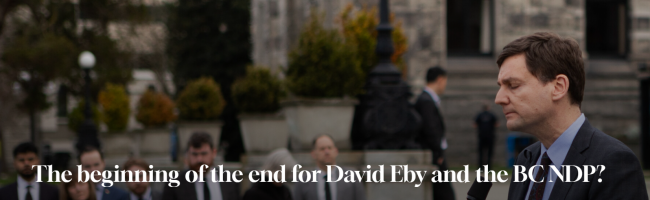
[Top photo: Premier David Eby during a press conference at the legislature in Victoria, B.C., Feb. 12, 2026. Chad Hipolito/The Canadian Press.]