Articles Menu
Some good information here, both data and organizing efforts.
-- Gene McGuckin
Feb. 13, 2026
Hello friends!
A bit of a hodgepodge of items to share today, most of which seek to make sense of the public landscape with respect to the interconnected crises of climate and inequality.
Seth Klein / Emergency Measures is a reader-supported publication. To receive new posts and support my work, consider becoming a free or paid subscriber.
But first, I just want to acknowledge that we’ve all spent the past few days reeling from the heart-wrenching news from Tumbler Ridge; feeling deep sorrow for the families of those lost, and gratitude to the first responders and teachers who acted so swiftly. In my home province of BC, we have now had two mass killing events in less than a year, both perpetrated by people clearly in great mental distress. This is a time to look for reasons to love, not to hate. It’s a time to show compassion and help people in pain. A time to hug tight those we love.
Now, some important news and resources to share…
Making sense of Canada’s new EV/auto strategy
Like many of you, I suspect, I found it a little hard to make sense of last week’s new federal EV & auto strategy. Was it yet another climate retreat or an innovative new way forward? My quick take: while there were some welcome elements, it is a retreat. The goals posts for electric vehicle adoption have been moved further into the future. Policy ‘carrots’ like new charging stations and rebates will help, but there is no getting around the need for policy ‘sticks’ as well. So, the loss of the EV mandate is a retreat.
If you are looking for a terrific take that cuts through the spin, I recommend the latest column from Chris Hatch, my fellow columnist at Canada’s National Observer. In “Canada’s auto strategy is driving blind,” Chris notes that the government hasn’t actually modeled the impact of their new approach. You can find the piece here.
I’ll have more to say on the role of mandates in a future column.
New BC polling shows underlying support for bold action, with caveats
The BC Climate Emergency Campaign released a fascinating new poll this week (commissioned from Abacus Data). The poll assessed public concern about climate generally, public understanding of climate issues, and measured support for policies seeking to get gas out of buildings. While the poll was provincial, I suspect the trends mirror national views. The full results (including some nice visuals) are available here.
The poll, conducted last November, surveyed 1,000 people in British Columbia. Among the key findings:
• A large majority (78%) worry about climate change and its impact on the people and places they love.
• A similarly large majority (77%) understand that if we fail to take strong action to confront climate change, it will cost us more down the road.
• 57% believe it’s either very important or important for the BC government to take stronger climate action, while a further 22% see it as somewhat important.
• A large majority (74%) support an export tax on oil & gas exports to US.
And there is clear support for various policies to decarbonize our homes and buildings:
• There is solid support for eliminating gas in new buildings, with 68% either supporting (46%) or accepting (22%) that all new homes and buildings be prohibited from using gas.
• Of those homeowners who don’t already have a heat pump (18%), over half (54%) are interested in installing a heat pump (but most haven’t yet due to cost and/or logistics).
• Half said they are concerned about the health impacts of gas appliances in their homes.
• 73% support more provincial government investment in building climate-resilient non-market housing units that use electric heat pumps and air filtration systems.
• And – a policy close to my heart for which I’ve been advocating for many years – almost half (48%) support the creation of a Crown corporation to mass produce and install electric heat pumps, solar panels, and battery storage units for BC homes (with a further 24% open to the idea, and only 13% opposed).
A number of folks from the BCCEC co-authored a piece summarizing the poll that was published in Canada’s National Observer earlier this week. Have a read and please give it a share. Here’s a Bluesky post you can share too.
The poll reinforces an important reality-check: while we are hearing less about the climate emergency from elected leaders and in the media, under the surface, the public remains very anxious about the crisis. But, as other surveys have found, they feel themselves alone in harboring such views, and so they largely keep them to themselves. That’s why it’s important to talk about the climate crisis more, not less – to signal to others that they are not alone.
But the poll also uncovered something else of great importance: disturbingly low levels of climate literacy are holding us back.
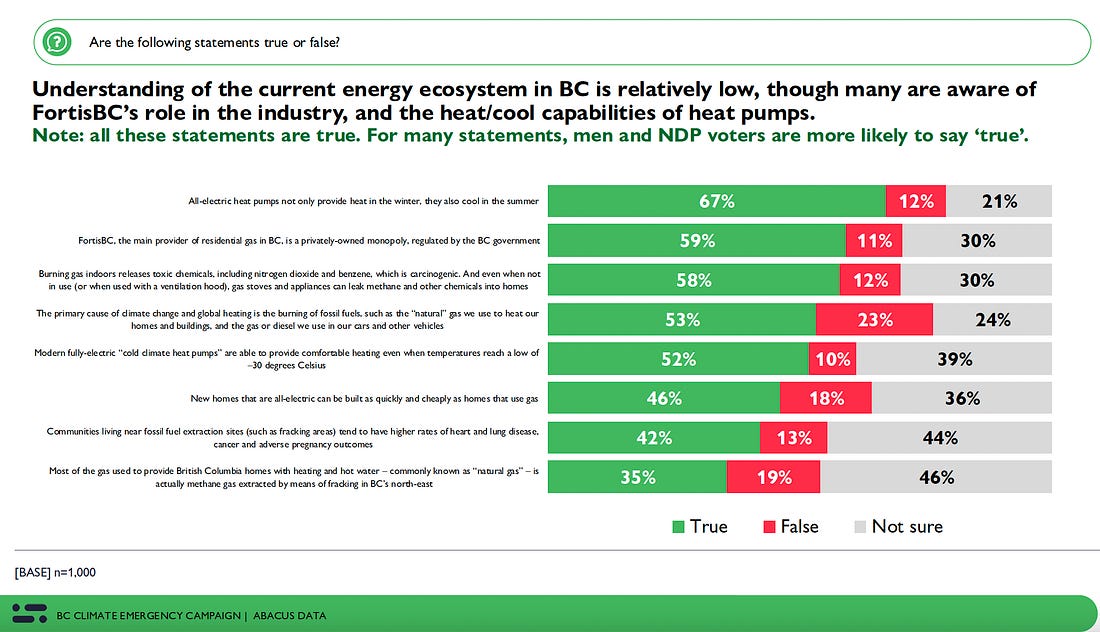
Take a look at the chart below. In the Abacus poll, British Columbians were given a series of statements and asked if they were true or false. In fact, all the statements are true, but far too few respondents knew this.
 |
For example:
· Only 53% of respondents correctly know that the primary cause of climate change is the burning of fossil fuels.
· Only 35% correctly know that the “natural” gas commonly used in our homes is actually methane extracted mainly by means of fracking.
But importantly, the poll also found that, as climate literacy increases, so does support for climate policies. So if our governments would only put some more resources into boosting climate knowledge and understanding, a virtuous cycle could result in which support for more and bolder action would grow.
Reflections on the changing climate landscape
If these paradoxes in Canadian public opinion intrigue you, I invite you to watch the recording of a recent webinar I participated in. Hosted by Re.Climate, the webinar was entitled “The View from Here: What Climate Communicators Are Holding Onto and What They Are Letting Go of in 2026.”
I was joined by My Climate Plan co-founder Jamie Biggar, Re.Climate’s executive director Amber Bennett, Canada’s National Observer managing editor David McKie, and Saskatoon Climate Hub co-founder Mackenzie Burnett. We shared:
Where we’ve had to pivot in our climate work;
What lessons we’re carrying into 2026;
How to make sense of our present moment; and
How we keep grounded in this work.
A summary of what we shared can be found here.
And the webinar recording is here.
Re.Climate also just released some national polling on Canadians’ view on climate. Once again, they find a majority remain concerned about the climate crisis, but paradoxically believe that only a minority share their concern. And Canadians want to see leaders keep their promises to take further action.
You can see the full results here, and a webinar at which the results were shared here.
The New Robber Barrons
One thing on which Canadians are nearly united is the need to better tax the uber-rich.
I’m a proud board member of BC Policy Solutions.
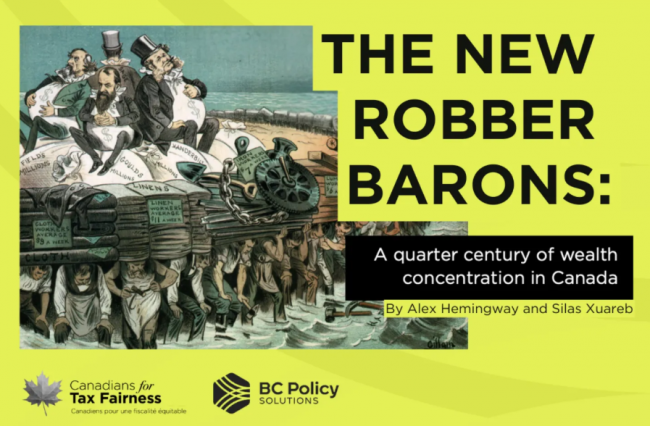
Earlier this week, BCPS and Canadian for Tax Fairness co-published an important new report, co-authored by BCPS senior economist Alex Hemingway and CTF economist Silas Xuareb: The new robber barons: a quarter century of wealth concentration in Canada.
The report contains some stark facts, such as:
The wealthiest 1% of Canadian families (169,000 families) who have at least $7.8 million in wealth per family owned 22.7% of household wealth in 2023, up from 19.3% in 1999 — an increase of $3 trillion in total over that period.
The wealthiest 0.01% of Canadian families (1,685 families) hold an average of $448.5 million, 4,041x the average wealth of a family in the bottom 50% in 2023.
86 billionaire families held as much wealth as the 6.2 million least wealthy families in 2023.
The report also maps why this shift to higher concentrations of wealth is happening and offers policy options to help counter this trend and steer a course towards a more equitable society.
You can read the report’s policy recommendations here and help share the report via Bluesky, Instagram, Facebook or LinkedIn.
BC Budget coming next week
Finally, for those of you in BC, BC Policy Solutions is offering a webinar two days after the release of BC’s 2026 Budget, where you can get progressive analysis from the province’s leading policy experts:
Thursday, February 19 at noon PT: a live session on what the BC Budget 2026 means for BC’s economic and climate direction and how it impacts you and your community. RSVP to attend or to get the recording here.
**
That’s all for now. Much gratitude to those of you who so quickly out of the gate became paid supporters of this new newsletter.
Wishing you all a good weekend with people you love.