Articles Menu
Dec. 2, 2025
Drug User Liberation Front founders Eris Nyx and Jeremy Kalicum are back in court arguing their compassion club members’ constitutional rights were violated by part of the Controlled Drugs and Substances Act.
The pair were arrested in October 2023 after running a compassion club for about a year. During that year they bought heroin, cocaine and methamphetamine off the dark web, worked with Vancouver Coastal Health to rigorously test the drugs for purity and potency, accurately labelled the drugs and sold them at cost to their 47 compassion club members.
The idea was that if a person knew the purity and potency of the drugs they were putting into their body, they could accurately dose themselves without taking too much and overdosing, even if they wanted to get really high, Nyx said on Thursday in court.
That is very difficult to do with the current illicit supply of street drugs, she added.
On Oct. 25, 2023, Nyx and Kalicum were arrested by the Vancouver Police Department and each charged with three counts of trafficking under Section 5.2 of the Controlled Drugs and Substance Act.
A little over two years later, on Nov. 7, 2025, the pair were found guilty of possession for the purpose of trafficking by Justice Catherine Murray.
In Canada, anyone who is charged with a criminal offence has the opportunity to challenge the law they’re accused of breaking as unconstitutional, in what’s known as a constitutional challenge. The challenge is being heard by the provincial court of B.C.
A constitutional challenge is basically a way to make sure all levels and parts of government are consistent with the Canadian Constitution, which is the supreme law of the country, said Margot Young, a professor at the Peter A. Allard School of Law at the University of British Columbia.
A constitutional challenge can be criminal or civil. It can be brought against any government action or legislation. Among other issues, the mechanism has been used to challenge welfare rules, the government’s lack of provision of sign language for deaf people accessing health care, and bus advertisement content, Young told The Tyee.
The only limitation is that the challenge must be against government. It does not apply to private institutions such as banks, universities or individual landlords.
The Drug User Liberation Front’s lawyers Tim Dickson, Stephanie Dickson and Kaelan Unrau are arguing that by criminalizing the compassion club, the government violated Section 7 and Section 15 of its members’ Charter rights.
Section 7 prohibits the state from depriving people of their rights to life, liberty and security of the person, and Section 15 says all people must be treated equally and have equal protection and benefit from the law.
By closing DULF, the compassion club is arguing, the government put highly marginalized people at risk of overdose and death because they’d have no choice but to buy drugs from the unregulated, unpredictable and toxic street supply.
The government will get a chance to argue its side and call witnesses later in the trial. So far the trial has been extended for at least one extra week into the new year, and the specific date the government will get to argue its side is not yet set.
If DULF successfully argues Section 5.2 of the Controlled Drugs and Substances Act was unconstitutional, then the charges against Nyx and Kalicum will go away.
“It’s an important rule of law principle that you can’t be prosecuted under an unconstitutional law,” Young said.
The court would move to a remedy phase where Justice Murray would have a lot of power to potentially change drug laws on possession as they relate to harm reduction efforts.
Murray could say Section 5.2 of the Controlled Drugs and Substances Act doesn’t apply in this one case for this one time, she could ask the federal government to amend the section, or she could get rid of Section 5.2 altogether.
It’s unlikely the court will go that far, however, and it’s also really hard to predict which way the case could go, Young said.
If DULF loses its constitutional challenge, then sentencing will begin for Nyx’s and Kalicum’s trafficking charges, she added.
The first week in court
During the first week of the trial, Kalicum and Nyx were cross-examined by Crown counsel.
The Crown’s line of questioning picked at the idea that Nyx and Kalicum were not genuine in their efforts to work with Health Canada or academically review their compassion club. DULF applied to get Health Canada’s permission to legally source pharmaceutical-grade heroin from a company called Fair Price Pharma, but their application was denied.
Nyx and Kalicum disagreed with the starting assumptions of most of Crown counsel’s questions and emphasized they did the best they could with the knowledge they had at the time.
Kalicum said DULF would have preferred to legally source heroin, but once their application was denied, they didn’t know any other way to source pharmaceutical-grade alternatives to street drugs. Canada’s Food and Drug Regulations are opaque and confusing, Kalicum said.
When Crown counsel asked Kalicum why DULF’s Health Canada proposal included only the one pharmaceutical company, Kalicum said he would have been happy to explore other options if Health Canada had asked him to, instead of rejecting the request.
Crown counsel also pointed to small flaws in the study DULF produced that found its compassion club reduced harms, crime and death related to the unregulated drug supply.
Nyx told the court that this was the first academic study she’d ever written. She said she thought the peer review process would have flagged those small flaws.
Nyx said she is in the process of completing a master of science at the University of British Columbia and is learning more about how to write academic papers.
“I’m learning a lot. I didn’t mean to misrepresent the data in any way,” she said. “We had very little resources. Remember, we were community members doing research and doing the best we could. I gave it my best go.”
She added she’d be happy to see another researcher replicate their study because that’s how good science happens.
‘A calamity beyond words’
As well as being under-resourced, Nyx and Kalicum told the court they were also deeply traumatized.
Nyx, who has lived in Vancouver’s Downtown Eastside for the past 15 years, said, “Thousands of people in my neighbourhood would die of an overdose per year.”
In 2023, which was the year DULF was shut down and the worst year yet for drug poisoning deaths, six people out of every 1,000 were dying of overdose in the Downtown Eastside. “That’s 10 times the provincial rate and 30 times the national rate,” she said.
“This is a calamity beyond words. This is a horror beyond words. This is a travesty,” Nyx said. “This is gutting my community and killing everyone I know.”
Nyx told the court she has responded to more than 100 overdoses. Many of the people whose overdoses she responded to needed eight doses of naloxone and half an hour of emergency breaths, waiting for the person to start breathing again on their own.
“No one should have to experience that,” she said, adding that this crisis has taken an enormous toll on her mental health.
“If you’re subjected to this over and over again it becomes routine,” she said. “My partner can tell you I grind my teeth at night, I kick and thrash around and sweat buckets. I wake up screaming. I’d say my general mental health is at an all-time low.”
Similarities to Insite
While the circumstances are slightly different, DULF’s case has some similarities to the legal victory won by Insite in 2011.
Insite was Canada’s first supervised injection site. It was created in response to the AIDS epidemic and opened in 2003 in an effort to respond to the spread of blood-borne pathogens such as HIV and hepatitis C among people who inject drugs. People could come and use drugs on site without risking arrest because of a federal exemption under the Controlled Drugs and Substances Act.
In 2008 Stephen Harper’s federal government said it would not renew that exemption.
This launched a legal challenge from PHS Community Services Society of the Controlled Drugs and Substances Act, which argued that shutting down Insite would violate the Charter rights of life, liberty and security of the person of people who use drugs.
The case went all the way to the Supreme Court. In 2011 the court said not extending the exemption would be unconstitutional. The court ordered the federal minister of health to grant the exemption.
“Insite saves lives. Its benefits have been proven. There has been no discernible negative impact on the public safety and health objectives of Canada during its eight years of operation,” wrote Chief Justice Beverley McLachlin in her 2011 decision. “The effect of denying the services of Insite to the population it serves is grossly disproportionate to any benefit that Canada might derive from presenting a uniform stance on the possession of narcotics.”
The DULF case is scheduled to be heard in court for the next two weeks. The case will resume in the new year, although 2026 dates have not yet been booked.
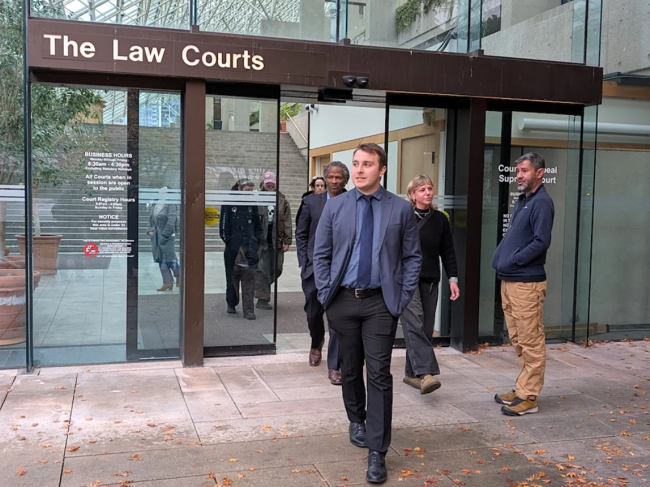
[Top photo: Jeremy Kalicum leaves court on Nov. 7. Sentencing for his criminal charges is on hold while the provincial court of BC considers his compassion club’s constitutional challenge. Photo for The Tyee by Michelle Gamage.]