Articles Menu
Dec. 11, 2025
As oil and gas companies drill and frack more wells in British Columbia than ever, they are using record quantities of water while frequently not paying the province for that resource, a new report warns.
The soaring water use comes from industries of all shapes and sizes, with companies as diverse as aluminum smelters and water bottlers paying the B.C. government almost nothing for the publicly owned water they use, warns the BC Watershed Security Coalition. The province is being shortchanged tens of millions of dollars annually, the coalition says.
If B.C.’s water use fees had been on par with those in Saskatchewan, Quebec or Nova Scotia last year, the province would have collected millions more — an additional $142 million if its fees matched those in Nova Scotia.
The coalition says that money could have been used to do long-overdue restoration work in watersheds badly damaged by the oil and gas and other industries. It is calling on the province to raise water rental fees and ensure that the money collected is invested in watershed restoration and management efforts.
“Aligning B.C.’s rates with those in other provinces would help generate much needed funding to protect and manage our water — without putting the burden on households, farmers, small businesses, or local communities,” the coalition concludes.
Charging pennies
As reported previously by The Tyee, oil and gas companies are using record volumes of water in their northeast B.C. fracking operations at a time when much of that region is in the midst of a multi-year, debilitating drought.
The drought has prompted the City of Dawson Creek to declare a state of emergency as its drinking water source, the Kiskatinaw River, dries up. The city plans to build a $100-million water pipeline stretching more than 50 kilometres from the Peace River to Dawson Creek.
The coalition has pointed to rates that have left the fracking industry and other water users paying the province at most $2.25 for every million litres of water being used.
Oil and gas companies use massive amounts of water, pressure-pumping on average nearly 10 Olympic swimming pools’ worth of water when they frack each drilled well. Based on the current fee structure, the most a fracking company would pay B.C. for all that water is $56.25.
But in many cases, they pay nothing at all. Last year the fracking industry paid the province nothing on nearly 2.9 billion litres of water used because that water was allocated under short-term water use approvals, which the BC Energy Regulator informed The Tyee carry no fees.
“If you’re a homeowner or small business in a town with metered water, you’ll pay more for your water than a mining or fracking company who is polluting that water with toxic chemicals,” Aaron Hill, executive director of Watershed Watch Salmon Society, a coalition member, told The Tyee.
With both the federal and provincial governments fast-tracking projects that use and pollute water, Hill said, the province should at the very least raise the fees to be on par with those in other provinces, if not exceed them.
“We are still charging pennies.”
A tale of two smelters
The coalition’s report shows a stark disparity between what B.C. collects in water use fees and what a province like Quebec collects.
In both provinces, mining juggernaut Rio Tinto Alcan produces aluminum at smelters that use large amounts of water to chemically process bauxite ore. Water is also used to cool and scrub away impurities.
Last year, Rio Tinto’s B.C. operation near Kitimat was licensed to use up to 81 billion litres of water, enough to fill 32,000 Olympic swimming pools. For that, it paid the province $182,000. That same year in Quebec, Rio Tinto used 72.5 billion litres yet paid the Quebec government $3 million for that water, nearly 17 times more than the company paid in B.C.
“For a company with a $16-billion net profit in 2024, paying Quebec-level rates in B.C. would equal just 0.02 per cent of annual profit,” the coalition says in its report.
The Tyee asked Rio Tinto about the prices it paid for water at its operations in Quebec and B.C. and received no answers prior to publication.
In an emailed response to questions, B.C.’s Ministry of Water, Land and Resource Stewardship said it is reviewing water rental fees paid by the fracking industry and others.
“We’re serious about the need to protect B.C.’s water resources and are exploring options for updating Water Sustainability Act application fees and rentals,” the ministry said, adding:
“The timeline for implementation has not yet been determined but will take into consideration potential impacts to affordability and business competitiveness, while also encouraging conservation. We recognize that during these challenging times, we also need to support our business sectors in remaining competitive.”
The province has long cited the need for cost competitiveness. When B.C. made changes to its water rental fees in February 2015 with the introduction of the new Water Sustainability Act, the provincial government said the increased rates would “only recover the costs” of implementing the new legislation and nothing more.
“British Columbia is blessed with an abundant water supply that our government is committed to preserving for future generations. The new fee structure will ensure fairness and affordability are cornerstones for our modernized water legislation,” then-environment minister Mary Polak said.
The myth of water abundance
Tim Morris, who co-wrote the coalition report and is a director of a watershed advocacy group called BC Water Legacy, said the Rio Tinto comparison is one of many that highlight the stark disparities between what companies pay for water in Quebec and what they pay in B.C. There is also more transparency about water usage in Quebec. In that province, companies are required to report their actual water use and that information is publicly available, whereas in B.C. in most cases it is not.
A notable exception to that rule in B.C. is the oil and gas sector, for which quarterly reports on water use are published by the BC Energy Regulator.
Morris believes that the low water charges in B.C. are rooted in the outdated belief that the province’s supply of water is essentially inexhaustible. But water shortage crises in communities ranging from Tofino on the no-longer-so-wet west coast to McBride near the Rockies show that outlook is misguided, Morris said.
“I think it reflects this myth of water abundance on the west coast and it has prevented a responsible approach to water management,” Morris said.
How corporations get free water
Although Rio Tinto’s water use in B.C. is substantial, but unlikely to grow in the foreseeable future, the same cannot be said of the fracking industry. That sector is now in full-throttle expansion with the first major shipment of liquefied methane gas from B.C. taking place in June.
No new methane gas or light oil production in the province is possible without fracking, in which massive amounts of water, sand and chemicals are pumped deep into the earth with earthquake-inducing force to fracture rock formations and release trapped hydrocarbons.
When the water returns to the surface following fracking, much of it is so poisoned with salts, hydrocarbons, chemicals and radioactive materials that it cannot be returned to nature without expensive treatment.
Typically, the toxic wastewater is held for reuse or for subsequent disposal in massive plastic-lined pits dug deep in the ground. The pits, however, have been known to leak and contaminate groundwater. The only long-term solution is currently to truck the water to “disposal wells” and pump it deep underground — a process that, like fracking, can also induce earthquakes.
The environmental organization Stand.earth recently reported that water usage in B.C.’s oil and gas industry increased by 50 per cent between 2023 and 2024.
Over the past five years, oil and gas companies doubled the volume of water they withdrew under licences and short-term approvals issued to them by the regulator, according to data collected by the BC Energy Regulator (formerly the BC Oil and Gas Commission) and analyzed by The Tyee.
The rapid rise in the industry’s water use was fuelled by a fourfold increase in the amount of water the sector withdrew under short-term approvals, which carry no fees, the regulator told The Tyee.
In 2024, the industry obtained just shy of 2.9 billion litres of water for free. That is enough water to fill 1,152 Olympic-size swimming pools.
More water use expected
It is almost certain that 2025 and 2026 will see further big increases in fracking water consumption as methane gas production increases to supply the massive LNG Canada facility outside Kitimat.
Because LNG Canada commenced operations only midway through 2025, its impacts on upstream methane gas production will be clear only in 2026, the first calendar year of full production.
With three more LNG plants approved in B.C. and the potential for LNG Canada to double its production, more methane gas wells will need to be drilled and fracked. Inevitably, the industry’s water use will also increase.
In an emailed response to questions, the BC Energy Regulator told The Tyee that it reviews each water application carefully to meet “environmental flow needs” and minimize “impacts to the environment and other users.”
The regulator said oil and gas companies use “strategic water-collection practices” to minimize their environmental impacts. Practices include capturing water during high spring flows rather than during drier periods.
The regulator has previously issued suspension notices that prevent energy companies from withdrawing water from some rivers where they hold water licences. Suspensions have included withdrawals on the Kiskatinaw River, which has been hammered by droughts in three successive years, leading to today’s water emergency in Dawson Creek.
The BC Energy Regulator also said that industry’s reuse of the toxic water that returns to the surface following fracking now accounts for 68 per cent of operational water use, “lowering the need for new freshwater withdrawals.”
Major water price disparities
The relatively low water rental fees charged to B.C. industries — including pulp and paper companies, mines, smelters and oil and gas operations — apply to a massive amount of water. Often, that water ends up polluted. According to the coalition, B.C.’s 10 largest industrial water users were licensed to use 500 billion litres of water last year but paid the province only a combined $900,000.
The coalition says it would take every resident in Vancouver running their household water taps continuously for four months to go through that much water.
The maximum industrial water rental fee in B.C. is $2.25 per million litres, compared with maximums of $54, $155 and $179, respectively, in Saskatchewan, Quebec and Nova Scotia.
The greatest disparity between low-cost B.C. and high-cost Quebec is in the area of water rental fees paid by companies collecting water for bottling and retail sale. Quebec charges water-bottling companies more than most other industrial users. In Quebec, the fee for bottling companies is set at $515 per million litres. In B.C. the corresponding figure is $2.25 — the same as that charged to industrial water users.
By far, the entity using the highest volume of water in British Columbia is the hydroelectric sector. The province charges water rental fees on the vast amount of water flowing through turbines at dams operated by BC Hydro. The money collected accounts for almost all (97 per cent) of the $400 million collected in water fees annually. The remaining three per cent, approximately $12 million, is paid by industrial operators, municipalities, farming operations and some individuals.
The coalition would like to see future fees from industrial users, and some of the money from hydro producers, go to fund watershed restoration work. They suggest such a plan could net $75 million from increased fees charged to industrial water users and $40 million from the fees charged to hydro producers.
The additional funds collected could also be used to fund local water management boards and to hire more regional staff to assist First Nations and local communities to better manage local water resources.
The coalition says the restoration work should be led by the Watershed Security Fund. The fund was established in 2023 with an initial $100-million investment from the provincial government. It is currently managed by the First Nations Water Caucus, First Nations Fisheries Council of BC and the Real Estate Foundation of BC.
Money from the fund has been used to underwrite the costs of restoration and water governance projects around the province.
One of those projects is led by the Líl̓wat Nation on the Birkenhead River near Pemberton. There, the Watershed Security Fund provided $140,000 in 2024 to improve chinook salmon habitat. Chinook populations are in dire straits, with nearly half of them in decline in the south of the province.
In an emailed response to questions from The Tyee, the Ministry of Water, Land and Resource Stewardship said it was aware of calls to bolster the fund, but did not directly address the question of whether more money should come from higher water rental fees.
“We know more needs to be done to face the scale of the water challenges in B.C., and we have committed to new actions that were identified as priorities through public engagement, stakeholder discussions and the First Nations Water Table. We are exploring all options to bolster the Watershed Security Fund and with the First Nations Water Caucus are continuing to push the federal government to invest in watershed security,” the ministry said.
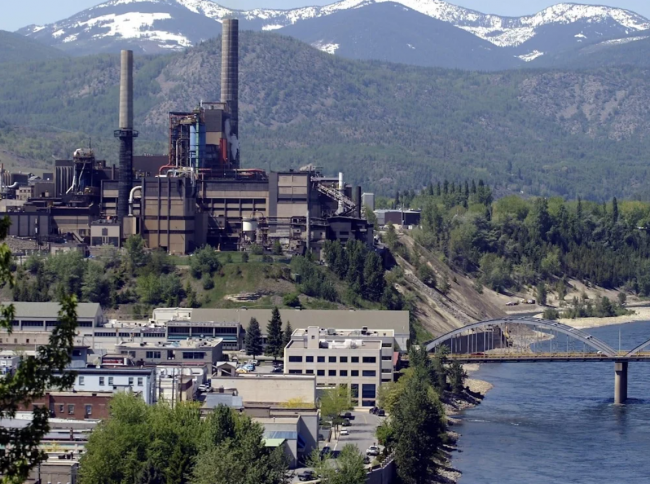
[Top photo: Trail’s large aluminum smelter is one of many BC factories and resource operations with licences to use major quantities of water. Photo by Jeff Bassett, the Canadian Press.]