Articles Menu
Apr. 22, 2026
One of the moderators of a popular Facebook page that promotes B.C. separating from Canada has been open about his white nationalist and antisemitic beliefs, and his interest in Adolf Hitler and other Nazi leaders.
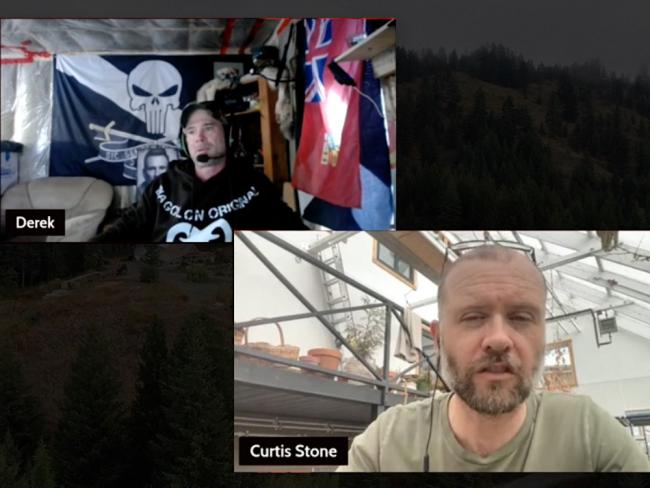
In February 2025, Curtis Stone appeared in a Rumble video called “Uncle Ted’s Disciples w/Curtis Stone,” which features Stone talking with Derek Harrison, a member of the extreme-right Canadian group Diagolon.
In the four-hour-long video, Stone talked repeatedly about his interest in Hitler, Joseph Goebbels and other antisemitic figures.
“Antisemitism is screaming right now, I love it, man. I love the memes. I love it. I’m fucking listening to Hitler lectures,” he told Harrison. “Dude, I’m — Henry Ford, Martin Luther, Goebbels, dude, I’m right into it.”
“It’s guaranteed that there’ll be less white people and, like, why should we take that shit, right?” he told Harrison. “I think we have to tribalize.”
In an interview with The Tyee, Stone confirmed that he identifies as a white nationalist and supports deporting many of the immigrants who have come to Canada in recent years. While he said he believes Canada should be a “white majority” country, he said he was not racist. Stone also confirmed the comments he made on the Rumble video reflect his interest in listening to Hitler’s speeches.
“They’re mind-blowing now that they’ve been translated into English, it’s actually incredibly interesting, because everything we’ve taught about in history with that has essentially been skewed in some way or another,” he told The Tyee.
Asked whether he believed the Holocaust occurred, Stone said he was limited in what he could say because of Canada’s hate speech laws but added, “It doesn’t take a lot, even in the days there of censorship, for people to look at that and skim past the surface to see a mountain of other things said about that time of history.”
In Canada, it is an offence to wilfully promote antisemitism by “condoning, denying or downplaying the Holocaust.”
The leader of the BC Prosperity Project, Peter LeTourneux, told The Tyee that Curtis Stone’s beliefs don’t reflect the overall views of the group. He said the BC Prosperity Project Society doesn’t have the resources to vet every member of their Facebook group.
“We have, between Facebook and X, nearly 25,000 people agreeing with the BCPP positions on B.C.’s future,” LeTourneux told The Tyee via email, responding to questions about Stone’s antisemitic and white nationalist views. (The combined number of followers as of publication is 23,448.)
“If you are insinuating that we should’ve taken a microscope to every person, [that] is... ridiculous. We cannot dig into every person’s privately held views on anything, but if they are acting in an official capacity within the Society, we insist focus on the Society, not personal views.”
Stone was still listed as a moderator on the BC Prosperity Project’s Facebook page as of April 13 but no longer appeared on the moderator list shortly before publication of this story. On April 12 he posted to the page, warning members that “leftists journalists” were “trying to call us racists.” He advised members not to talk to the media and “never apologize.”
Hal Hewett, the vice-president of the B.C. separatist society, said that Stone has some “interesting views” on how B.C. should separate. Asked about Stone’s antisemitic views, Hewett got into a discussion about Israel and Palestinian rights and said he’s aware that on X, AI-generated English versions of Hitler’s speeches have been circulating.
When The Tyee asked Hewett if he shares Stone’s white nationalist views and opposition to immigration, Hewett spoke at length about his concerns that immigrants are taking job opportunities away from Canadians.
Extremism experts say modern western separatist movements are propelled by a suite of grievances that include opposition to the current model of Canadian immigration and, in Alberta, a stated desire to eject between 65,000 and 100,000 immigrants from the province. There’s also a tendency among the supporters of separatism to talk about wanting to return the province to a “better” version of the past.
That kind of language is leading white nationalists to be attracted to these movements, even if they’re not a major part of these groups, said Amarnath Amarasingam, an associate professor at Queen’s University who studies radicalization, extremism and conspiracy theories.
“I think once you start talking about cultural erasure and anti-immigrant sentiment and ‘globalist elites’ taking over and destroying who we are at the core,” Amarasingam said, “you naturally get into a kind of nativist space which has, maybe not its core, but at least orbiting around it, the neo-Nazi movement.”
The Tyee has reviewed numerous posts from members of the BC Prosperity Project Facebook group that express concerns about immigration. Some call for deporting immigrants. There are also posts that describe the federal Liberals and Prime Minister Mark Carney as “globalists” or a “globalist banker.” There are also numerous posts that express admiration for the Alberta separatist movement.
Kurt Phillips, an extremism researcher based in Alberta, said that not every separatist supporter holds extreme views.
“But I’d say probably the loudest and probably the most agenda-setting parts of the movements kind of drift into the far-right style of politics,” Phillips said.
That includes “the kind of conspiracy-theory thinking, anti-immigrant scapegoating, attacks on democratic institutions, and fantasies about restoring a lost country that never truly existed.”
Phillips said that rhetoric can be inviting to people with more extreme views.
“The space becomes really open to the extremists, because they kind of view it as a wedge issue,” Phillips said.
BC separatists copy the Alberta playbook
Alberta separatism has a long history, going back all the way to the 1800s, University of Lethbridge professor Amy Mack pointed out on a recent podcast appearance alongside Amarasingam.
Separatism got a boost in the 1980s in the wake of former prime minister Pierre Trudeau’s energy policy, and interest ticked upwards again with the Canadian version of the yellow vest movement and the convoy movement that mobilized against government COVID-19 regulations.
The leaders of the current movement, under the name Alberta Prosperity Project, are now pushing for a referendum on separating from Canada and have claimed to have had meetings with officials in U.S. President Donald Trump’s administration — even as Trump has repeatedly threatened Canada’s sovereignty and promised to make the country part of the United States.
The BC Prosperity Project shares a similar name but does not have formal ties with the Alberta group, said LeTourneux, who declined an interview with The Tyee but answered a series of questions via email. There is also a Saskatchewan Prosperity Project.
LeTourneux said he is the president of the B.C. group, while Hewett is the vice-president and Alex Vallee is the secretary and acting treasurer.
Hewett lives in the Comox Valley on Vancouver Island and has worked in construction, as a tree planter and as a mechanic. He said he was attracted to the B.C. separatist cause because he’s worried about freedom of speech not being upheld in Canada. He was also dismayed when several ethical scandals linked to former prime minister Justin Trudeau didn’t lead to any consequences. Hewett said that for most of his adult life, he would have described his political views as left-wing.
Hewett said he has concerns about immigrants taking job opportunities that should go to Canadians, but that isn’t his biggest concern.
“It seems like Canada’s become so fractured,” Hewett said. “And then Trudeau said, ‘There’s no such thing as Canadian identity anymore.’”
(In a 2015 interview with the New York Times, Trudeau said: “There is no core identity, no mainstream in Canada. There are shared values — openness, respect, compassion, willingness to work hard, to be there for each other, to search for equality and justice. Those qualities are what make us the first post-national state.”)
Vallee, the secretary of the BC Prosperity Project Society, declined The Tyee’s request for an interview, saying his views are the same as LeTourneux’s.
On their Facebook page, members of the BC Prosperity Project talk about their fear of what will happen if Alberta votes to become a separate country but B.C. is left in Canada. Some members have posted memes calling Mark Carney’s government illegitimate or “communist.” Others say that people from non-western countries are unable to “assimilate into western civilization,” although not all members of the page agree with those comments.
There are also posts raising fears about airplane contrails and the belief that they’re a sign of “weather manipulation,” as well as messages expressing concerns about the rising cost of energy and others that express support for Conservative politicians like leader Pierre Poilievre and Kerry-Lynne Findlay, a former Conservative MP who is now running in the Conservative Party of BC leadership race.
Some members of the Facebook page share residential school denialist posts and express the opinion that Indigenous people didn’t really experience trauma from the widespread abuse they endured at the schools. (Extensive abuse regularly occurred at residential schools, a fact established by the Truth and Reconciliation Commission, which heard testimony from thousands of survivors between 2007 and 2015.)
LeTourneux, the co-owner of a sewing store in Campbell River, said the BC Prosperity Project is pushing for a referendum on separation for B.C. The group has already held one in-person meeting in Campbell River and plans more in-person events, LeTourneux told The Tyee.
LeTourneux initially told The Tyee that the next event was scheduled to take place in Comox on April 21 at a community hall called the Little Red Church. But a few days later, he posted in the BC Prosperity Project’s Facebook group, telling members that the event had been cancelled.
“Considering that the Society has only been in existence for less than three months, I’d say we have a good chance,” LeTourneux told The Tyee in an email, referring to the push for a referendum on separating from Canada.
“And because of this we are stressing that ALL votes are valuable and sought. White, Black, Red, Yellow, Various shades of chartreuse, First Nations, Second Nations, Third Nations, South Island, North Island, Lower Mainland, Interior, ALL OF B.C., are valued and desired to make this happen.”
Hewett said he’s inspired by the Alberta separatist movement.
“The conditions are approaching what led to the French Revolution or the American Revolution, but we don’t need to be violent anymore,” he said.
“They’re having fun with it in Alberta and they’ve got lots of engagement and that’s a beautiful thing.”
Curtis Stone’s role in the BC Prosperity Project
Curtis Stone is a content creator with over 600,000 YouTube subscribers. He posts videos about small-scale farming in B.C., often using his own property in southern British Columbia as an example.
In the 2010s, Stone was frequently featured in local B.C. news stories about urban farming.
Over the past few years, Stone has become open about his white nationalist beliefs. On his X account, Stone calls for “remigration” on a “large scale” and complains that Toronto is being “overrun” by “non-white people.” (“Remigration” is linked to the “Great Replacement” conspiracy; it calls for mass deportations, usually focusing on people of colour.)
In addition to appearing in the February 2025 Rumble video, in May 2025 Stone also appeared in a video for Red Ice, a website that says it promotes a “pro-European” perspective. Talking about farming and intentional communities, Stone offered advice for an audience he said he assumed would likely be looking to live in a “predominantly white community.”
As a moderator for the BC Prosperity Project, Stone has written multiple posts laying out his ideas for an independent British Columbia.
In a quote from Feb. 1, Stone said an independent B.C. would not have “the Crown, Canada, the Indian Act or corporate special interest.” It would also have no taxes, free health care, free education and the right to “bear arms” and would “prioritize its own citizens much like seniority in a company” and “preserve its own culture.”
In a February 2026 appearance in a YouTube video for the Kelowna Community Safety Association, Stone said he was interested in running for elected office in the 2026 municipal elections in B.C.
“There’s a growing separatist movement in British Columbia that I become involved with, that’s interested in separating from Canada just like Alberta,” Stone said.
“The local elections are coming up in the fall. I’m going to be involved in that in our area.... I am running, [but] I don’t want to make any announcements yet.”
Stone told The Tyee he’s currently too busy with work and family to run in this year’s municipal elections.
Stone does not reveal the location of his property in his videos or social media content and told The Tyee he does not want to reveal where he lives because he is a “semi-famous” person. In 2025, he posted several times in a community Facebook group for the small town of Grand Forks in B.C.’s Boundary region.
Grievance politics and conspiracy theories
Phillips said it’s important to realize that western separatism in its current form isn’t just “a quirky regional protest movement.”
“It’s often a meeting ground where these kind of grievances, conspiracy theories, immigration politics, far-right identity narratives reinforce one another,” he said.
“It’s the echo chamber that’s created, right? So people enter into these spaces and they have their beliefs they already held previously confirmed. That doesn’t mean that every person shares the same beliefs, but it does mean the movement’s culture is being shaped and going down some pretty dangerous currents.”
Amarasingam said he’s concerned about the future of the western separatist movements, as people who already hold conspiratorial beliefs come up against the difficult and complicated legal process that governs separation referendums in Canada and their outcomes.
“I worry about politicians trying to ride this kind of populist wave, not realizing that once you let the toothpaste out of the tube, it’s very hard to kind of put it back,” Amarasingam said.
In Alberta, Premier Danielle Smith has repeatedly said she does not want Alberta to separate from Canada, but she’s made it easier to hold a referendum on separating by reducing the number of petition signatures needed. Critics have pointed to a number of actions Smith has taken that they say have helped the separatist movement, such as holding a series of town halls on the future of Alberta and making repeated statements about Alberta needing to have more control over federal responsibilities, such as appointing judges.
One of her own United Conservative Party MLAs — who is also Smith’s parliamentary secretary for constitutional affairs — is open about his support for separatism.
“What worries me is what happened with Brexit,” said Amarasingam. “Sometimes these ideas seem stupid and fringe and not at all popular and completely out to lunch — and then they win and you’re like, ‘What the hell just happened?’”
If the referendum fails, Amarasingam worries that result will lead to separatism supporters believing the electoral process “was rigged and that the federal government is ‘infiltrated.’”
“And then you get into the space,” he said, “where the U.S. is currently: where the institutions aren’t trusted, the electoral process isn’t trusted, and there’s democratic backsliding.”
This article is part of The Tyee’s reader-funded Reality Check project exposing and explaining the rise of digital disinformation.
[Top image: Curtis Stone speaking with Derek Harrison, a member of the extreme-right Canadian group Diagolon. Screenshots via Rumble.]