Articles Menu
Nov. 4, 2026
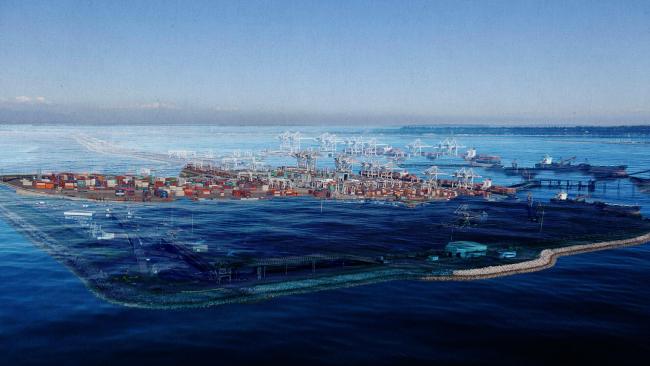
A 6.5-million-barrel oil storage terminal south of Vancouver is planned for land that could turn to liquid in an earthquake.
The 260-hectare site is the end point of the proposed Pacific Link pipeline, which would sprawl more than 1,200 kilometres from Bruderheim, Alta., through Jasper National Park, to Roberts Bank, in Delta, BC.
On Oct. 1, Prime Minister Mark Carney announced that the new million-barrel-a-day pipeline would be the first project to secure “national interest” status and be quickly shepherded to construction.
The proposed route of the pipeline has not been finalized, but the Alberta government’s proposal to the federal Major Projects Office says the Roberts Bank site was chosen due to “existing port infrastructure, favourable geological conditions, and availability of deep-water channels.”
But decades of environmental assessments of the site from previous projects and contemporary earthquake hazard mapping directly contradict the claim that geological conditions are favourable.
A series of regulatory filings reaching back to 1979 warn of “unacceptable risks” to the Roberts Bank ecosystem if oil is exported from the site, underscoring the need for robust environmental assessments that could be bypassed if Pacific Link is fast-tracked, experts say.
Those risks include an earthquake-induced collapse of the entire facility, bleeding oil into the Strait of Georgia a few kilometres south of Vancouver.
Canada’s National Observer examined a trove of regulatory documents to better understand the known environmental risks of exporting oil from Roberts Bank. The filings include a 1979 environmental assessment studying a proposal to expand port capacity at Roberts Bank; a 1996 report from the Roberts Bank Environmental Review Committee; and detailed site information submitted by Trans Mountain in 2014 to the National Energy Board (now called the Canada Energy Regulator).
Over a 35-year period, the documents consistently recommend not shipping oil out of Roberts Bank.
In 2014, when Trans Mountain was describing its route choice to the National Energy Board, it said it had considered building the pipeline to a terminal at Roberts Bank but found the risks to be too high.
“The sand and silt deposits comprising parts of the delta are known to be relatively loose and subject to liquefaction during an earthquake,” the company explained. “The delta front itself is thought to be unstable in some places.”
The soil conditions “represent a significant source of uncertainty,” and the “extent of ground improvements necessary to address potential ground instability due to seismic-induced liquefaction is unknown.” That effectively meant costs to make the site suitable for storing millions of barrels of oil were far higher than other options.
Soil liquefaction refers to when soil suddenly loses its strength and behaves like a liquid. If a major earthquake strikes, the sand the export terminal is built on could violently shake loose, leading to environmental disaster.
Imagine walking on a beach, says Edwin Nissen, a University of Victoria professor and Canada Research Chair specializing in earthquakes: The dry sand feels solid beneath your feet, but go to the water’s edge where waves lap the sand, wiggle your feet around, and feel yourself sink.
“That’s what’s happening with ground shaking in big earthquakes where you have water-saturated sediment,” he said. “The port facilities could slump into the water, the slumping could also generate tsunami waves that could cause significant flooding.”
It’s not unheard of, even in built-up areas. In a 1964 Alaska earthquake, known as the Good Friday earthquake, the Valdez port slid into the ocean, causing a tsunami. In the 2011 Christchurch earthquake in New Zealand, cars and buildings virtually melted into the ground due to soil liquefaction.
“That's what I would fear most in a big earthquake in [the Vancouver region],” Nissen said.
Known as The Big One, seismology experts say a magnitude 9 earthquake expected to cause thousands of fatalities, building collapses, flooding and billions of dollars worth of damage will someday occur in the area. The historic record in the region shows a major earthquake occurring every 500 to 600 years on average, with the last one occurring more than 300 years ago.
Seismologists say predicting earthquakes with precision is impossible, but the best science available combined with statistical analysis from geologic records peg the chance of a “megathrust” earthquake in the Cascadia subduction zone at a one in three to one in six chance in the next 50 years.
A disaster and climate risk resilience report published by the British Columbia government last year warns a megathrust magnitude 9 earthquake could cost thousands of lives and cause more economic damage than all disasters over the past 200 years put together. Consequently, earthquake-proofing infrastructure is a priority. Hundreds of schools, water storage reservoirs holding millions of litres of drinking water, and high rises are being seismically upgraded.
Even setting aside the risk of the megathrust, Nissen says a problem facing the region is that seismologists simply don’t yet know all of the faults that will eventually rupture in big earthquakes.
The US Geological Survey has “mapped a number of faults trending northwest of Bellingham right towards Roberts Bank and that area,” Nissen said. “Their mapping stops at the 49th parallel, but I'm pretty sure that those faults don't stop at the border.”
Jessica Shoubridge, a disaster risk planning consultant who previously led the city of Vancouver’s earthquake preparedness strategy, puts it bluntly: don’t build an oil terminal on Roberts Bank.
“It's not just hazardous, it's [among] the highest liquefaction hazard we see globally,” she said. “It's a different ballgame. Essentially, that whole area is sediment that has washed out from the Fraser River.”
“If you're going to build something in this context in the lower mainland or delta, make sure you're doing it eyes wide open in terms of the hazard,” she said. “Don't pretend the hazard isn't as great as it.”
Project documents for the Pacific Link pipeline and oil terminal submitted to the federal Major Projects Office do not mention earthquake or soil liquefaction risks.
Eugene Kung, a staff lawyer with West Coast Environmental Law, called Trans Mountain’s existing disclosure of soil liquefaction risk “chilling and frightening.”
“This is a company whose whole job is to build and operate pipelines who are saying, essentially, that the risks are too high,” he said. Building the project “seems pretty risky and reckless to begin with, but doing so without any further risk assessment and mitigation, which would happen in an environmental or impact assessment process, is even scarier.”
Environmental lawyers, scientists and conservation experts have repeatedly warned that fast-tracking major projects as proposed in Bill C-39, the Building Canada Strong Act, risks damaging ecosystems and exterminating species, and misses opportunities to mitigate harm by failing to adequately study project impacts.
Federal officials maintain environmental standards will be upheld even as regulatory decision timelines are tightened and ministers are given sweeping new powers to exempt projects from regulations.
However, 56 scientists with the Royal Society of Canada published an open-letter to Carney stating that Bill C-39, as proposed, threatens “irreversible harm” to ecosystems, species and human health.
The proposed legislation would allow pre-construction of projects, such as site-clearing or dredging, to begin before environmental assessments are completed. The proposed bill would also grant cabinet ministers new powers, such as allowing companies to pay a fixed fee for habitat destruction, remove environmental standards if deemed “too costly” for a project, and caps impact assessments to a strict one-year timeline, even if more complex projects require more time to understand.
Perhaps most controversially, the proposed legislation allows for entire regions to be designated “in the national interest,” allowing projects to be built quickly without any set environmental safeguards.
“You can have the highest standards possible, but if those are optional, bypassable or unenforceable, then they’re not really much of a standard,” Kung said.
“It’s really easy and nice to put out in a sound bite that you’re cutting red tape,” he said. “But we have to think about what we’re losing by not understanding fully what the potential impacts of these activities are.”
[Top image: Art by Ata Ojani/Canada's National Observer]