Articles Menu
May 27, 2026
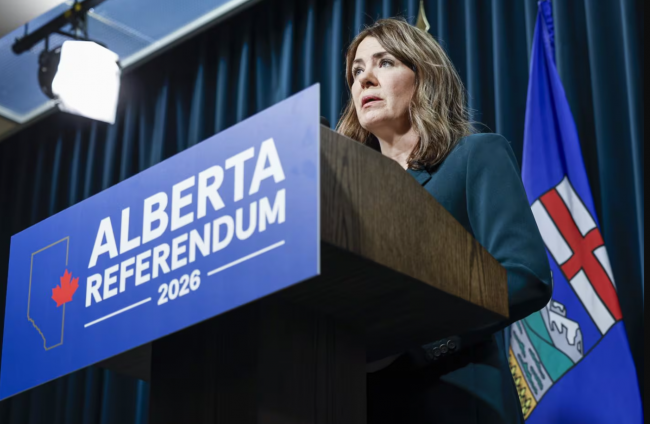
A referendum on an official referendum scheduled for the night of October 19, 2026, could set Alberta on an official legal process of leaving Canada.
Earlier this month, a judge of the Court of King’s Bench of Alberta ruled against an official, non-binding referendum going forward this fall, citing a lack of consultation with the province’s Indigenous people and the Crown.
Premier Danielle Smith, under pressure from her base of supporters of the United Conservative Party (UCP), has pivoted in a way that bypasses the court’s ruling while still putting a referendum on independence of some sort before the people.
The loophole is that the October 19 question inquires about holding an official referendum on separation, asking if the province should “commence the legal process required under the Canadian Constitution to hold a binding provincial referendum on whether or not Alberta should separate from Canada.”
Western alienation is not new. For decades, Albertans have pushed back against a system that entails the province disproportionately paying into Canada’s equalization system while Ottawa enacts policies that stifle industry competitiveness and block pipeline access to tidewater, leaving their biggest driver of wealth primarily captive to a single buyer—the U.S., which then benefits by buying the oil and gas at steep discounts, calculated to be roughly $49 billion USD in the past 15 years.
The hated National Energy Program of the 1980s, imposed by then-prime minister Pierre Elliott Trudeau, remains in the minds of many older Albertans.
More recently, former prime minister Justin Trudeau forced the province to adopt a controversial federal carbon pricing backdrop. During his tenure, tanker bans and environmental review legislation, which many Albertans derided as the “no-more-pipelines act,” gummed up further development of the province’s bountiful oil reservoirs—globally the fourth largest at an estimated 167 billion barrels.

Albertans have also pointed to chronic underrepresentation in Parliament and the Senate in proportion to population, which has also fuelled a sense that the province struggles to have its voice heard and is taken for granted by the rest of the country despite paying significant amounts into Confederation.
The case that Albertans pay too much to Ottawa and get too little back, especially through equalization and other transfers, is central to the separatist case. The irony noted by analysts is that Alberta does not fit the classic template of a marginalized region; its economy has grown faster than any other province since 1950, and it still sits near the top of Canada’s income and employment rankings.
But the anger of those who want to separate stems not from poverty but from believing the province could be much wealthier on its own, and is currently disrespected and the province’s political preferences are not reflected in the federal system.
The Liberal election victory in April 2025, prolonging the party’s power after 10 years of reign that many Albertans found destructive to the province’s prosperity, was the catalyst for the separatist movement to initiate a referendum.
To understand how the current referendum was put forth by the government, it is necessary to go back to the first citizen initiative, anti-separatist movement, called the Forever Canadian petition, which gathered more than 400,000 signatures or 13.6 percent of all electors supporting Alberta remaining in Canada. This pro-unity effort was eventually brought before the legislature, where critics say it was slow-walked by Smith’s government.
Opposition critics have argued that Smith kept the Forever Canadian petition as a political insurance policy: if the subsequent separation petition failed or was struck down by the courts, the government could fall back on the pro-unity petition to justify putting a unity-framed question to voters instead. Critically, the referendum’s current double-barreled question—asking Albertans whether they wish to remain part of Canada or begin the constitutional process toward a binding referendum on separation—was obviously shaped by the Forever Canadian petition, using the same exact words in the first part of its question.
Furthermore, the separation petition that followed—run by Stay Free Alberta—benefited from a lower signature threshold that Premier Smith’s government had set last year for citizen petitions of that type.
The separatist group Stay Free Alberta ultimately gathered over 301,000—significantly more than the lowered 178,000 threshold—and submitted them to Elections Alberta in May 2026. That’s 10 percent of the roughly 3 million registered voters in Alberta, or what amounts to one in six of the 1.78 million people who voted in the Wild Rose province’s last provincial election.
The proposed referendum question was blunt: “Do you agree that the Province of Alberta should cease to be a part of Canada to become an independent state?”
However, the courts intervened twice. In December 2025, a Court of King’s Bench justice found that the referendum proposal was unconstitutional, ruling that it did not guarantee Charter rights or Aboriginal and Treaty rights if Alberta successfully seceded, because the Constitution Act would no longer apply. The UCP government responded by amending the Citizen Initiative Act to strip the constitutional compatibility requirement.
Then, in May 2026, a second judge struck down the petition, ruling in part that the province had failed to consult with First Nations about how breaking off from Confederation could affect treaty rights. Smith immediately condemned the ruling as “incorrect in law and anti-democratic.”
Smith added that appealing the decision could take years and undermined Albertans’ agency: “Kicking the can down the road only prolongs a very emotional and important debate, and muzzling the voices of hundreds of thousands of Albertans wanting to be heard is unjustifiable in a free and democratic society.”
In a separate legal question also tied to Alberta secession, a separatist group called the Centurion Project posted a public, searchable online database containing the personal information of 2.9 million Albertan voters. The database was built using an electoral list that contained personal information of all individuals registered to vote in Alberta.
Elections Alberta eventually obtained a court injunction forcing the database offline, but questions remain how the Centurion Project obtained the data and if it lawfully did so.
Premier Smith has repeatedly stated that she does not support Alberta separating from Canada and personally still hopes for “a strong and sovereign Alberta within a united Canada.”
In reference to why her government has launched a referendum to decide on an official referendum, Smith says the vote would be a policy question, meaning the result would technically not be legally binding on the Alberta government. She has nevertheless pledged to accept the outcome.
Alberta NDP leader Naheed Nenshi has accused Smith of repaying political debts and that her strategy is “extraordinary political malfeasance.”
The numbers are consistent.
The most recent Angus Reid Institute survey, conducted just days ago, found 60 percent of Albertans would vote “No” to the October referendum question, compared to 35 percent who would vote “Yes.” A CBC News poll from late April found 27 percent would vote for separation versus 67 percent against, numbers that have barely moved in eight years of tracking.
Among 2023 UCP voters, according to an Abacus Data poll from March, support for independence reached up to 42 percent.
There is also a stark rural-urban split. The Angus Reid Institute survey finds that outside of Edmonton and Calgary, the issue is deadlocked, with 48 percent saying they would vote to stay in Canada and 48 percent saying they would vote to begin the separation process.
Alberta is now on a five-month clock. The October 19 vote will not itself separate Alberta from Canada; it will only ask whether Albertans want to begin a legal process toward a binding referendum.
Whether Premier Smith’s gamble—holding a vote on separatism she will herself vote against and expects will lose—succeeds or simply hands separatists another grievance remains the biggest question of Albertan and Canadian politics in 2026.
[Top photo: Alberta Premier Danielle Smith speaks during a news conference in Calgary, Alta., Friday, May 22, 2026.THE CANADIAN PRESS/Jeff McIntosh]