Articles Menu
Feb. 5, 2026
As Ottawa publicly defended its largely permit-free procedure to send Canadian arms and munitions to the United States, the Crown corporation overseeing international transfers conducted a review of the final destination of those shipments, CBC News has learned.
Obtained through an access to information request, the assessment's main text is mostly redacted — including its conclusions.
But 288 of its 300 footnotes are not.
The online publication The Maple first reported on the documents last year.
In the review's opening pages, one of the few unredacted paragraphs refers to Parliament's non-binding motion passed in March 2024 about ceasing further arms transfers to Israel, and also to a statement by then foreign affairs minister Mélanie Joly saying no Canadian arms should be sent, directly or indirectly, "for use in Gaza."
One report by the United Nations Human Rights Office cited from February 2024 says the U.S. is "among the largest arms exporters" to Israel, and urges all states to stop those exports. A Human Rights Watch report from March 2024, also cited by the document's authors, says Israel's assurances it is using U.S. arms legally "are not credible."
Called "Human Rights Assessment–Indirect Transfers," the assessment was written by the Canadian Commercial Corporation (CCC)'s internal human rights body on Dec. 6, 2024, and updated on March 24, 2025.
An annex lists at least 30 U.S. military contracts, primarily linked to General Dynamics Ordnance and Tactical Systems Canada, with a few to a smaller company based in Brantford, Ont.: Patriot Forge.
Other contract information in the annex is redacted.

The document does not clarify if the listed contracts were signed, but CBC News has confirmed 15 of them were, through a publicly searchable database.
They include batches of 105-mm ammunition, destined for the U.S. Navy, awarded in 2018 and renewed last September. The Canadian exporter is listed as General Dynamics Ordnance and Tactical Systems Canada.
Another contract is for 150- to 200-mm guns, which would qualify as heavy field or howitzer guns. That one was awarded by the U.S. government to Patriot Forge in June 2025.
One section of the human rights assessment is titled "Buyer/End-user risk."
Though almost entirely redacted, the section's footnotes include references to an Axios article about the U.S. preparing to send Israel artillery shells initially destined for Ukraine. Another footnote links to an article published by Just Security, an American legal and policy journal, which examines a stockpile of U.S. weapons in Israel and argues that Congress should not allow its expansion, alluding to the number of Palestinians killed at the time.
The section also cites the May 20, 2024, announcement by International Criminal Court prosecutor Karim Khan that he was seeking warrants for the arrests of Israeli Prime Minister Benjamin Netanyahu and his then defence minister Yoav Gallant, along with a trio of Hamas leaders.
The document links as well to a paper by the UN's special rapporteur on the situation of human rights in the Palestinian territory occupied since 1967, Francesca Albanese, published in March 2024, which called on UN member states to "enforce the prohibition of genocide" and "immediately implement an arms embargo on Israel."
Albanese visited Canada a month before this assessment was written, and told journalists government officials were declining to meet with her.

In another section of the assessment, titled "Overall Analysis," the document refers to an International Court of Justice (ICJ) order from May 24, 2024, which asks Israel to "immediately halt its military offensive, and any other action in the Rafah Governorate, which may inflict on the Palestinian group in Gaza conditions of life that could bring about its physical destruction in whole or in part."
The same section cites a paper called Obligations of Third States and Corporations to Prevent and Punish Genocide in Gaza, by Irene Pietropaoli with the British Institute of International and Comparative Law, noting the ICJ's provisional orders place an obligation on third countries to stop arming Israel.
It is not clear who requested the assessment, or whom outside the CCC has seen it. An unredacted portion notes that according to the corporation's human rights policy, "CCC's due diligence is an ongoing process that requires attention at regular stages."
It says that due diligence "needs to be completed for all transactions that contain a human rights trigger, such as when the transaction involves a defence buyer and end user."
Of the report's four recommendations, only one is unredacted. It says the committee recommends the assessment to be presented to the corporation's senior management, as well as another advisory body that analyzes risks and opportunities.
In response to CBC News' access to information request, the CCC also sent redacted memos by its human rights committee examining three individual contracts with the U.S. Department of Defence.
Two of them list General Dynamics Ordnance's Valleyfield, Que., operation as the exporter, while the last has the exporter's name redacted.
The memos block out the committee's recommendations.
In a statement to CBC News, Global Affairs Canada did not answer questions about whether any elected or departmental officials have seen the assessment, or whether they ordered it.
They also declined to comment on "the specifics of transactions due to commercial confidentiality," but said departmental officials "have remained in communication with the parties involved to ensure compliance with Canada's rigorous export control regime."
Global Affairs said any violations of that regime "will be taken extremely seriously."
CBC News also sent questions to General Dynamics Ordnance Canada, Patriot Forge, as well as the Canadian Commercial Corporation.
The CCC cited the Access to Information Act in not answering questions, saying its "due diligence of a proposed export sales transaction" is protected because it "includes commercially confidential and privileged information, as well as advice or recommendations developed by or for a government institution."

CBC News will update this story if the companies respond.
In the redacted human rights assessment, the CCC referenced sections 15, 21 and 23 in its use of Canada's Access to Information Act. Those sections allude to defence, advice or recommendations by or for a government institution or minister, consultations or deliberations involving institutional or ministerial staff and solicitor-client privilege.
U.S.-bound shipments have come under scrutiny recently, both because of a report by activist groups tracking Canadian goods ending up in Israel after first being sent south of the border, and due to a private member's bill by NDP MP Jenny Kwan.
The bill seeks to close what it calls a "loophole" permitting Canadian goods to end up in third countries after going to the U.S.

During an initial hour of debate on the bill last November, Rob Oliphant, the parliamentary secretary to Foreign Affairs Minister Anita Anand, called the legislation "well-intended but misguided," saying it would put Canada out of step with military allies.
He said Canada and the U.S. have a "unique geopolitical relationship" rooted in "shared security commitments, continental defence and decades of military integration," and called that relationship "deep and symbolic."
While he said the government could not stand behind the bill, four Liberal MPs have indicated public support. The Conservatives have said they could not support it either, while the Bloc Québécois said it needed more time to study the bill.
The legislation is expected to be debated for a second hour on Feb. 27, with a vote in March.
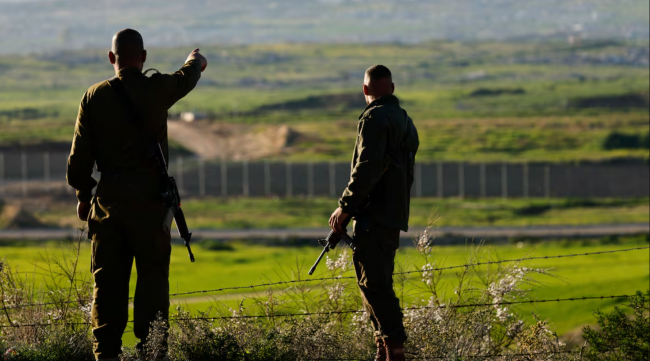
[Top photo: Israeli soldiers are seen looking toward Gaza this month. A internal report obtained by CBC News shows the Crown corporation in charge of international arms transfers in Canada has looked into whether shipments destined for the U.S. were potentially being used by Israel. (Amir Cohen/Reuters)]