Articles Menu
Canada’s first major liquefied natural gas (LNG) export plant, on the B.C. coast, has been having problems with a key piece of equipment since the facility fired up in late 2024. The companies behind the project, a consortium of foreign-owned corporations, have said it will take three years to fix the problem — a timeline experts have questions about.
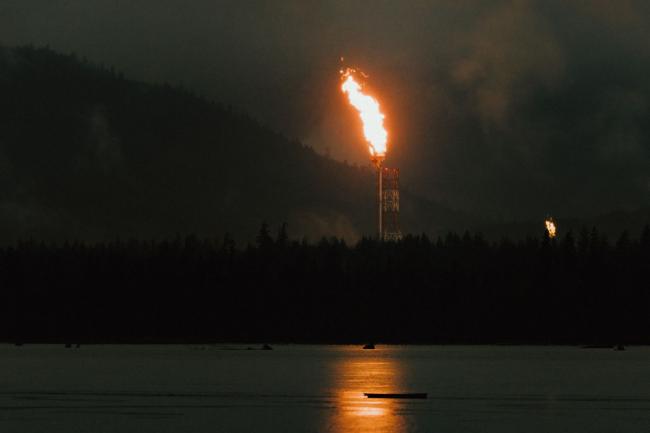
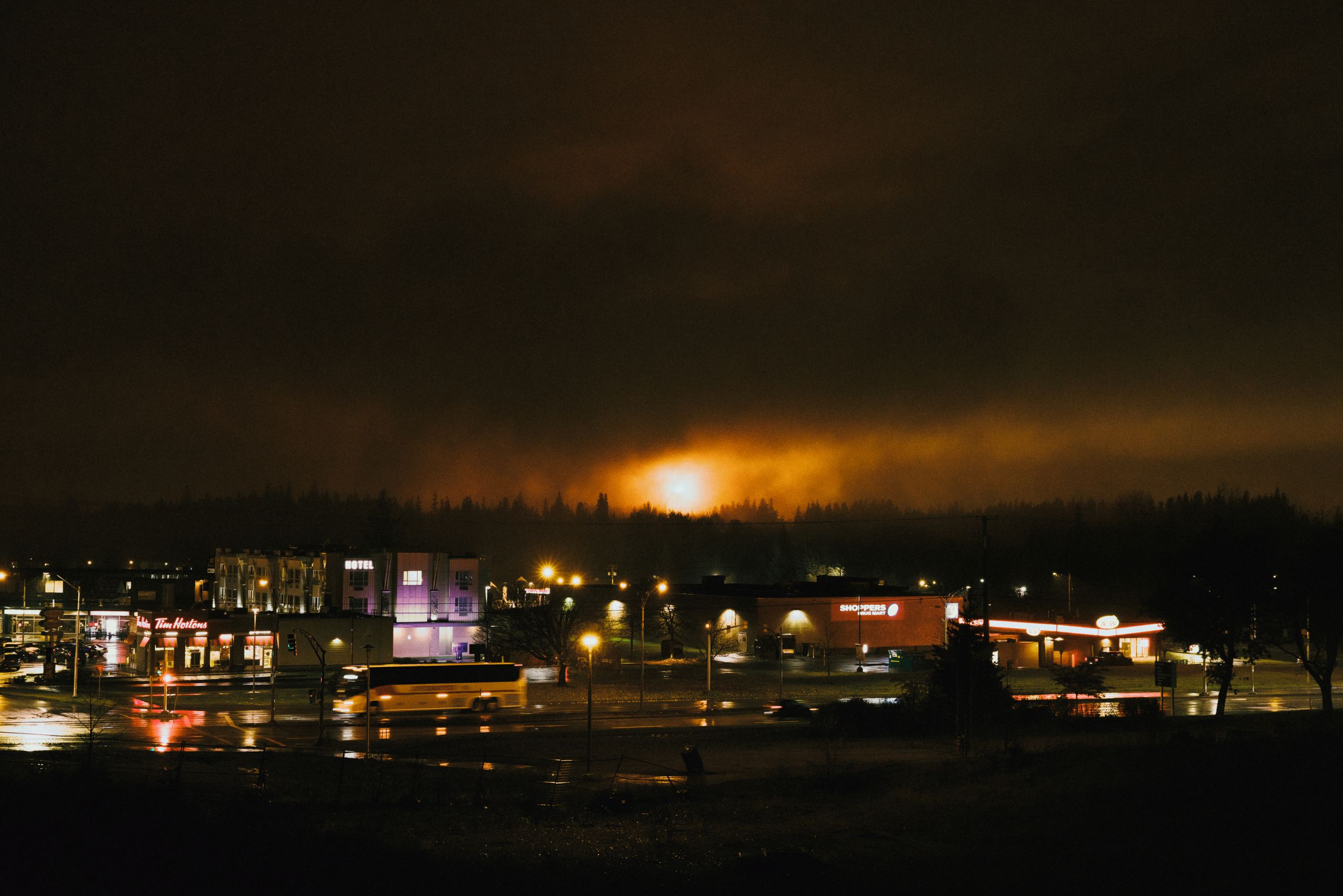
Earlier this year, The Narwhal revealed LNG Canada has been flaring, or burning off, more than 15 times the amount of gas its permits allow. Internal documents obtained by The Narwhal found this unexpected increase is due to an “integrity issue” with one of its flare stacks. For several months, residents of Kitimat, B.C., have been voicing concerns with the intermittent 90-metre-high flames, noise and air quality issues due to the increased flaring.
To understand why this is happening and what it could mean for residents of the coastal community, The Narwhal spoke to legal, policy and engineering experts. They speculate the three-year timeline is more likely a financial decision for LNG Canada, combined with a lack of enforcement by the BC Energy Regulator, the provincial agency tasked with regulating energy resource activities.
“Nobody wants a bunch of flaring at these kinds of volumes,” Matthew Johnson, the scientific director of the Energy and Emissions Research Laboratory at Carleton University, said.
LNG Canada told the BC Energy Regulator it needed to flare an additional 170,000 cubic metres of gas daily to mitigate the issue, which would produce roughly 430 tonnes of carbon dioxide equivalent per day — equal to driving a gasoline-powered car roughly 1.5 million kilometres. The regulator has told The Narwhal the actual average of gas flared due to the issue was even higher, averaging more than 205,000 cubic metres per day over the summer and early fall.
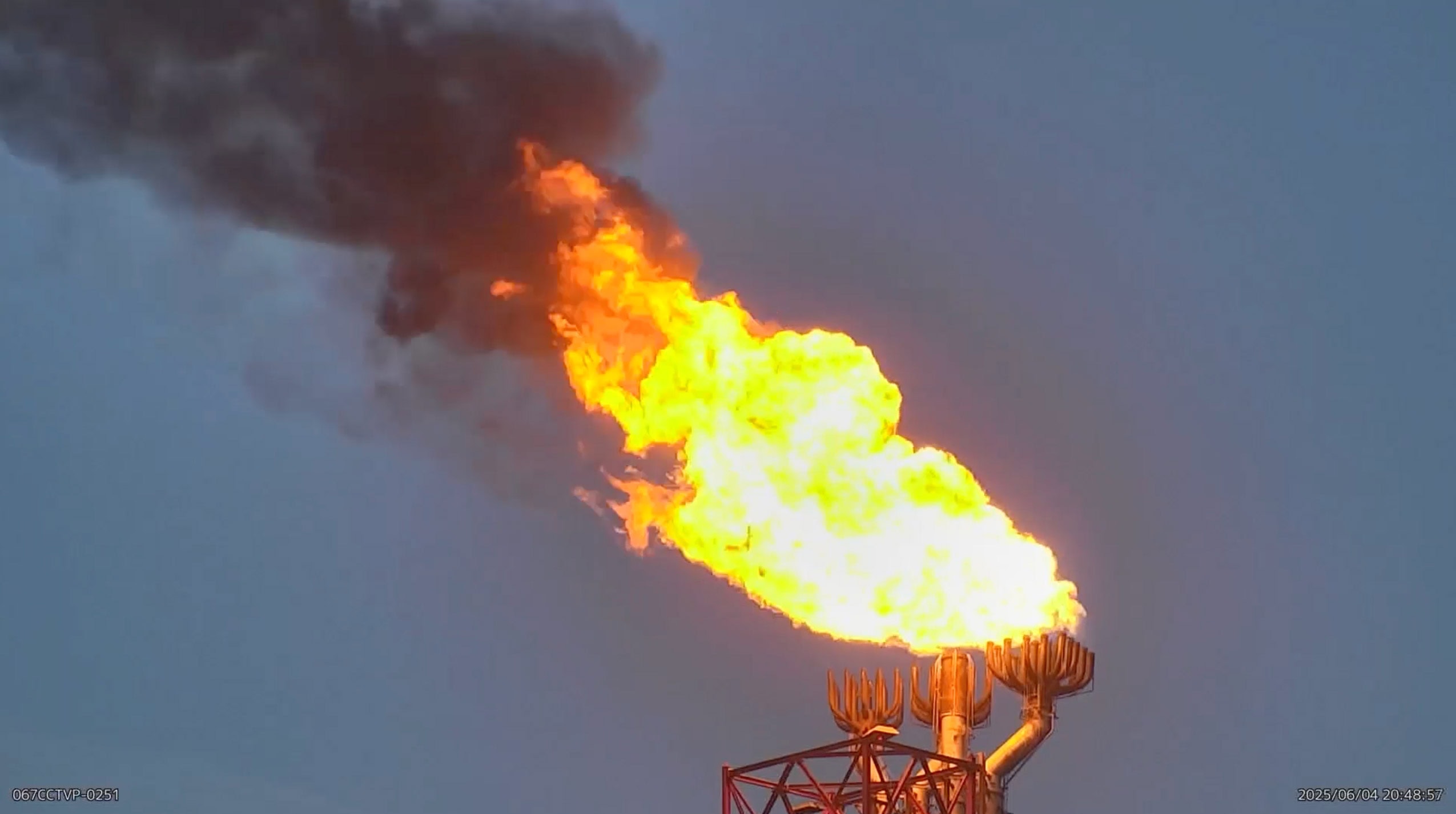
Flaring burns off excess gas, such as methane, produced at the plant when liquefied natural gas is processed. That waste gas is sent up a metal tube that stands more than a hundred metres high and ignited by a pilot light, converting the raw gas into carbon dioxide and carbon monoxide — among other potential gases — and water vapour. If the flare isn’t designed correctly, the gas may not make it to the pilot flame. As a result, more gas has to be used to increase the pressure to reach that flame.
Johnson wouldn’t speculate on the specific issue or its fix without seeing all of the technical documents, but questioned why LNG Canada didn’t appear to be able, or willing, to fix the problem sooner. Other mechanical engineers The Narwhal spoke to suggested the delay is likely a financial decision rather than a manufacturing one: shutting down the facility to replace the equipment would likely be more costly than continuing to flare gas that could be sold.
A spokesperson from LNG Canada responded to questions about the three-year timeline by referring back to a previous statement emailed to The Narwhal in mid-January. It stated LNG Canada is focused on safety and, as the facility is in early operations phase, flaring is a normal occurrence. It noted disruptions will be reduced during “regular operations.”
“We continue to meet regularly with community members, First Nations, local stakeholders and government agencies to listen and respond to any concerns raised about our activities. LNG Canada extends its continued appreciation to the Kitimat community and to the Haisla Nation for their continued support,” the spokesperson said.
Johnson still questions the three-year timeline. “We should pay attention to this issue, and should try to force them to get this under control,” he said. Johnson is especially worried about what has been reported about the observations and experiences of Kitimat residents.
“Anecdotes about sooty films on cars, if true, would be especially concerning,” he said, regardless of whether the flare was operating properly or not.
The BC Energy Regulator maintains “there have not been any measurements in the Kitimat Valley in excess of the B.C. Ambient Air Quality Objective metrics attributable to LNG Canada’s operations.” It referred The Narwhal to publicly available data. However, since learning about the issue in April, the regulator has required LNG Canada to submit daily reports related to elevated flaring and the presence of black smoke.
It was never a secret that LNG Canada would be one of the province’s largest polluters. Project documents produced in 2014 include estimates that, once complete, the facility will emit roughly four million tonnes of carbon dioxide equivalent annually for at least 25 years. Most of the project’s emissions are expected to come from its turbines and acid gas incinerators — not flaring.
B.C. rules require flares to convert 98 per cent of methane, a potent greenhouse gas, to carbon dioxide, though Johnson said there’s no reliable way to independently verify how much is burnt off in real time.
Neither the B.C. Environmental Assessment Office, which was responsible for approving the greenhouse gas management plan for the project, nor the Impact Assessment Agency of Canada, responsible for making sure the project adheres to the environmental protection and impact mitigation conditions under which the project was approved, responded to questions of when or if they had been informed of the integrity issue.
The Impact Assessment Agency of Canada specified in an email that one of the major concerns for flaring was the impact on migratory birds. One of the conditions for LNG Canada was to limit flaring to “what is necessary for maintenance or emergency situations.” In LNG Canada’s 2024-2025 annual report, released in April, the company listed no malfunctions had occurred during the reporting year.
LNG Canada’s first phase was always expected to increase B.C.’s total emissions by about 6.6 per cent, according to the 2015 assessment report by the B.C. Environmental Assessment Office. With the additional flaring due to the integrity issue, the emissions are 4.5 per cent higher than anticipated, based on the flare data provided to the regulator.
Despite the additional gas being flared, it’s still a fraction of what will be shipped and sold from LNG Canada: an estimated 14 million tonnes of gas per year. Choosing to prioritize profits might be a “pragmatic decision and maybe that’s the correct decision,” Johnson said, “But it’d be nice to have some transparency.”
Public records on the BC Energy Regulator’s compliance and enforcement website show just two inspections of LNG Canada since the flaring issue was identified: one in February 2025, three months after the company identified the integrity issue but two months before the company informed the regulator. That inspection was marked “in compliance,” and another in August was listed simply as “inspected.”
To date, the regulator has issued no penalties, no inspection reports and no formal non-compliance findings. Last summer, the regulator recategorized the additional flaring from “non-routine,” a designation that allows for as much flaring as needed in emergency situations, to “routine,” meaning the company was required to submit daily non-compliance reports for exceeding the permit limit, internal documents showed.

“What you’ve discovered regarding LNG Canada is the latest example of the persistent (and frankly disgraceful) non-enforcement of environmental law in Canada against industrial polluters,” David R. Boyd, a professor of law, policy and sustainability at the University of British Columbia, told The Narwhal by email. Boyd recently co-authored a report examining air pollution enforcement across Canada, which found governments often rely on “co-operative and non-responsive” approaches and rarely impose penalties on repeat offenders.
“Canada and B.C. governments pay lip service to the widely accepted polluter-pays principle but rarely apply it in practice,” he told The Narwhal. “Large corporations frequently break environmental laws but are rarely penalized for doing so.”
A spokesperson for the BC Energy Regulator told The Narwhal the daily reports filed by LNG Canada are because the flaring is “not consistent” with the facility’s permits, using that term instead of the term “non-compliant.” In order for the activities to be found non-compliant, they have to be identified in an inspection by the regulator and then documented and investigated.
“It seems very much the kind of thing that the regulator and the permitting conditions were designed to prohibit,” Amanda Bryant, manager of the Pembina Institute’s oil and gas program, said. “They’ve got the tools. I think it’s about willingness to escalate and willingness to enforce.”
The regulator did not specify whether the consortium would be facing any penalties for the permit violations for flaring, but noted “an enforcement action could occur at any time in a three-year period following the date of discovery if the facts of an investigation support compliance action.”
However, that would also mean three years of emissions before a potential penalty is levied. “It’s really difficult to see how waiting three years to actually solve the problem is in the public interest,” Bryant said.
[Top photo: Experts question why the B.C. government isn't doing more to get LNG Canada back in line with permit requirements as flaring issue persists. Photo: Marty Clemens / The Narwhal]