Articles Menu
Dec.11, 2025
With public attention focused on a proposed bitumen pipeline to British Columbia’s northwest coast, Alberta Premier Danielle Smith let drop that Premier David Eby had told her he agreed to a different proposal to expand oil shipments through B.C.
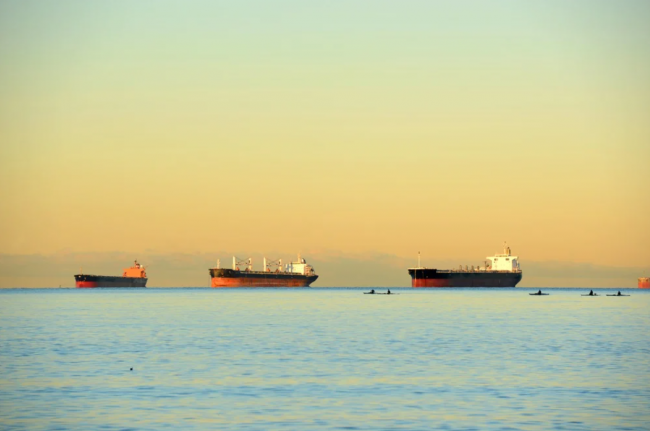
That proposal would see a 40 per cent increase in the capacity of the existing Trans Mountain pipeline to B.C.’s Lower Mainland and an increase in tanker traffic in the Salish Sea.
“I will acknowledge through gritted teeth this is not something we’re keen about, but we understand the role that we play and we have access to ports that we need to partner to Alberta,” Eby confirmed in response to a question from The Tyee.
Trans Mountain, which cost $34.2 billion, has been owned by the federal government since it bought it from Kinder Morgan in 2018. It is not yet running at its full capacity of 890,000 barrels per day, but already there are proposals that would increase the amount of bitumen it can carry by around 360,000 barrels a day.
That’s about 40 per cent more than it can carry now and would be enough to fill four more Aframax tankers a week.
“We are absolutely going to engage in those conversations about optimizing that publicly owned facility that taxpayers have paid for,” said Eby. “But the frustration is obviously that apparently that’s not sufficient, that there also needs to be that British Columbia agrees, even in the absence of any project, to get rid of the oil tanker ban off the north coast, which is the foundational keystone to Indigenous support for all the projects we’ve put on major projects for the federal government.”
Instead of being an alternative in exchange for forgoing a pipeline to the northwest coast, as Eby and the B.C. government intended, expanding Trans Mountain has become in addition to it.
That’s spelled out in the memorandum of understanding signed late last month between Alberta and the Canadian federal government: “It is agreed this new pipeline would be in addition to the expansion of the Trans Mountain pipeline for an additional 300,000 to 400,000 barrels per day destined for Asian markets.”
The idea of further expanding the recently expanded Trans Mountain pipeline has been discussed since at least August, when Tim Hodgson, the federal minister of energy and natural resources, dismissed the notion the expansion would be considered in the national interest.
According to Trans Mountain’s website, it could optimize the mainline by building 11 new pump stations, expanding nine existing ones and adding 30 kilometres of new pipe between Darfield and McLure, north of Kamloops.
It could add a drag-reducing agent that would reduce friction and improve the pipeline’s flow efficiency, a change that would increase shipments by 10 per cent. And it could make upgrades that would flow an added 60,000 barrels per day to its facilities in Washington state.
The work would take place over the next four or five years, Trans Mountain says, but the company has yet to submit formal applications to regulators.
Opposition to the previous expansion of Trans Mountain was strong, including from the Tsleil-Waututh Nation, whose traditional territory includes Burrard Inlet.
In 2016 the federal government approved it and Enbridge’s Line 3 replacement project as part of a grand bargain with Alberta that also rejected Enbridge’s Northern Gateway proposal for a pipeline between Bruderheim, Alberta, and Kitimat, B.C.
During construction, at least 248 people were arrested for contempt of court while protesting against the project.
Under then-leader John Horgan, the NDP opposed the Trans Mountain expansion in large part because of the increased tanker traffic and the risk of spills.
Asked if his government remains concerned about shipping bitumen from Vancouver, Eby said that dredging the harbour could make it possible to reduce the number of sailings.
“There are actually more boats than are necessary that have to be used because they are only filled three-quarters of the way,” he said. “It would actually reduce the number of boats potentially if they were filled up all the way.”
Jeremy Valeriote, the BC Green MLA for West Vancouver-Sea to Sky, said the NDP’s positions on different pipeline proposals have been inconsistent.
“It allows the BC NDP to look like they’re environmentally aware by being against a northern pipeline, but in reality they’re still willing to cave on optimization and dredging, and they’re all over LNG, so it’s just reframing it in a way that I don’t think is helpful to anybody,” he said. “We need to be moving away from fossil fuels altogether, not the least worst fossil fuel.”
The issues around shipping and dredging haven’t been solved with the Tsleil-Waututh and other nations, he added, saying the priority should be to get the existing pipeline running at capacity before there’s discussion of expanding it.
“We just stand opposed to continuing to invest, especially public money, in this fossil fuel economy when other countries are way ahead of us for renewable,” Valeriote said. “I don’t see why we would give anything up if we’re not getting something in return.”
Expansion could be tied to a large investment in renewables, agreement to permanently kill the proposal for a northern pipeline route, an emissions cap and an industrial carbon price. “I don’t see that in the discussion,” he said. “I see a blanket ‘Yes, we’ll optimize the pipeline, and yes, we’ll dredge,’ and I don’t see that we’re getting anything for it.”
Sven Biggs, the Canadian oil and gas campaign director for the environmental advocacy group Stand.earth, said getting both the northern proposal and the Trans Mountain expansion into the agreement was “a clever trick” by Smith.
“I’ll tell you now, if they try to expand the Trans Mountain expansion again, we’ll be out there protesting,” said Biggs, who is based in Vancouver. “If [the northern proposal] is a distraction ploy, it’s not going to work.”
Concerns around oil spills remain, he said. “The thing about an oil spill of that magnitude is that it’s a low risk that it will happen, but if it happens just once it would devastate the local ecology and economy.”
A main constraint keeping the existing pipeline from running at full capacity is that construction overruns made it necessary to set the tolls too high to be affordable, he said.
“It is a boondoggle that keeps getting worse,” Biggs said, noting that the federal government intended to own the pipeline only temporarily but has been unable to find a buyer for it. “It’s been years now; there’s still no buyer in sight and not even really a process to sell it.”
That makes it unclear who would pay for the proposed expansion, he said. “Are taxpayers going to be asked to pay for the expansion to the expansion as well?”
If there were a real need for increased pipeline capacity, either to the north coast or to Vancouver, a company would be stepping forward to build it, said Biggs. “The MOU and the whole process around it is clearly driven more by politics than economics.”
Both approving Trans Mountain and the decision to buy it came out of previous compromises between the federal government and Alberta, he added.
“We keep making these grand bargains with Alberta and they’re never satisfied,” he said. “Each time, Alberta gets exactly what it wants and the rest of us seem to be on the losing end.”
[Top photo:The MOU between Alberta Premier Danielle Smith and Prime Minister Mark Carney includes support for a northern pipeline and a Trans Mountain expansion. Photo via Shutterstock.]