Articles Menu
May 21, 2026
There was a lot of debate in the media and across the country in the wake of the RCMP moving to dismantle the Wet’suwet’en checkpoints in northern BC in 2019, and the rail and road blockades that erupted across Canada in response.. This debate has included numerous calls for the rule of law to be respected. Unfortunately for Justin Trudeau and John Horgan, the key documents that exist on the topic point out how strong the Wet’suwet’en’ case is and how flimsy is the federal and provincial governments’ position. When it comes to determining who has title and jurisdiction over the lands pipelines want to cross over, the simple fact is the governments are breaking their own laws. Indigenous people are not.
The Coastal Gaslink project is a proposal to build a natural gas pipeline across northern B.C. to Kitimat to permit the export of liquified natural gas to Asian markets. The project is being developed by a Canadian corporation – TC Energy – on behalf of a consortium of five foreign petroleum corporations, Royal Dutch Shell, Petrochina, Mitsubishi (Japan), Petronas (Malaysia) and the Korea Gas Corporation. There is considerable speculation that – completely separate from the current crisis over indigenous sovereignty -- the whole LNG pipeline project is close to financial unviability and may simply be forced to shut due to the continuing glut of LNG on international markets. B.C. natural gas sales are half what they were four years ago, and at the lowest level since 2000. B.C. natural gas drilling rights revenues have dropped 72% since 2009. Royalties for natural gas have dropped 88% in the same period. Asian natural gas prices have dropped over 70% in the last 18 months. https://www.theglobeandmail.com/business/article-amid-the-coastal-gaslink-conflict-bcs-elusive-natural-gas-boom/
Much has been made of the mutual benefits agreement that CGL has signed with 20 Wet'suwet'en band councils, but relatively little attention has been paid to the terms of these agreements, because they are secret. The example of the agreement with the Nak'azdli Whut'en band council seems typical of the process. CBC BC reports that "among the benefits to Nak'azdli in the leaked agreement are education and training, contracting and employment opportunities, annual legacy payments over the lifetime of the pipeline, and "general project payments" to be paid in three instalments. But there's also a condition that the band will "take all reasonable actions" to dissuade its members from doing anything that could "impede, hinder, frustrate, delay, stop or interfere with the project, the project's contractors, any authorizations or any approval process.", turning band councils into censors and enforcers.
And how was this agreement arrived at? Over the heads of the band members, it appears. "Nak'azdli Chief Alec McKinnon said signing an agreement with Coastal GasLink was one of the most difficult decisions he's ever made. His nation was split on whether to make an agreement with the company. In 2015, the Nak'azdli held a referendum on whether to enter into a benefit agreement with the province of B.C. for the Coastal GasLink pipeline, as well as the Prince Rupert Gas Transmission pipeline. Nearly 300 band members took part, with more than 70 per cent voting no. By early 2018, several years after Coastal GasLink first approached Nak'azdli about its project, McKinnon said pressure from the company to sign an agreement was growing. At the time, a final investment decision from the joint-venture partners in the proposed LNG Canada project was looming. McKinnon said the community was given a deadline of May 1, 2018 to decide if it was going to sign. When the decision went to a vote at council, the results were split: three councillors voted in favour, three voted against. McKinnon made the tie-breaking vote, voting in favour." In other words, the band membership's vote was ignored, overruled by the single vote of the band chief of an impoverished reserve being economically blackmailed by a huge multinational, and then hidden from public view by a coerced nondisclosure agreement. Just like Harvey Weinstein. https://www.cbc.ca/news/indigenous/coastal-gaslink-nak-azdli-whut-en-agreement-1.5238220
But it gets even worse.
The Wet’suwet’en nation’s territories encompass 22,000 square kilometers of northern BC. This is the land the Coastal Gaslink pipeline needs to cross from northeast BC to Kitimat. 20 band councils have signed agreements with Coastal Gaslink, but their legal jurisdiction does not extend beyond the physical boundaries of their respective reserves, which are tiny. For example, the Hagwilget reserve covers 1.6 sq. km. The Moricetown reserve is 14 sq. km. The Nee-Tahi-Buhn reserve is 3.2 sq. km. The Skintyee reserve is 4 sq. km. The Tsil Kaz Koh (Burns Lake) reserve covers 1.8 sq. km. Palling Reserve No. 1 is 0.3 sq.km. The remainder of Wet’suwet’en land – the overwhelming majority of those 22,000 square kilometers – falls under the jurisdiction of the Wet’suwet’en hereditary chiefs, and they did not give consent.
The Wet’suwet’en hereditary chiefs made two separate proposals to TC Energy that the pipeline be rerouted away from sensitive ecosystems and watersheds. The company refused both proposals. This has led directly to the current situation, where the hereditary chiefs refuse to give consent for the pipeline to cross their territory, to which they have uncontested title. Unlike CGL and the provincial government, the Wet’suwet’en hereditary chiefs have the law on their side.
Indigenous title is rooted in King George III’s Royal Proclamation of 1763, which states that “whereas it is just and reasonable, and essential to our Interest and the Security of our Colonies, that the several Nations or Tribes of Indians, with whom We are connected, and who live under our Protection, should not be molested or disturbed in the Possession of such Parts of Our Dominions and Territories as, not having been ceded to, or purchased by Us, are reserved to them, or any of them, as their Hunting Grounds.” https://www.thecanadianencyclopedia.ca/en/article/royal-proclamation-of-1763
This acknowledgement of title was subsequently incorporated into the Canadian constitution in 1982: Section 25 of the Charter of Rights and Freedomsstates “The guarantee in this Charter of certain rights and freedoms shall not be construed so as to abrogate or derogate from any aboriginal, treaty or other rights or freedoms that pertain to the aboriginal peoples of Canada including (a) any rights or freedoms that have been recognized by the Royal Proclamation of October 7, 1763; and (b) any rights or freedoms that now exist by way of land claims agreements or may be so acquired.” https://laws-lois.justice.gc.ca/eng/const/page-15.html
In 2007 the United Nations adopted the UN Declaration on the Rights of Indigenous People, which states: “Article 10 Indigenous peoples shall not be forcibly removed from their lands or territories. No relocation shall take place without the free, prior and informed consent of the indigenous peoples concerned and after agreement on just and fair compensation and, where possible, with the option of return.” https://www.un.org/development/desa/indigenouspeoples/declaration-on-the-rights-of-indigenous-peoples.html
Article 26 of the Declarationgoes further: “1. Indigenous peoples have the right to the lands, territories and resources which they have traditionally owned, occupied or otherwise used or acquired. 2. Indigenous peoples have the right to own, use, develop and control the lands, territories and resources that they possess by reason of traditional ownership or other traditional occupation or use, as well as those which they have otherwise acquired”
In 2019 the BC Legislature passed Bill 41 (DRIPA), which incorporated the UN Declaration into law. It stated “3. In consultation and cooperation with the Indigenous peoples in British Columbia, the government must take all measures necessary to ensure the laws of British Columbia are consistent with the Declaration.” https://www.leg.bc.ca/parliamentary-business/legislation-debates-proceedings/41st-parliament/4th-session/bills/first-reading/gov41-1
In 1997 the Supreme Court of Canada ruled in Delgamuuwk v. British Columbiathat aboriginal title continues to exist on unceded indigenous territories. The Wet’suwet’en nation exists on just such an unceded territory. https://scc-csc.lexum.com/scc-csc/scc-csc/en/item/1569/index.do
In 2014, the Supreme Court of Canada ruled again in Tsilhqot’in v. British Columbiathat this title to unceded land is not held by band councils established under the Indian Act, but by the indigenous nation in question. https://scc-csc.lexum.com/scc-csc/scc-csc/en/item/14246/index.do
Finally, last year's Cowichan decision (Cowichan Tribes v. Canada) is a landmark British Columbia Supreme Court ruling that recognized the Cowicvhan nation's aboriginal title to roughly 732 acres of land and submerged areas on the Fraser river in Richmond. The court declared that Crown grants (fee simple titles) held by Canada and the City of Richmond in the title area were defective, invalid, and an infringement of Aboriginal title. The ruling allowed an 18-month suspension period to negotiate a resolution. Despite concerns that the ruling could invalidate private homes and businesses, both the court and the Cowichan Tribes confirmed the decision is not challenging individual private property owners (fee simple titles held by non-parties). The title dispute primarily concerns the Crown and government-held lands. https://www.bccourts.ca/jdb-txt/sc/25/14/2025BCSC1490.htm
For indigenous people the “rule of law” has made it illegal to own agricultural equipment, illegal to keep religious artifacts, illegal to have a potlatch, illegal even to hire a lawyer. The rule of law made the wholesale theft of land legal, and led to the incarceration of children in residential schools. It even – literally - permitted the sale of indigenous children to white families(!)
So while it’s extraordinarily cynical and bitter to see this “rule of law” being completely ignored by the governments that find it inconvenient, we shouldn’t be surprised. The federal Liberal government was willing to fire its Attorney-General when she opposed its illegal attempt to award SNC Lavalin a deferred prosecution agreement. We should not be surprised that here too, adherence to the law is a matter of “do as I say, not as I do” for Mark Carney and David Eby.
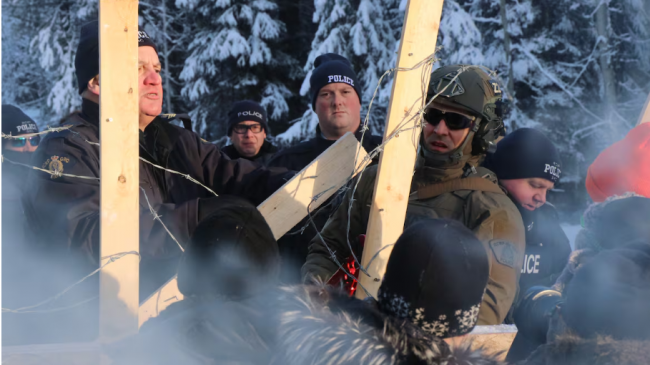
[Top photo: Members of the RCMP move in to enforce an injunction against Wet'suwet'en people and their supporters on a forest service road in the nation's traditional territory in northern B.C. on Jan. 7, 2019. (Chantelle Bellrichard/CBC)]