Articles Menu
Aug. 27, 2026
It has been heartening to witness the degree of national unity as Canadians steel themselves for the current trade war and insist that our governments stand up to Trump. According to many reports, Canada was dangerously close to signing a terrible deal with yet more concessions. But thankfully, at the 11th hour, the US demanded too much and Prime Minister Carney pulled the plug. The federal government has now announced counter-tariffs that will kick in after Labour Day, along with initial supports for affected workers and businesses.
But in all likelihood, more will be needed.
In my last newsletter, I argued Canada should impose an export tax on oil and gas shipments to the US. A number of you sent me very thoughtful responses raising some concerns and questions. So today I’d like to offer some follow-up points in reply.
Some worry about how Trump would retaliate against an oil and gas export tax. Others wonder what the economic cost of the export tax would be, and who would bear it. Would the export tax cause too much harm to employment in Canada, or would it result in lower US demand and thus fail to raise the revenues I claimed? And some fear the reaction in Alberta, particularly given the forthcoming separation referendum in that province.
All legit questions. But here’s my take:
The sad reality is that we are now in a trade war, and counter-measures are necessary. It’s the only thing bullies like Trump understand, and our dignity and independence requires. Every counter-measure comes with costs, benefits, risks, winners and losers, and needs to be carefully weighed accordingly.
Trump can be expected to retaliate whatever our response. The argument I have sought to make is that our retaliatory measures should be maximally strategic (not just a broad, “dollar-for-dollar” response). And ideally, we should impose measures that will be paid mainly on the American side rather than here.
In that regard, there is a key distinction to be made between counter-tariffs versus export taxes. While in both cases, the Canadian government will collect the revenues, in the case of counter-tariffs, the resulting higher prices will be borne by Canadians, while with export taxes, the additional costs are borne primarily by consumers and businesses in the US, which in my view makes them more effective (they will put more political pressure on Trump).
Would the export tax reduce US purchasing of oil from Canada, and thus reduce the revenues raised? Likely not by much. That’s because US demand for our oil is very “inelastic” (as the economists say). Meaning, it is not very sensitive to price changes (at least not in the short and medium term). Oil prices regularly shift up and down by more than this proposed tax, with minimal impact on short-term demand (that’s why the oil companies have been able to make such a killing from the oil price shocks stemming from the Iran War; longer-term, people and businesses can shift to less-expensive electric alternatives, which is a positive for the climate, but that’s a slow process). And US refiners aren’t able to quickly shift who they buy from. Trump, for his part, is unlikely to add his own counter-tariff on top of our oil export tax or to restrict US oil to Canada, as the companies impacted are mostly American and his friends.
Would people in Alberta go nuts? Some would. This is probably the most sensitive point, given Alberta’s forthcoming referendum. We could arguably keep this measure in our back pocket until after the October referendum. That said, Canadians are now very united on the need to retaliate, and most believe the response should be fair and equitable across provinces and industries. And, given the previous point about inelasticity, the export tax would be unlikely to noticeably reduce oil production and employment in Alberta.
That said, the one premier who is clearly not fully on “Team Canada” is Alberta premier Danielle Smith. She is showing herself to be more loyal to the oil industry than to Canada. Frankly, the game she is playing approaches treachery. She should not be allowed to stymie the steps that are now needed, and I suspect a good many Albertans agree. In a fascinating development, in the last couple days, two former Conservative Alberta premiers – Alison Redford and even Jason Kenney – have publicly come out saying Canada needs to be ready to put oil on the table.
Says Redford: “If you’re negotiating with someone and they don’t feel that you’re putting your strongest position forward, then you look weak.” She told CBC, “I don’t think Albertans should consider themselves to be an exception. We are Canadians... We can contribute to what the Canadian negotiating position is. And I think most Albertans want to do that.” Bravo!
Kenney argues the Americans would be extremely sensitive to export taxes on things like fuel and potash given the cost-of-living crisis. “(That) would affect Republicans who drive F-150s and lay fertilizer on their farm fields,” he said. (Note to self: check sky for flying pigs.)
Their sentiments were echoed this week by former PM Jean Chretien, who stated, “If we want to stay upright, we have to hit where it hurts.” He called on the federal government to impose an export tax on certain goods, pointing to energy, oil, natural gas and potash as examples of Canadian goods the US needs. “The advantage of an export tax is it’s not us who pays, it’s the Americans.” Exactly.
[Feel free to share my Bluesky post about these unlikely endorsements here.]
Yesterday, federal NDP leader Avi Lewis also called for an export tax (re-stating his position from the recent leadership race):
“When you’re in a war, you use your strongest weapons – and our power in this trade war comes from the resources the US needs, like oil, gas, potash, and other critical minerals,” said Lewis. “We can’t leave our best trump card sitting on the table” [pretty sure the pun was intended].
You can read Avi’s full statement here.
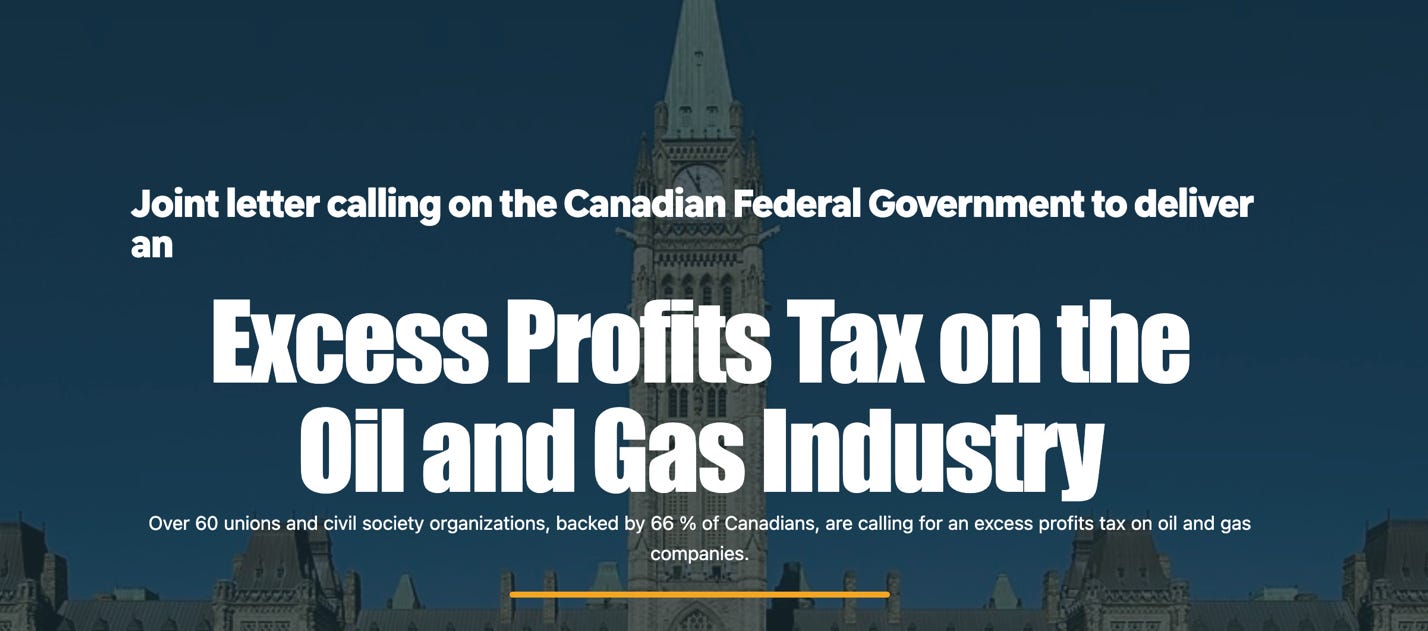
Happy to share that over 60 organizations across Canada have now joined the call for a windfall profits tax on oil and gas (an idea I wrote about here last April).
350 Canada states, “As Canada burns, fossil fuel companies continue to rake in billions in extra profits. In fact, Canada’s top 4 fossil fuel companies more than doubled their after-tax profits, which reached a combined total of $13.3 billion. That’s $150 million per day in after-tax profits over their second quarter by exploiting Trump’s illegal war on Iran.”
It’s time to tax those excess profits!
You can see the joint call from these 60+ groups here, and please share the news on socials.
**