Articles Menu
May 23, 2026
Can Danielle Smith continue using Alberta separatism as a tool of political management without eventually losing control of the forces she helped unleash? This past week suggests she can’t. Political movements built on grievance rarely remain controllable for long. Since becoming premier in 2022, she has systematically normalized the politics of betrayal, victimhood, and existential crisis. Now she is trying to surf a political tsunami wave of her own making.
Can she survive?
Extremists like David Parker are talking openly of removing her as leader of the United Conservative Party. He and his ragtag group of Christian Nationalists deposed Premier Jason Kenney and installed Smith. Will they do it again?
Even if she survives as premier, what damage will be done to Confederation? Canadians outside Alberta are angry about Smith’s machinations. “I wish there was a word in the English language for something at once deeply consequential and profoundly silly. I don’t know how else to describe what’s going on in Alberta right now. It’s a national unity crisis and it’s incredibly stupid,” writes Toronto Star editorialist Richard Warnica.
The stupidity of it all baffles Canadians outside Alberta. I spent two of the past three weeks in Montreal—irony noted, given that Quebec may have its own independence referendum in the near future—giving energy transition presentations and fielding many questions about Alberta separatists.
To outsiders, separatist leaders like Jeff Rath, Mitch Sylvestre, and David Parker look cartoonish. Buffoons right out of the anti-vax, anti-science conspiracy theorist crowd. Rath, a lawyer of all things, claims Canada under Prime Minister Mark. Carney is a Chinese state and invokes silly ideas like the “New World Order.” Sylvestre invokes debunked oil and gas nonsense as if it were gospel, while rarely being challenged by mainstream reporters.
Parker is in a league of his own. He spearheads the Centurion Project that leaked the Alberta Electors List that includes personal information on every voter in the province. First, he claimed the list was no different than a phone book. Now, he is reportedly refusing to cooperate with Elections Alberta’s investigation. And this is hardly Parker’s first brush with the elections watchdog.
What all three separatists, and many in their movement, have in common is a profound detachment from political and economic reality. They talk about Alberta independence as if it were a straightforward exercise in popular will rather than a constitutional, legal, economic, and geopolitical crisis unlike anything modern Canada has experienced.
They invoke slogans about freedom and sovereignty while largely ignoring Indigenous treaty rights, currency issues, pension liabilities, trade relationships, capital flight, investor confidence, and the sheer complexity of disentangling Alberta from Confederation. Or, worse yet, they wave away complexity with slogans and memes.
That’s how unserious these people are.
And yet, despite all this, Smith continues legitimizing them by treating separatism not as a fringe ideology to marginalize, but as a political force to accommodate. That accommodation strategy may prove to be the defining mistake of her premiership.
Smith appears convinced she can maintain a careful balancing act: keeping separatists energized enough to remain loyal to her leadership while preventing the movement from spiralling out of control. But movements organized around anger and identity do not reward moderation for long. Eventually, activists demand proof of commitment. They demand escalation. They demand victory.
And leaders who fail to deliver quickly become targets themselves. Jason Kenney learned that lesson the hard way. Smith may be next.
Is Smith badly misreading the public mood?
Pollster David Coletto argues that Canadians are living in what he calls a “precarity mindset,” a period defined by economic anxiety, institutional distrust, and fear about the future. They care about the price of gasoline and milk, mortgage rates and rent, more than they do about politics. In that environment, voters punish disruption. Particularly when the disruption was created deliberately by their own provincial government.
Smith may believe she is strategically managing separatist pressure inside her base. Many Albertans think that she is manufacturing instability for her own political reasons. And they won’t be happy if Smith’s “national unity crisis” looks to drag on for years and years.
Separatist movements, once legitimized, rarely disappear. They evolve. Quebec separatism survived repeated defeats. Scottish nationalism spent decades building institutional strength before achieving electoral dominance. History suggests political movements built around grievance, identity, and existential crisis rarely remain frozen in place for long.
Smith appears to believe she can keep Alberta separatism suspended indefinitely between symbolism and reality: heated enough to satisfy activists, but controlled enough to avoid irreversible consequences.
“You do not summon that kind of movement and then put it back in the box,” said Coletto.
The Court of King’s Bench ruling was the week’s most important constitutional event because it reminded Alberta’s separatists — and the Smith government — that Canada is not simply a voluntary economic arrangement between provinces. The ruling turned on the constitutional duty to consult Indigenous nations whose treaty rights would be directly affected by any attempt at secession.
That reality cuts through much of the rhetoric driving the separatist movement. Alberta cannot unilaterally redraw the constitutional map without confronting the legal and political status of Treaty 6, Treaty 7, and Treaty 8 territories.
The Athabasca Chipewyan First Nation understood this immediately, which is why its legal challenge proved so consequential.
“The threat to Canadian sovereignty is deadly serious. Their goal is to destroy Canada," Chief Allan Adam said in a press release. "We drove Smith into the open and forced her to abandon a binding question."
The deeper irony is that separatists who claim to defend provincial sovereignty collided headfirst with a constitutional order that predates Alberta itself.
This past week may eventually be remembered as the moment Alberta separatism crossed an important political threshold. Separatism has now become embedded in the governing dynamics of Conservative politics in the province. Danielle Smith did not create Alberta alienation. But she helped transform it from a regional grievance into a permanent instrument of political mobilization.
That strategy delivered short-term political benefits. It helped consolidate her leadership and unify disparate factions inside the United Conservative Party. But it also normalized ideas, rhetoric, and political actors that previous Conservative leaders would have kept firmly at the margins.
Now Smith finds herself trapped by the very forces she spent years cultivating. She can no longer easily retreat, as doing so risks rebellion from her own base. Yet escalation risks economic instability, constitutional conflict, and lasting damage to national unity.
Separatists have chafed at her leash for some time. Now they are slipping their collars. Smith may have unleashed the dogs of serious political disruption. within the Confederation.
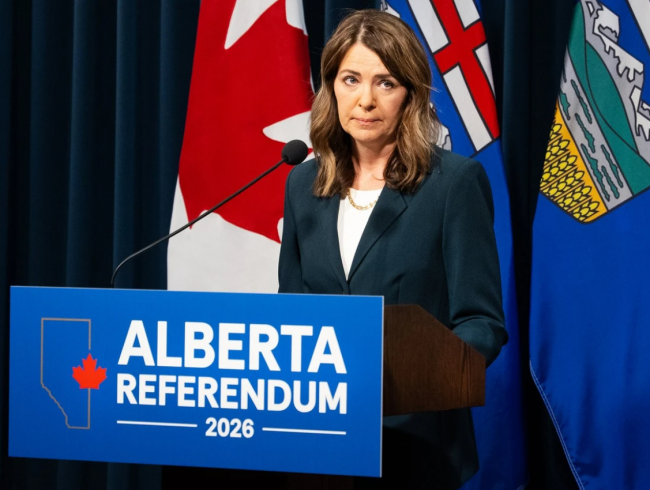
[Top photo: Alberta Premier Danielle Smith speaks at a press conference at McDougall Centre in Calgary. Photo by Dean Pilling /Postmedia]