Articles Menu
Jan. 5, 2026
Reconciliation with First Nations, questions about land title, and creating economic certainty are complex and urgent questions in our province. That is why I feel the need to respond to an opinion piece by Conservative Party of BC interim leader Trevor Halford, published in the Vancouver Sun on Dec. 27.
I do so as a member of Tsartlip First Nation and former member of the legislative assembly for Saanich North and the Islands with a record of seeking solutions based on inclusion, equity and justice.
British Columbians need leaders who deal in facts, not dog whistles. The truth matters, especially when it comes to the foundation of our province.
What Halford gets wrong about Eby and DRIPA
In any case, Eby is correct when he describes DRIPA as framework legislation. It does not create or alter Indigenous title. And to be clear, the B.C. Supreme Court decision Cowichan Tribes v. Canada, rendered in August, has very little to do with DRIPA. Rather, the decision is based on long-established constitutional rights.
Halford’s argument in his Sun piece reveals either a fundamental misunderstanding or a wilful misrepresentation of B.C.’s legal reality. DRIPA does not create Indigenous title; the Canadian justice system was recognizing it decades before (see Supreme Court decisions in Delgamuukw, 1997, and Tsilhqot’in, 2014).
The rule of law applies to everyone, even government
If our society believes in the rule of law, then we must accept that it applies even when it affirms Indigenous title, just as when it affirms private property rights. The courts are enforcing the law and governments must act accordingly.
Halford accuses Eby of playing a “direct role in bringing about this crisis.” That’s wrong on two counts. First, Premier Eby inherited the situation, just like every premier before him. His predecessor, the late John Horgan, just took the advice of the courts more seriously than some others, and worked more expeditiously towards co-operative and negotiated solutions.
The second inflammatory falsehood by Halford is his use of the word “crisis” to describe where we’ve arrived in this province.
When Eby put $150 million forward for private property owners who may be affected by the Cowichan decision, he was not acting recklessly; arguably, he should have done it sooner. Mostly because it is unlikely that it will be needed because the decision is not likely to directly affect private property owners, especially if Eby creates an effective table for the Crown and First Nations to negotiate a solution.
Halford’s call for DRIPA to be repealed or for Eby to resign is no solution at all, but rather amateur political theatre. Repealing DRIPA will only compound the problem; it does not change one word of the Constitution, nor would it overturn a single court decision.
Halford writes that he understands “actions without planning lead to disaster, and that favouring empty rhetoric over sound governance produces policies that hurt British Columbia.” That claim to wisdom is laced with hypocrisy, because Halford makes no effort to offer a plan while favouring empty rhetoric fashioned to produce his own political gain.
The way forward requires courage and negotiation
There is no shortcut to the certainty that British Columbians want. What is needed takes hard work, honest leadership and respectful negotiation.
The just path forward includes negotiated agreements, co-operative governance and legal alignment. Yes, in good part due to overblown rhetoric like Halford’s, business confidence has been shaken. People are afraid the value of their homes and investments may not be certain.
And yes, it is challenging work to reconcile this with Indigenous rights and title. It is why every premier before Horgan sidestepped their responsibility.
But false certainty is no certainty at all, so let us together approach this important work with a deep commitment to building a British Columbia where legal obligations are respected and individuals, businesses and communities can thrive. That is in all our interests.
I am deeply disappointed that my friend, Trevor Halford, has resorted to using fear to pit communities against one another.
The people of this province need leaders who are willing face hard truths, not exploit them for political gain. True leadership is not about scapegoating and succumbing to the politics of fear, but rather about facing our collective reality with courage, and walking a path of truth even when it is difficult. British Columbians deserve nothing less.
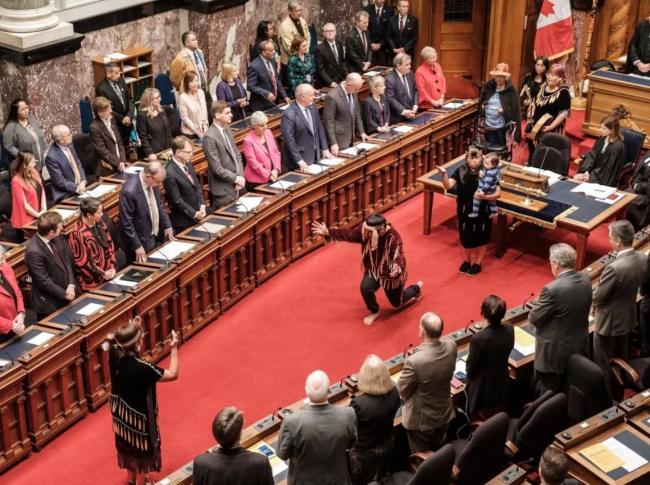
[Top photo: DRIPA, introduced in 2019, is framework legislation that does not create or alter Indigenous title. Photo via BC government.]