Articles Menu
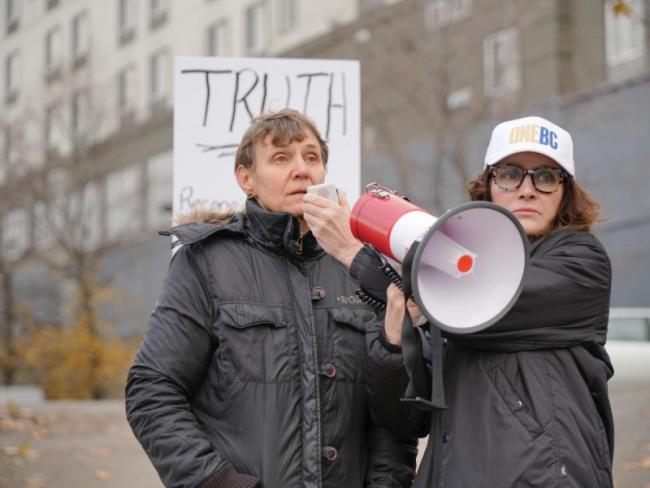
Jan. 16, 2026
Given the rising tide of anti-Indigenous politics in Canada, it is crucial to pay close attention to how the far-right is deliberately weaponizing misinformation about residential schools to undermine truth and reconciliation. What might appear, at first glance, as isolated controversies or “debates” about historical facts are better understood as part of a coordinated political strategy aimed at eroding public confidence in Indigenous testimony, survivor truth, and the legitimacy of reconciliation itself.
As I have argued previously, and as recent events in British Columbia make abundantly clear, residential school denialism is not simply about disputing aspects of the historical record. It is a form of political propaganda. Drawing from the American far-right playbook, denialists seek to “flood the zone” with misleading claims, half-truths, and bad-faith arguments—overwhelming public discourse to the point where confusion replaces accountability, and doubt supplants well-established evidence. In this environment, even firmly documented truths become framed as “controversial,” while Indigenous nations are recast as untrustworthy or manipulative actors.
OneBC’s documentary Making a Killing exemplifies this strategy. Marketed as a provocative exposé, the film is in fact a piece of political propaganda designed to shake public confidence in residential school history and stoke anti-Indigenous resentment for political gain. By recycling far-right talking points, misrepresenting the findings of the Truth and Reconciliation Commission, and narrowing the definition of genocide to suit its ideological ends, the documentary aims to convince viewers that reconciliation itself is built on a lie—and therefore should be abandoned.
To help people better recognize how this strategy works, I joined the Redeye podcast to discuss Making a Killing, its political context, and the broader growth of residential school denialism in Canada. As the conversation below makes clear, this denialism is not confined to fringe actors. It is increasingly being taken up by elected officials and mainstream political figures, particularly on the far-right, as part of a wider project to legitimize anti-Indigenous racism and defend the settler-capitalist status quo.
As I explain in greater detail in the interview that follows, we share an ethical responsibility to confront and counter this harmful wave of denialism. Reconciliation is not a matter of belief or opinion—it is a relationship grounded in truth. Allowing that truth to be deliberately distorted for political profit risks poisoning that relationship and deepening the injustices that reconciliation was meant to address.
Redeye (RE): This is the Redeye Podcast. You can hear our live broadcast on Saturday mornings from 10 till noon PST at 100.5 FM in the Lower Mainland in British Columbia.
On the podcast today, Sean Carleton of the University of Manitoba on the OneBC documentary Making A Killing and the growth of residential school denialism in Canada.
On December 2, the OneBC Party released its documentary Making A Killing: Reconciliation, Genocide, and Plunder in Canada. Since then, the writer and producer of the film, OneBC Chief of Staff Tim Thielmann, has been fired along with two other senior staff. MLA Dallas Brodie, who apparently carried out the purge, has herself been removed as interim party leader.
But the documentary lives on with Dallas Brodie voicing Thielmann’s script and interviewing all the guests. Two weeks after it was posted on YouTube, the film had over 360,000 views. Sean Carleton joins me today to talk about the film.
He’s a professor of history and indigenous studies at the University of Manitoba, and he joins me today from Winnipeg.
Sean Carleton (SC): Hello, thanks for having me.
RE: I’m really happy we were able to connect. The film incorporates a whole mishmash of far-right memes, but what would you say is the central message?
SC: I think the best way to understand the documentary is as a form of political propaganda. It’s a promotional video for OneBC that openly and proudly engages in anti-Indigenous racism, residential school denialism, and debunked conspiracy theories to build and push the party’s brand by appealing to some British Columbians’ fear and growing resentment towards Indigenous people. The film uses the distortion of residential school truth as a vehicle to promote anti-Indigenous hate and the OneBC political brand.
RE: What does it want us to believe?
SC: Making a Killing wants Canadians to think they have been guilted into caring about Indigenous people based on a lie. If the foundation of reconciliation is a lie, then Canadians can feel good about abandoning reconciliation and stop worrying about building a better relationship with Indigenous peoples. That’s what is being manufactured in this documentary, a sort of disbelief in Indigenous people, an open embrace of anti-Indigenous politics, and the willingness to profit from misinformation in the form of a political party such as OneBC.
It’s not just OneBC that’s engaging in this kind of politics, but they’re trying to use this film as a way of garnering support and growing that resentment politics to poison the political relationship between British Columbians and Indigenous nations.
RE: What is the solution that Brodie and Thielmann propose to this problem? What do they say we should do?
SC: By the end of the film, the solution is to support OneBC, to support not only its anti-Indigenous policies, but also anti-LGBTQ2+ politics, anti-immigration politics, and so on. It’s using residential school denialism to push this simple formula: British Columbia needs a far-right party that is going to stand up for white supremacy and Christian nationalism, and OneBC is the only party that will. In this way, we can see the film for what it is: political propaganda. It’s not just a curious documentary, trying to get to the truth. It’s trying to appeal to fear by using a whole host of disingenuous tactics that are meant to foment anti-Indigenous racism and cash in on it politically.
RE: What are some of those disingenuous tactics that you saw in the film?
SC: It’s important to point out that the tactics of the film are not new. It’s really just a recycling of a lot of the popular far-right misinformation about Indigenous people generally, about reconciliation, but specifically about residential schooling in Canada. It’s textbook residential school denialism. If you pay attention to some of the sources that are being used, it’s Rebel News, True North, Western Standard, all of these far-right extremist internet platforms, and interviewing the most prominent voices in the residential school denialist movement.
There’s no effort at unbiased presentation of evidence. Actually, the best way to really understand what’s going on is if you skip to the end, you learn everything that you need to know about the reliability of the information being presented. There’s a credit that says: “no guarantee is made regarding the accuracy, completeness or current viability of the information presented.” That’s pretty telling.
None of the information is rigorous, peer-reviewed, nuanced, or expert knowledge supported by evidence. They admit that, but only at the end in the credits.
What’s really going on, then, is this deeply unethical, deliberately disingenuous presentation of cherry-picked information meant to promote and foment politically-useful hate. They are harvesting hate.

An Instagram post by Dallas Brodie in support of the Making a Killing documentary. In 2025, she was expelled from the BC Conservative caucus after mocking residential school survivor testimony in a podcast appearance.
RE: They actually have an interview with a former residential school teacher.
SC: Yes, who they don’t identify. They allow this person, unchallenged, to say that everything was fine and the system was great. That’s a deeply unethical way of engaging with the evidence of the system.
They’re not the first to do this. They’re using a lot of the information and tactics from other far-right publications, such as Grave Error. For example, one of the tricks the film plays early on is it contends that Canada is being charged with the “mass murder” of Indigenous children. What they’re doing is they’re making a false equivalence between the fact that children died in residential schools—and church and state records have already confirmed more than 4,000 deaths—and mass murder. It’s a sleight of hand. That’s actually not what Indigenous nations or even the TRC concluded.
There is also a narrowing of the meaning of genocide to only mass death events, which is not how the United Nations defines genocide. Attacks on group life can take various forms, including removing children from the group or undermining cultural life—which is why the TRC used that term. But the film presents a simplistic understanding of “genocide equals mass murder” and then proceeds to question evidence of mass murder and therefore the applicability of the term genocide. That is the kind of deliberate twisting going on in the film; it’s a misrepresentation of what the TRC and Indigenous nations, including Kamloops, have proven already.
We know, for example, that there are confirmed deaths at Kamloops. Confirmed by church and state records, approximately 50. But, like other residential school teams, the nation’s doing additional investigation, including things like ground-penetrating radar, but also working with religious groups to gain access to more records that were not given to the TRC. They’re not the only nation doing this work. In Williams Lake, after the Kamloops announcement, the Oblates and Williams Lake team worked together to make 50,000 additional records accessible and those records have confirmed that the death rate in that school was three times higher than the TRC reported.
What Making a Killing is trying to do is shake public confidence in residential school truth and the truth of survivors to derail reconciliation efforts. It is part of the strategy of “flooding the zone” as a form of political propaganda that we’ve talked about before. What OneBC wants is to keep us stuck in the colonial cul-de-sac. The film is a really good example of how people are disingenuously engaging in debate, discussion, and dialogue about residential schools as a way of undermining truth and reconciliation and protecting that colonial status quo.
RE: You use the term propaganda and we tend to kind of throw that term around. What does it actually mean?
SC: In this sense, it’s really about presenting biased or misleading communication, often appealing to emotion, and using it to promote a specific agenda. Its goal is persuasion, not education. Propaganda often relies on tactics such as selectively presenting facts and deploying emotionally charged language—such as claiming there is a “blood libel” against Canada for the “mass murder” of Indigenous children—when that is not what the Truth and Reconciliation Commission or Indigenous nations are saying.
That’s the wilful twisting and deliberate appeal to emotion to try and persuade people that OneBC is the answer to stand up against the so-called “reconciliation industry.” When in reality, OneBC and many of the people interviewed in the film are part of the anti-Indigenous industry in Canada that is publishing books and articles and monetizing misinformation. Of course, we also need to talk about the fact that OneBC, which is now in turmoil, essentially siphoned off taxpayer money from its caucus funds to make this film.
They claim to stand up for democracy and accountability but here they are using tricks to essentially create a new party and get all of this public money and use it to make building relationships with Indigenous people harder.
Regardless of where you stand politically, the damage that is being done by this film—and denialist propaganda like it—makes it harder for anyone to work with Indigenous people, and since they’re the original people of these lands, they’re not going anywhere. It’s making that relationship much more difficult and risking the future for many British Columbians in the process. Reconciliation is a relationship. If we continue to poison that relationship, it’s going to make for turbulent times ahead.

Kamloops residential school, 1937. Photo courtesy the National Centre for Truth and Reconciliation.
RE: OneBC has now imploded as a party but Dallas Brodie and Tara Armstrong are still MLAs. Are these kind of views represented by other sitting MLAs?
SC: I think there’s a risk right now in seeing Dallas Brodie or Tara Armstrong as aberrations. Instead, they’re symptoms of a larger problem. When we dig a little deeper, we can see many politicians across the country, and in British Columbia in particular, who have been engaging in this residential school denialism. Many of them are on the far-right.
It’s not just OneBC. In fact, British Columbia Conservative MLAs like Sheldon Clare, who represents Prince George-North Cariboo, or Brent Chapman who represents Surrey South, have recently engaged in similar anti-Indigenous rhetoric.
Even John Rustad, former BC Conservative Leader, regularly promotes far-right residential school denialist talking points. This is a sign of not just the incursion of far-right American thinking—we need to see the problem as being much bigger.
If we think of people like Aaron Gunn, who is the MP for North Island—Powell River, he’s been working with the far-right, getting money from people in Alberta, trying to shift the politics in British Columbia, particularly in the rural areas, away from a sort of working class, NDP-supporting social democratic politics to increasingly a far-right politics, openly supportive of white supremacy and Christian nationalism and exploitive settler capitalism at every turn.
I think we do ourselves a disservice, then, to think of these people as exceptions, when in reality, there are a lot of people espousing these kinds of beliefs and trying to make it more legitimate. We see this recently in the open call to now repeal the Declaration on the Rights of Indigenous Peoples Act (DRIPA), for example, whereas a year ago that would have seemed absurd. This is the result of the slow creep of anti-Indigenous politics lurking behind things like residential school denialism.
Increasingly, anti-Indigenous politics is just one plank in a growing far-right strategy. This also includes climate denial, anti-trans issues, and anti-migration rhetoric. We need to be vigilant so that this does not take root. We need to figure out ways to build better relationships with Indigenous peoples and create a stronger future for all British Columbians and Canadians.
RE: How can we push back against this anti-Indigenous racism, especially as courts increasingly recognize Indigenous rights that were long denied? For example, there have been recent rulings requiring reforms to British Columbia’s Mineral Tenure Act, as well as decisions involving the Cowichan Tribes and disputed land in Richmond.
SC: As a historian of British Columbia, I can tell you that the federal government tried to warn BC against the perils of not signing treaties with Indigenous nations and disregarding the land situation in the 1870s, when BC was admitted to Confederation. Colonial officials like Joseph Trutch preferred a more aggressive approach of just asserting sovereignty and then selling the land as the economic backbone of the new province.
Well, guess what? That was not a good idea. And now, chickens are coming home to roost.
While there are many problems with the treaty process, including where I live here in Manitoba, British Columbia is unique. Indigenous nations didn’t consent to Britain nor Canada’s assertion of sovereignty. Most weren’t even informed.
What I think a lot of political voices today are trying to do, as people like Khelsilem have pointed out, is capitalize on fear and propose particular kinds of solutions. Instead of reconciliation, far-right politicians are suggesting Canada should just bully Indigenous people into accepting that they have been conquered, which is actually not true historically.
So how do we fight back against this? Well, I think people need to understand the history first, so that we can truly learn from the mistakes of the past as we determine a better path forward, together.
Next, we need to understand that what Indigenous nations are trying to do is build a relationship of respect and reciprocity. I think the vast majority of Canadians and British Colombians want to find ways to move forward and build a strong future for their families, for the future generations.
We also need to be aware of the kinds of tactics and strategies being used by far-right actors who are trying to sabotage that process. British Columbians, regardless of their political stripe—I hope—can see through the propaganda that OneBC and others are creating and promoting. We might disagree on what building a stronger relationship with Indigenous peoples look like, but what OneBC is saying is that we should abandon reconciliation altogether.
That’s just basically going back to the 1870s approach, which created a lot of these contemporary problems in the first place. You know, I talked to a lot of people who say, “I didn’t have anything to do with that. That was a long time ago; I’m not responsible.”
Well, it’s true, you didn’t make those decisions, but you are the continuing beneficiary of the colonial process nonetheless. And hey, the good news is that we all have an opportunity to make sure that Canada doesn’t double down on those mistakes, that wrong-headed approach.
Today, we can demand our politicians do better. That includes putting pressure on the BC NDP and all parties. If we want to have a better relationship with Indigenous people, we can’t just say, well, OneBC and the BC Conservatives are the problem. We also need to put pressure on the BC NDP to make good on their promises, to work and resolve many of these issues quickly and in a just and fair way.
If the NDP can do that, they will take a lot of steam out of OneBC and the BC Conservatives and the rising tide of anti-Indigenous politics. The longer they dither and delay, the more space they give to the far-right to harvest hate and benefit from it politically to the great detriment of society.
This interview has been edited for clarity and length.
Sean Carleton is a settler historian and associate professor at the University of Manitoba.
[Top photo: Frances Widdowson, a former Mount Royal University professor, left, and OneBC interim leader Dallas Brodie at an anti-reconciliation event in Kamloops, November 2025. Brodie has called reports of residential school graves the “worst lie in Canadian history.” Photo courtesy Dallas Brodie/X.]