Articles Menu
Jan. 28, 2026
Health Canada’s witness in the Drug User Liberation Front’s judicial review trial frustrated the judge and highlighted how opaque and frustrating Canadian drug policy can be.
On Monday Eric Costen, who was associate deputy minister for Health Canada from June 2023 to September 2025, was questioned by DULF’s lawyers, Tim Dickson and Stephanie Dickson. Costen had worked for Health Canada since 2002 and had worked as an executive since 2006.
He told the court his role as associate deputy minister made him “No. 2” at Health Canada on the public service side.
Despite his role and tenure at Health Canada, Costen replied to almost every one of Tim Dickson’s questions with a hedging response, such as “I’m not sure I remember” or “That was outside of my department.”
Justice Catherine Murray chastised Costen several times while he was on the stand.
When asked how pharmaceutical-grade heroin could have been approved for non-medical safer supply programs, Costen said he wasn’t familiar with the process for changing regulations because he wasn’t involved in the regulatory side of Health Canada.
Murray spoke up. “You were one of the head people in the country dealing with drug regulations and the toxic drug crisis,” she said. “So if an issue goes strictly outside of your box into another bureaucrat’s, you just stop paying attention?”
“Is the whole time you are being asked about vague, or just the questions you’ve been asked so far?” Murray said, referring to Costen’s responses. “Did you refresh your memory in order to testify meaningfully today?”
Murray also said he seemed to be “seeing [evidence] for the first time and guessing” in his responses, and provided responses of “very little value” despite being asked to talk about emails he had sent and meetings he had been in during his time at Health Canada.
Murray asked DULF lawyers and Crown counsel if they should pause so Costen could reflect on his time at Health Canada, but the court decided to continue without breaking for the day.
The main line of questioning Tim Dickson delivered to Costen focused on Health Canada’s approach to safer supply.
Safer supply is a program that works to separate people who use drugs from the unregulated market by providing them with pharmaceutical-grade alternatives. This reduces their risk of being poisoned by the unpredictable street supply. The short-term goal is to keep people alive, and the longer-term goal is to help them stabilize.
B.C. has been running a prescriber-based safer supply program, also referred to as a medical model of safer supply, since 2020. A person who uses drugs needs to get diagnosed for substance use disorder and then find a doctor who will prescribe them safer supply and a pharmacy that will regularly dispense the medication. This medication is generally covered by B.C.’s Medical Services Plan.
Costen said Health Canada wanted to scale up the prescriber-based safer supply program.
However, the program comes with barriers. Many people don’t have family doctors, don’t live close to a pharmacy that could dispense the medication or don’t qualify — or want to qualify — for a substance use disorder diagnosis.
At the peak of B.C.’s safer supply program in 2023, about 5,200 people were accessing it, a fraction of the estimated 225,000 British Columbians who use unregulated drugs. Today, about 2,900 people are accessing the program.
Several groups of experts have recommended Canada develop a non-medical safer supply program, which would not require doctors or pharmacies, alongside its prescriber-based program.
The court was presented with a list of experts who had recommended a non-medical safer supply program, including experts from Health Canada, the BC Centre for Substance Use, Vancouver Coastal Health, Fraser Health, the BC Centre for Disease Control and two death review panels called by B.C.’s former chief coroner, as well as provincial health officer Dr. Bonnie Henry.
Costen said Health Canada was aware of how beneficial safer supply programs could be in reducing drug-related deaths.
He said he had always “kept the door open” to the possibility of allowing medical and non-medical safer supply programs to operate.
Health Canada’s drug policies were based on “evidence,” he said.
However, he wasn’t able to provide any evidence that Health Canada was willing to consider non-medical safer supply programs.
Dickson pointed to several emails, documents and meetings where Costen said Health Canada was willing to consider only a prescriber-based model.
The BC Centre on Substance Use, Vancouver Coastal Health, Fraser Health and the BC Centre for Disease Control worked together to develop a non-medical model, for example, but after five years it wasn’t able to clear all of the regulatory hurdles laid out by Canadian drug laws and therefore it never got off the ground.
DULF was the only organization running a non-medical safer supply program in Canada.
To access DULF’s compassion club, people who use drugs did not need a diagnosis or a doctor. Instead they needed to be an adult who used unregulated drugs and to apply to be a compassion club member.
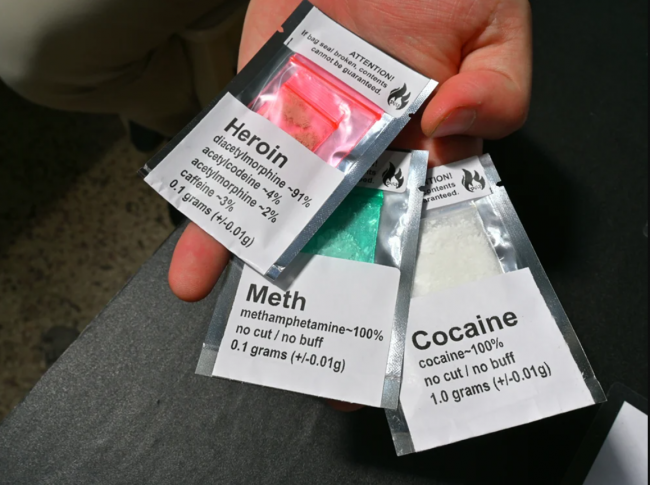
Members could come to DULF’s headquarters and pay for a tested, pure form of heroin, cocaine or methamphetamine. There was a limit on how much members could buy in a week.
DULF was able to buy these drugs thanks to private donations and sold the drugs at cost, meaning it did not make a profit from sales and the drugs were not a risk for resale, because they had been bought and sold at the same cost as street drugs.
When setting up DULF’s compassion club, co-founders Eris Nyx and Jeremy Kalicum tried to work with Health Canada, requesting a Section 56(1) exemption from the Controlled Drugs and Substances Act, which would have given them permission to source, test and sell these unregulated drugs.
Health Canada denied their request. DULF set up its compassion club anyway.
For a time, DULF operated with tacit support from police and provincial health authorities.
About a year into operations, Nyx and Kalicum were arrested by the Vancouver Police Department and each charged with three counts of trafficking under Section 5(2) of the Controlled Drugs and Substances Act.
On Nov. 7 the pair were found guilty of possession for the purpose of trafficking by Justice Murray.
Murray is now hearing the judicial review of the case.
DULF’s lawyers are arguing that shutting down the compassion club violated members’ Charter rights by putting them at risk of overdose and death from the unregulated street supply.
DULF’s legal team were able to show the court how challenging it can be to get a straight answer from Health Canada about working with the agency to seek exemptions and changes to drug policy.
The next trial dates are booked for late March and July.
[Top photo: On Monday, DULF’s legal team questioned a Health Canada witness on the agency’s approach to safer supply. Photo for The Tyee by Michelle Gamage.]