Articles Menu
Jan. 2, 2026
Fewer than 60,000 people — the richest 0.001% — now control three times more wealth than half of humanity combined.
That is our world’s balance sheet: a planet of over eight billion people ruled, in practice, by a rounding error.
In the World Inequality Report 2026, whose foreword was written by PI Council Member Jayati Ghosh, researchers show that the world’s top 10% now take more income than the other 90% combined, while the poorest half receive less than 10% of global income. Wealth is tighter still: the top 10% own three-quarters of everything, while the bottom half holds just 2%.
Some children are born into a world of libraries, broadband, clinics, and clean water; others are born into a world of debt, plunder, and permanent emergency. Average education spending per child in Sub-Saharan Africa is around €200 (PPP) — compared to €7,400 in Europe and €9,000 in North America and Oceania — a forty-fold gap that reproduces hierarchies forged through colonialism and genocide and sustained by imperialism today.
Apartheid is global: a system organised around who owns, who lends, who takes — and who decides who lives.
No technocratic fix will rebalance an economy structured this way. It will only change through struggle.
And when people demand bread, land, dignity, sovereignty, the security apparatus of extreme wealth answers swiftly: batons, prisons, sanctions, border walls, and war.
Scarcity for the many requires violence. Supply chains are guarded, migrants criminalised, workers disciplined, and whole regions turned into sacrifice zones. Global apartheid travels with an armed escort.
Our world — with extreme wealth, extreme violence, and extreme heat — is hardening by the day.
Yet the story does not end there. Across the world, people continue to prove that deprivation is political — and reversible.
Kerala, an Indian state with modest income levels, has eliminated extreme poverty through sustained public investment in health and education, targeted guarantees, and local democratic planning. China has lifted 800 million people out of poverty in two generations — the largest poverty reduction in human history. The results are written on bodies as well as balance sheets: children are taller, healthier, and living longer lives.
These victories show what organised public power can do. The powerful insist this order is permanent. The evidence says otherwise. Inequality is produced by policy and power; it can be reduced by policy and power. That is the task before us.
2026 has begun at a disorientating pace. History is moving at a pace. The crises are converging. The Progressive International exists to help assemble the forces capable of meeting this moment: linking struggles for wages to those against debt; land to climate justice; public services to public ownership; national liberation to an internationalist strategy.
Global apartheid will not soften on its own. It will either be dismantled — or deepen, militarise, and destroy.
To bend the arc of rapidly moving history towards justice, there is no shortcut. We must organise across borders. We build institutions that outlast repression. We defend one another. We forge the counter-power needed to defeat the Reactionary International and build a new order.
The world we need will not be granted. We will have to seize it.
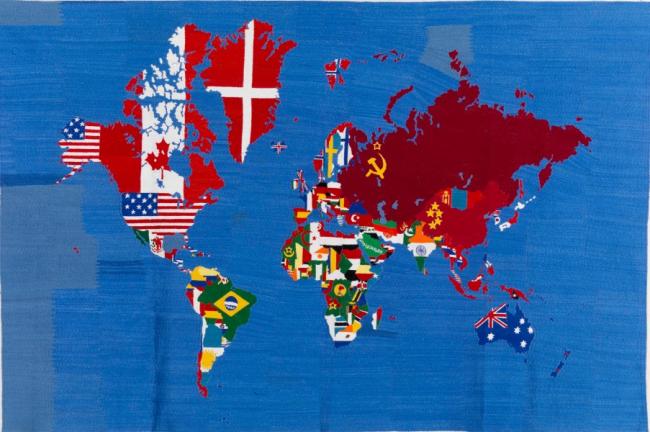
[Top: Mappa, 1979 - 1983 Alighiero Boetti]