Articles Menu
Jun. 29, 2026
When the French are banning booze, you know things are really getting extreme. It is only June, but Europe is suffering through its second major heat wave in two months, and this one is shattering records by astonishing margins.
It’s the most severe heat wave ever recorded on the continent — temperatures and humidity that are only possible because of fossil-fuelled climate change, according to a scientific analysis released on Friday. There are red alerts in countries as varied as Britain and Italy, Switzerland and Spain. France has received the brunt of the heat dome so far, repeatedly logging its hottest days ever, beating records set the day before. The fact that authorities have banned alcohol in public spaces is hardly the most devastating human impact, but it certainly demonstrates just how worried officials are.
And for good reason: Heat may be a silent killer, but it is vicious. One estimate found that more than 62,000 Europeans died from heat-related deaths in 2024, the planet’s hottest year so far. “Over just the past 4 years, heat has claimed more than 200,000 lives across the EU,” said Hans Kluge, the World Health Organization’s regional director, in a statement earlier this month.
The truly unsettling thing isn't that Europe is enduring record heat. It's that these are just the early stages of climate change. Every tonne of carbon pollution we add today makes tomorrow's heatwaves more likely, more intense and more deadly.
Scientific studies have found the vast majority of these premature deaths — as much as 68 per cent — are attributable to higher temperatures caused by fossil-fuelled climate change. In other words, climate change is already tripling the death toll.
The intensity of the current heat wave is astounding meteorologists. The temperatures in France beat the all-time record for Florida, which is 20 degrees of latitude closer to the equator. “This type of event would be almost impossible without climate change,” wrote Jeff Berardelli, a prominent Florida meteorologist. “Historically speaking it’s likely greater than a 1,000 year event, but in today’s climate it’s becoming just another summer.
 ”
”
The scorching temperatures have prompted some sheepish backpedalling over climate hushing and the drop in media coverage. Le Monde’s editorial page slammed “politicians [who] still fail to treat the fight against global warming as an absolute priority.” The editorial concludes: “Nothing will be solved with one-off measures. The fight against global warming must be seen as a new paradigm … All future public policies must take climate change and its consequences into account. The issue must be made central to the 2027 presidential election campaign.”
Heat deaths, overloaded hospitals, overwhelmed emergency crews and melting rail lines understandably receive the bulk of our attention, but let’s spare some compassion for non-human beings. You might remember that when the early season heat dome hit the Pacific Northwest, over one billion intertidal animals are thought to have been broiled alive. By mid-week, the extreme heat in France had already killed hundreds of thousands of birds on poultry farms.
The number of dead animals has completely overwhelmed the system, and farmers are being left to spread sawdust over piles of carcasses. One dairy farmer in western France described his cows desperately clustering under ventilation fans in his barn. “They're standing there with their mouths wide open, just trying to find air," he told Reuters. "It's very difficult, physically for people and for the animals."
Today’s heatwaves are bad enough, but far too few people realize that these are still the early days and there’s much worse to come. It will keep getting hotter and hotter as long as we keep spewing climate pollution and piling it up in the atmosphere. Remarkably, only 58 per cent of Canadians expect extreme weather to become more common. That’s quite an achievement by the fossil fuel lobby considering physics and chemistry are unequivocal and scientists have been absolutely clear on this point for decades: heat waves will keep getting more intense, at least until we cut greenhouse gas pollution down to net-zero.
There’s a morbid saying in climate circles that it may be hot but it’s likely the coolest summer of the rest of our lives. Looking at those weather maps from 2015 and today, that line is clearly not hyperbolic. What will things be like in 20 or 30 years? As climate scientists like Johan Rockström phrase it: “Remember. This is just the beginning. It will get worse, before potentially getting better. To return from overshoot, global emissions must decline at least 5 per cent per year.”
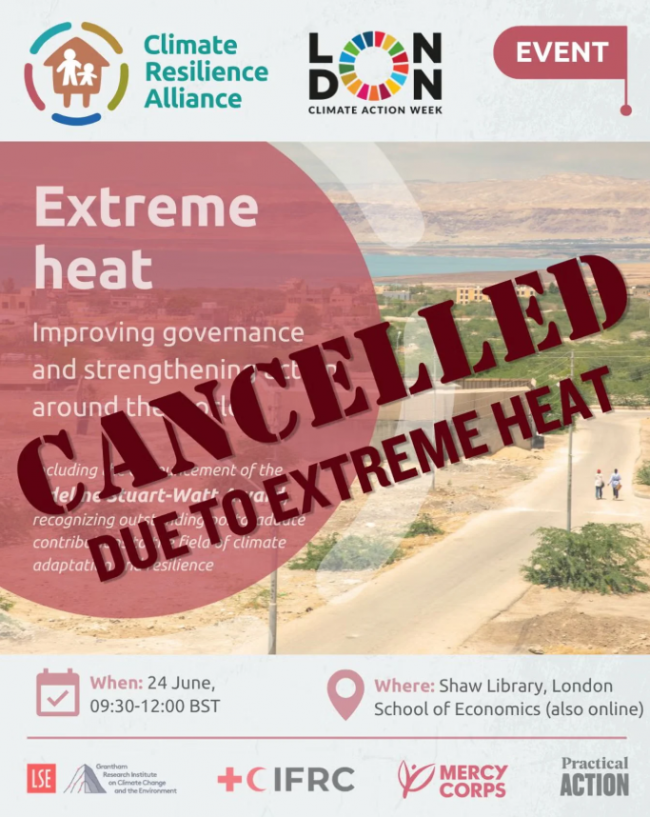
Needless to say, we are not cutting carbon pollution at anything like 5 per cent per year. Certain countries are more intent on fast-tracking fossil fuels than replacing them. And even adaptation is lagging far behind the pace of change. One of the most bitter ironies of the European heat wave took place in London where a conference by the Zurich Climate Resilience Alliance about adapting to extreme heat had to be cancelled… due to extreme heat.
The timing of the heat wave was slightly more propitious for the UK government’s debate over its legislated carbon budget. Parliamentarians sweltered as they debated the measure during an “Extreme High Temperature Warning” while thousands of schools closed down and thermometers broke monthly records across Britain. The legislation passed decisively, 332 votes to 94.
Even the record heat was not enough to sway those 94 votes. Conservative and Reform MPs voted nay, underscoring the Trumpian shift on the UK’s right wing. All previous carbon budgets had passed unanimously, half of them under Conservative governments.
But the carbon budget did pass and the UK has now legally enshrined an 87 per cent cut in climate pollution by 2040. More impressive still, the ingeniously-designed legislation sets 5-year carbon budgets well into the future. The targets and plans currently in force were set by previous Parliaments — this week, parliamentarians were adopting the seventh budget, setting pollution limits for the 2038-2042 period. The result is that the UK has already cut its greenhouse gas emissions by 54 per cent (compared to 1990 levels). It is the first big country to cut its carbon footprint by half.
Even though Europe has suffered several severe heat waves and shocking mortality rates in recent years, there is still something surprising and counterintuitive going on. Even within Europe, people and governments have been slow to install air conditioning, change building standards and retrofit homes. In France it’s actually the far-right under Marine Le Pen
that has latched onto cooling as a political issue, while the greens and leftist parties are only begrudgingly coming around. When we think about deadly heat waves, we tend to think about Lahore or Delhi, not Paris or Berlin.
But Europe is actually the fastest-warming continent in the world. It is heating at twice the global average and is already 2.4 C hotter than pre-industrial levels. The only region warming faster is the Arctic. There are several reasons, some of them surprising. For example, strict air quality regulations — aerosol pollutants had unintentionally been shading Europe and reducing the amount of solar radiation reaching the ground. The solution, of course, isn't dirtier air. It’s faster cutting of greenhouse gas emissions so the warming effect of carbon dioxide is reduced as well.
The most ominous connection to the recent heat is the most counterintuitive of all. When you look at the maps peppered with temperature records, there’s a peculiar blue stain a few hundred kilometres west into the North Atlantic, interrupting all the angry red dots. South of Greenland and stretching toward Ireland is the only place on Earth that has stubbornly resisted global warming, actively cooling while the rest of the world’s oceans break heat records. Scientists have a technical term for it: the “cold blob.”
It is one of climate change's great visual paradoxes: a cold patch in a warming world. And perhaps one of its most enigmatic warnings.
As Greenland’s ice melts and the Arctic warms several times faster than the global average, staggering quantities of fresh water pour into the North Atlantic. That fresh water is lighter than salty seawater and interrupts the great conveyor belt of ocean circulation that has, for millennia, spread tropical warmth northward.
You might already know that the Atlantic Meridional Overturning Circulation is slowing down, which could lead to harsh winter cold in Northern Europe. Iceland recently declared the potential AMOC collapse to be a national security threat. But several studies have also linked the slowing of the Atlantic currents and “cold blob” to increased heat in summer.
The blob disrupts and splits the jet stream, triggering extreme “omega blocks” — giant atmospheric traffic jams that cause heat domes to stall and intensify across large regions, which is precisely what is happening right now.
Scientists are still debating just how much the slowing Atlantic currents and “cold blob” are contributing to heat waves across the continent, but they are absolutely clear on the fundamental culprit. Europe’s worst heat wave so far is “brought to you by fossil fuels,” said Friederike Otto, a professor at Imperial College London.
“Scientists like me are beginning to sound like a broken record, reacting year after year to heat extremes that climb ever higher,” she said. “Yes this is climate change, yes it’s us, yes we have the solutions, no we’re not implementing them fast enough. It’s really now a question of what kind of future we want for ourselves, and whether we’re willing to do what it takes to secure it.”
[Top image: poster - London conference by the Zurich Climate Resilience Alliance June 24/26 - cancelled due to extreme heat.]