Articles Menu
Apr. 8, 2026
On recent trips to the Northwest Territories and Norway, Prime Minister Mark Carney has made major announcements that will militarize and mine the Arctic. He has outlined a $40 billion plan of expansive armed force and extractive capitalism in the mineral-rich region. However, Carney’s costly, carbon-intensive plan will degrade the oceanic ecosystem, accelerate climate breakdown, and increase conflict. He has also ignored repeated appeals to make the Arctic a zone of peace and cooperation.
In Yellowknife, at the press conference in the Department of National Defence’s Transport Squadron, Carney explained that Canada will “get more boots on the ground.” The federal government will build new forward operating bases in Yellowknife, Inuvik, and Iqaluit, two new operational support hubs in Whitehorse and Resolute, and two new operational support nodes at Cambridge Bay and Rankin Inlet, and will upgrade the operating base at 5 Wing Goose Bay in Labrador.
As well, the Carney government will invest $420 million to sustain a year-round permanent presence and operational capacity of the Canadian Armed Forces (CAF) across the Arctic. Airfields, hangars, and fuel and logistics systems will be modernized for the new fighter jet fleet and military equipment will be pre-positioned for rapid operations.
Canada’s northern plan and NATO’s Arctic Sentry are turning the region into a new battleground and impeding Indigenous people’s persistent efforts to preserve their homeland for peace and sustainable development.
By contrast, the government announced a miserly $228 million in new investments to provide Inuit communities with health care, food security, and post-secondary education. Despite promises of dual-use infrastructure to meet the needs of Inuit communities, the clear priority is to bolster the presence of the North Atlantic Treaty Organization (NATO), the U.S.-led military alliance. Defence Minister McGuinty confirmed that Canada’s Arctic plan will prioritize NATO’s deterrence and defence in the northern flank.
To create the Arctic Economic and Security Corridor, the federal government will also construct new highways and ports for moving military equipment up north and extracting critical minerals out of the territories. New hydropower systems will be installed to power the bases and the mines. As NATO detailed, critical minerals are needed for weapons production, which the federal government is ramping up. Canada is a top supplier to the U.S. defense sector of these natural resources that are mined in the north.
From Yellowknife, Carney and McGuinty went to Bardufoss, a site in Norway’s Arctic, to observe NATO’s large-scale military exercise Cold Response. The 10-day exercise was a wargame conducted to enhance the allies’ readiness and interoperability in the high north and to practice an Article 5 response against Russia and China.

Canada sent a team of soldiers and special forces to participate in the exercise alongside over 30,000 personnel from eleven allied nations including the United States. The exercise was part of NATO’s new, multi-domain Arctic Sentry program to scale up and strengthen the alliance’s intelligence, surveillance, and reconnaissance activities in the region and to consolidate the NATO Arctic states under one command.
Fossil-fuel powered combat helicopters, armoured vehicles, snowmobiles, and missile launchers were heavily used in NATO training with significant adverse impacts on the atmosphere and land. The exercise included warships and submarine warfare with harm to the sea. Yet, the climate and environmental impacts of NATO’s exercises and installations in the Arctic are overlooked by the Canadian government and allies.
At the subsequent Canada-Nordic Summit in Oslo, Carney met with the leaders of Denmark, Finland, Iceland, Norway, and Sweden. They issued a joint statement “to bolster the Alliance’s presence, deterrence and defence in the Arctic.” During the press conference, the Prime Minister of Finland asserted “We need to have a strong NATO in the Arctic.”
Carney explained that the “the biggest security threat, physical security threat in the Arctic, is Russia.” The Norwegian Prime Minister concurred that “Russia is the defining threat” and added “On the longer horizon is China and we have to prepare for that.” The leaders ignored the alarming and rising threat of climate change in the Arctic with the drastic loss of ice mass and sea level rise. More military bases and wargames will compound this climate and environmental stress.
Worse still, Carney and the Nordic leaders did not discuss any diplomatic measures to reduce tensions or emissions to protect the Arctic. Canada’s northern plan and NATO’s Arctic Sentry are turning the region into a new battleground and impeding Indigenous people’s persistent efforts to preserve their homeland for peace and sustainable development.
To avert catastrophic global warming and war, the Arctic must be demilitarized and made a zone of peace and cooperation.
In 2022, the Inuit Circumpolar Council (ICC) that represents 180,000 Inuit and Yupik peoples in Canada, U.S., Greenland/Denmark and Russia passed the Ilulissat Declaration that affirmed “the Arctic shall continue forever to be used exclusively for peaceful and environmentally safe purposes, and shall not become the scene or object of human conflict or discord.”
When she was President of the ICC four decades ago, Canada’s Governor General Mary Simon advocated for the Arctic to be a zone of peace and cooperation. In 1986, Simon led a delegation of Canadian, Alaskan, and Greenland Inuit to the Soviet Union and met the Chukchi people in the Arctic. Later, Simon was instrumental in establishing the Arctic Council, the intergovernmental forum for cooperation among the Arctic nations and Indigenous peoples.
This past February, in her speech at the Arctic Tides conference in Tromsø, Norway, the Governor General recalled how “Indigenous peoples have long travelled and learned from one another with respect, curiosity and a commitment to peace.” She highlighted the importance of cooperation, resolving conflict peacefully, and reconciliation.
At the same time, the ICC released another statement “A Changing World Order Requires Indigenous Peoples to Stand Firm,” which re-emphasized that “The Arctic must remain a zone of peace—a region of cooperation through diplomacy.”
Yet, the NATO allies’ militarization of the Arctic disregards and undermines the many calls for circumpolar cooperation. It also poses a grave security threat to Russia. Russia possesses over half of the Arctic coastline spanning 24,150 kilometres. On February 11, Foreign Minister Sergei Lavrov confirmed to the State Duma of the Russian Federation that Russia’s “principled position is that the Arctic should remain a zone of peace and cooperation.”
Canada and the Nordic countries must heed these appeals for peace to responsibly steward the shared oceanic ecosystem. They must renew diplomacy with Russia and reinvigorate the Arctic Council to deal with the climate and environmental crises in the polar region. They must also recommit to the United Nations’ Convention on the Law of the Sea as the platform to resolve challenges in the Arctic Ocean through negotiations and international law not through NATO. To avert catastrophic global warming and war, the Arctic must be demilitarized and made a zone of peace and cooperation.
Tamara Lorincz is a PhD graduate, Balsillie School of International Affairs, Wilfrid Laurier University, and a member of the Canadian Voice of Women for Peace and the Women’s International League for Peace and Freedom-Canada.
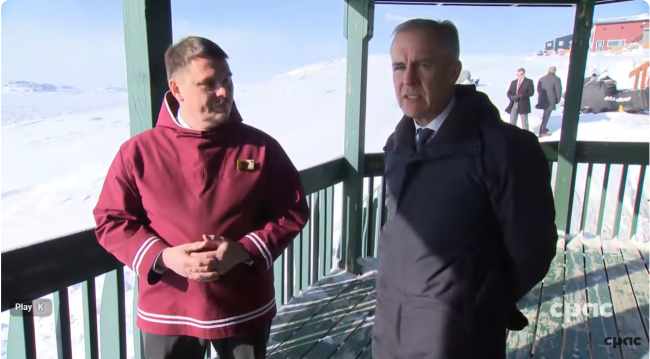
[Top photo: Screen shot Prime Minister Carney meets Nunavut Premier P.J. Akeeagok in Iqaluit, Nunavut, last month.]