Articles Menu
Jan. 5, 2026
The Bloom Lake iron mine is expanding. The Quebec mine, which started in 2018, has plans to more than double annual production next year. The estimated 572 million cubic metres (more than nine million shipping containers) of tailings waste created by this mine will end up in eight lakes and 37 rivers, where it will remain forever.
Bloom Lake is but one of many mines in Canada that has either received approval to use natural bodies of water such as lakes as tailings impoundment areas — basically, permanent storage for mining waste — or is requesting authorization to do so. It is an object lesson in how mines are granted permission to destroy habitat.
Using lakes, rivers and wetlands in this fashion is equivalent to landfilling. They will be ruined forever, require perpetual environmental monitoring and potentially spread pollution. They’ll no longer be available for fishing or recreation, or as sources of clean water. And Canada’s new push for mineral exploitation and the One Canadian Economy Act (C-5) has some worried that even more approvals are on the horizon.
The Bloom Lake mine is 13 kilometres north of Fermont, QC, and on Innu Takuaikan Uashat Mak Mani-Utenam First Nation land. André Michel, director of the nation’s Office of the Protection of Territorial Rights — as well as a biologist — says they would like to avoid destroying lakes and wetlands. But they are also surrounded by water.
Not everyone in the community supports these projects, he says, but even with strong opposition the Nation does not have the right to veto, says Michel.
“Certainly, we don’t want that there will be development ideally, but is that realistic?” he asks.
Other communities may well be asking the same question. Upcoming mining projects that have proposed reclassifying lakes as tailings impoundment areas include the Shaakichiuwaanaan lithium mine, the iron ore and vanadium Mont Sorcier mine and the Troilus gold mine, all in Quebec.
Using lakes, rivers and wetlands for tailings is equivalent to landfilling. They will require perpetual environmental monitoring and potentially spread pollution. They’ll no longer be available for fishing or recreation, or as sources of clean water. Blue Sky
Information: The dark side of the moon
The Shaakichiuwaanaan lithium mine is owned by PMET Resources and will possibly be one of the biggest lithium mines in the world. The project is on Cree land and is being planned with the Nation.
Adamie Delisle-Alaku, vice president of environment at the Makivvik Corporation, which has commented on the draft Tailored Impact Statement Guidelines for the Shaakichiuwaanaan Mining Project, says northern communities are concerned about Bill C-5’s potential environmental impacts. “It’s worrisome for Indigenous people and Inuit in the north because of our fragile ecosystem,” he says. “The impacts are greater up here.”
Delsile-Alaku calls mining waste “the dark side of the moon for mining” that people don’t talk about. “They talk about riches and minerals dug from under our feet and shipped elsewhere,” he says. “Guess what stays unearthed in our backyard and our territories? It’s the tailings.”
And, in fact, C-5 does allow some projects to be exempt from environmental regulations, like the Metal and Diamond Mining Effluent Regulations, to fast-track approvals. But Delisle-Alaku, who worked in the mining industry for 12 years, says communities are already frustrated by the way environmental impact studies are done. “It’s very worrisome at multiple levels that everything seems to be biased towards the mining industry,” he says.
Environment Canada responded to questions about this process in an email that said, in part, “Canada recognizes that Tailing Impoundment Areas (TIAs) should be avoided if possible. Canada’s approach to TIAs is based on the expectation that natural water bodies frequented by fish shall be avoided to the extent practicable for the long-term disposal of mine waste.”
People who live near these projects have submitted comments that describe their fears of loss of water and access to lakes and rivers, impacts on wildlife, and possible pollution.
Canada is an outlier in this regard. We have a lot of lakes, and many of Canada’s mines are in isolated places with few inhabitants. But lakes don’t exist in isolation. “For the majority of lakes in Canada, they're connected through waterways to each other and downstream effects,” says Ellen Petticrew, a geology professor at the University of Northern British Columbia.
Lakes, rivers and wetlands may be reclassified as tailings impoundment areas but they’re still permeable and mining pollution can still travel.
“Lakes are quite complex in their physical dynamics and behavior. They're not just this big bowl or bucket that is not connected to the environment,” says Philip Owens, ecologist, also at the University of Northern British Columbia, who adds that cleaning up water post-mining is difficult (if not impossible) and expensive. Petticrew and Owens have both done extensive research on the Mount Polley tailings dam disaster.
What we call “tailings” can be a number of things: waste rock or water, or the chemicals used to get metals out of the rocks. They contaminate water, food webs and air, disrupt organisms’ abilities to feed, hunt and migrate, and can kill them off entirely. And then there’s Acid Mine Drainage: when mine waste comes into contact with oxygen, it can discharge acid and metals into the environment. For traditional owners and others, hunting and fishing can be off limits forever.
“I can't see that [using lakes] is a good idea under almost any circumstance because you are changing the system potentially irreversibly,” says Owens.
But even calculating the total number of lakes and other bodies of water that have historically used or are being used as tailings areas isn’t easy. That information is in the individual applications and gazettes for each project.
When the regulations governing mine waste were updated in the 1990s, some of those involved were in for a surprise.
The 1977 Metal Mining Liquid Effluent Regulations were prompted by the mining industry, which wanted more specific rules, says MiningWatch’s Catherine Coumans. “Essentially, the mining industry [was] saying, ‘we want to dump effluent into water bodies, and we just want to know where's the line’,” she says.
Coumans was part of that seven-year-long process. Everything was reviewed, she says, but allowing tailings to be dumped into lakes was not discussed — so she and her colleagues were surprised by the last-minute addition of Schedule 2. "Anything put on Schedule 2 is a tailings impoundment area," Coumans explains, and it was justified by the need to grandfather in existing tailings dumps. They were assured that using lakes to dump waste would not become a regular occurrence. The mining companies, they were told, would have to go through an intensive regulatory process every time.
The regulations came into force at the end of 2002 and by 2005 there was a list of companies wanting to use lakes, says Coumans. “From then on, it was downhill,” Coumans says. “It was basically mining companies looking at the nearest lake and saying, ‘That would make a great tailings entailment area’.”
A surprising update
When the regulations governing mine waste were updated in the 1990s, some of those involved were in for a surprise.
The 1977 Metal Mining Liquid Effluent Regulations were prompted by the mining industry, which wanted more specific rules, says MiningWatch’s Catherine Coumans. “Essentially, the mining industry [was] saying, ‘we want to dump effluent into water bodies, and we just want to know where's the line’,” she says.
Coumans was part of that seven-year-long process. Everything was reviewed, she says, but allowing tailings to be dumped into lakes was not discussed — so she and her colleagues were surprised by the last-minute addition of Schedule 2. "Anything put on Schedule 2 is a tailings impoundment area," Coumans explains, and it was justified by the need to grandfather in existing tailings dumps. They were assured that using lakes to dump waste would not become a regular occurrence. The mining companies, they were told, would have to go through an intensive regulatory process every time.
The regulations came into force at the end of 2002 and by 2005 there was a list of companies wanting to use lakes, says Coumans. “From then on, it was downhill,” Coumans says. “It was basically mining companies looking at the nearest lake and saying, ‘That would make a great tailings entailment area’.”
Nonprofit Eau Secours is working on a document that will detail as many bodies of water that have been used for mine waste storage that it can find. So far, they have identified 135 bodies of water and 124 watercourses — and that’s only going back 20 years. The organization wanted to compile this information to support its demands that these practices stop, according to Émile Cloutier-Brassard, mining analyst with Eau Secours.
Eau Secours and others also want the federal government to provide public status reports on water bodies used as tailings areas, says Cloutier-Brassard. In response to a question as to why it doesn’t do this, Environment Canada wrote, “Mining is a shared jurisdiction in Canada. Each province and territory regulates mine closure, reclamation, and post-closure activities, and reporting on these activities falls within provincial or territorial jurisdiction.”
The reality is that it’s often up to local communities to deal with the environmental damage after mines are closed. “The [mining companies] walk away from it,” says Petticrew. “The governments are often left to monitor the ones that are really bad.”
There are federal, provincial and territorial rules governing tailings waste. In Quebec, a Bureau d'Audience Publique sur l'Environnement (BAPE) is a public consultation process for projects that will impact the environment. For Bloom Lake, the BAPE rejected mine owner Minerai de Fer Quebec’s proposal to dump tailings into lakes, yet the company did not provide alternatives as requested before the project was approved — so it will dump the tailings into the lakes, because, as the BAPE report notes, the federal government approved the use of lakes and has precedence, says Cloutier-Brassard.
“It's explicitly mentioned that all demands from mining companies to the federal government to use such lakes as dump sites have been accepted,” he says. “Which is pretty concerning, if you ask me.”
During the public hearings for the mine’s expansion, Ottawa-based NGO MiningWatch Canada suggested the company instead backfill existing pits, says MiningWatch’s Rodrigue Turgeon. “That’s the saddest part,” he says. “There was an option for the company.”
Minerai de Fer Quebec responded to questions about Lake Bloom with an email that read, in part, “[t]he option of backfilling the pit is not an option at Bloom Lake at this stage, as it would condemn access to the rest of the deposit, which is still very young. In 30 to 40 years’ time, when the pits have reached the end of their life and no longer have any mineral potential, this solution may be considered.”
And there’s the economic clue: Once a pit is backfilled, it’s no longer an asset. It can’t be mined further in the future or sold as a potential mine.
“Often mining companies want to maintain permanently that possibility of more exploitation in the same pit or to sell the pit to someone else,” says Steven Emerman, head of Malach Consulting.
A report commissioned by Eau Secours, MiningWatch, and Fondation Rivières and written by Emerman calculated a small difference between the cost of backfilling — $502 million — and a new lake tailings storage at $463 million. Minerai de Fer Quebec is a subsidiary of Australia’s Champion Iron, which reported a net revenue of $1.61 billion for 2025.
Quebec doesn’t require open pit backfill but does require a feasibility study that includes an explanation as to why backfilling isn’t possible. Minerai de Fer Quebec’s report did not say why backfilling isn’t technically feasible, says Emerman.
“In the case of Bloom Lake, I thought those were very deficient, those feasibility studies,” says Emerman. “I didn't see those as serious studies.”
Dumping tailings into a natural body of water is not considered a best practice, says Emerman. Best practices, apart from backfilling existing pits, including dry stacking, reusing waste and minimizing waste creation in the first place.
“There are other options like dry stacking, but the companies always say, ‘oh, too expensive’,” says Petticrew.
No other country uses natural bodies of water for tailings to the extent that Canada does. Globally, Emerman says, there’s a move from regulations to permits. In Indonesia, for example, while it’s technically legal to dump tailings in waters, the government has made it clear that they will not grant permits to do it, he says.
While the Bloom Lake mine expansion is a done deal, the Innu Takuaikan Uashat Mak Mani-Utenam First Nation is making the best of it. They’re hoping it will offer jobs and other economic benefits, in addition to annual $5 million in royalty payments. The Nation has asked that fish be relocated from the impacted waters and to hold a ceremony to ask the land for forgiveness for the destruction, as they’ve done with other mine projects in their area, says Michel.
“We asked for forgiveness ceremonies because the land was destroyed,” says Michel. “As we say, there's a fine line between economic benefits and reality.”
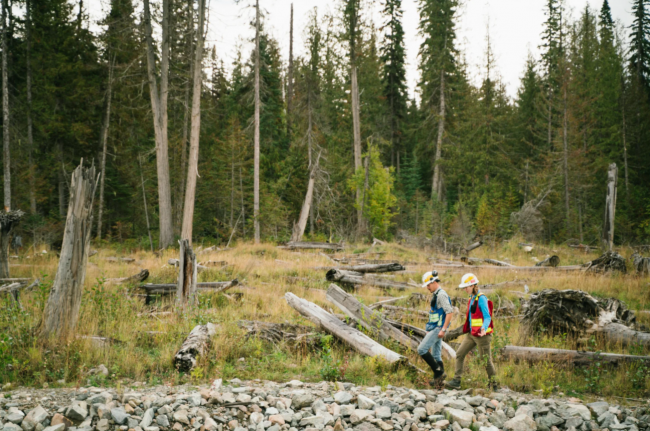
[Top photo: Remediation workers walk the shoreline of Hazeltine Creek near the town of Likely, BC in 2020. The creek was one of several bodies of water contaminated with tailings from the Mount Polley gold and copper mine when its tailings dam breached in 2014. File photo courtesy Mount Polley/Flickr]