Articles Menu
Dec. 5, 2025
Canadian lentils are exposing simmering tensions between Carney's European trade ambitions and his government's proposal to eliminate a key part of Canada's pesticide risk assessment, observers say.
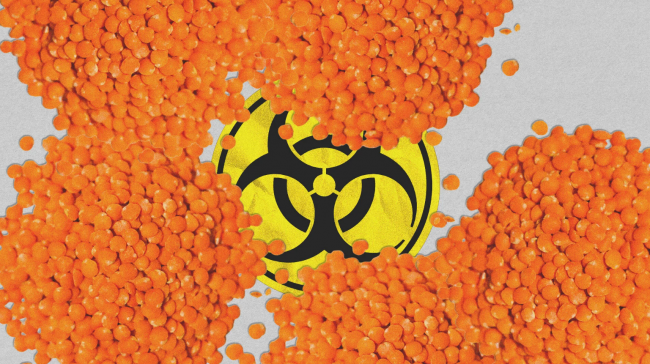
The frustrations arose after an investigation last month by France 5 network journalist Hugo Clément found some of the Canadian lentils sold in major grocery stores were contaminated with glyphosate and diquat pesticide residues. The amount of glyphosate residue found in the samples was below the EU's safety threshold — which was increased in 2012 under pressure from Canada during free trade negotiations.
The EU banned diquat in 2019 and heavily restricts glyphosate use because of health concerns. Canada allows the use of both and lets farmers spray their fields with the chemicals right before harvest to kill and dry out the plants — a practice the EU prohibits because it leaves too much pesticide residue on crops.
Clément's findings hit a nerve, with the journalist's Instagram teaser racking up hundreds of thousands of views on top of the network viewership. The French food safety agency even recalled two brands of Canadian lentils, citing pesticide risks.
Across the Atlantic, Quebec outlets from La Presse to Radio-Canada ran headlines about the findings, which have mostly gone unnoticed in English-language media despite the legumes’ importance to farmers across the Prairies.
A spokesperson for Agriculture and Agri-food Canada (AAFC) told Canada's National Observer that Canadian crops, including pulses, "consistently test well below EU MRLs (and those of other importing countries). The lentils tested within the documentary were shown to be within EU limits."
Pulse Canada, the industry's lobby group, told Canada's National Observer the show "confirms that Canadian lentils continue to meet the EU’s rigorous safety standards."
"If Europeans believe that they are at risk from consuming produce imported from Canada, that does not bode well for this government's ambitions to expand new trade partners," said Sean O'Shea, trade expert with Ecojustice. - BlueSky
Canada is France's largest lentil supplier. Canadian farmers grew about three million tonnes of lentils this year and European countries are one of their key markets, after countries such as India, Turkey and the UAE.
"If Europeans believe that they are at risk from consuming produce imported from Canada, that does not bode well for this government's ambitions to expand new trade partners," said Sean O'Shea, government and campaign specialist with Ecojustice.
The European outrage comes as the Carney government is proposing to implement a suite of new measures critics say will weaken Canada's pesticide rules. The changes, if implemented, will get rid of scheduled re-evaluations for Canadian pesticides and reduce how many companies need to regularly apply to keep their products on the market.
Environmental and health advocates slammed the proposals as a "very sneaky" way to significantly weaken Canada's pesticide rules and make decisions about which products can be used in Canada "entirely discretionary."
In an interview last month with The Western Producer, an agricultural industry paper, Pierre Petelle, the president and CEO of CropLife Canada, said the pesticide industry lobby group sees the government's proposal as "potentially significant."
A spokesperson for Canada's Pest Management Regulatory Agency (PMRA) told Canada's National Observer that the proposed changes will make regulatory decisions more efficient "while strengthening monitoring activities that support detection of issues related to the environment and human health."
Ottawa's proposal follows years of criticism that Canada's pesticide regulator is too cozy with pesticide producers. As far back as 2000, the parliamentary committee on the environment's inaugural report slammed the agency for being “captive of the pesticide industry.”
The trend has continued. An investigation last year by Canada's National Observer found the agency is predisposed to working with producers to keep pesticides in use, despite evidence the chemicals are causing harm.
O’Shea said that with increased attention in European markets toward pesticide contamination, there’s an increased risk from loosening the rules. "This is not time to deregulate and to roll back current protections," he said.
Laure Mabileau, the head of glyphosate campaigning and communications for Quebec environmental organization Vigilance OGM called the government's proposal to end routine pesticide re-evaluations "astounding" because it risked closing access to European markets.
Some federal officials have been raising similar concerns for years, according to a trove of internal Agriculture and Agri-Food Canada (AAFC) emails obtained by Canada's National Observer through an access to information request.
In a spring 2023 email thread, David Cox — at the time a policy analyst with AAFC — warned several of his colleagues that growing scientific concern could lead other countries to ban Canadian crops because of pesticide contamination.
Cox wrote that he was "concerned about risk and risk exposure to the Canadian agriculture industry" if countries start to impose stricter limits on glyphosate residue on imported crops. Without a plan to help farmers modify their practices and use less of the pesticide, "we may float into a crisis," he wrote.
The email thread shows his concerns were dismissed by colleagues because glyphosate is so pervasive in Canadian agriculture that restricting or banning it "would be disruptive, to put it mildly."
Lentils and other pulses in particular have a history of pesticide residue controversies. In 2021, Canada's pesticide regulator tried to increase the allowable pesticide residue limits on several crops, including pulses, after pressure from pesticide giant Bayer. Public condemnation forced the government to pause the increase and initiate a four-year reassessment of its approach to pesticide regulation.
"What needs to change is a mind shift at a federal level," O'Shea said. Where European countries regulate pesticides and other toxic chemicals based on the danger those pose to health or the environment, Canada's decisions are rooted in the risk they can pose if used according to federal rules — a similar approach to the US's.
That philosophical difference could hamstring Canada's ability to trade all sorts of products — from crops to cosmetics — beyond American markets, said Sabaa Khan, the David Suzuki Foundation's director-general for Quebec and Atlantic Canada.
"There's so much stuff that Canada still allows, in alignment with the US, that is completely banned in the EU," she said.
[Top:Illustration by National Observer/Ata Ojani]