Articles Menu
Jan. 19, 2026
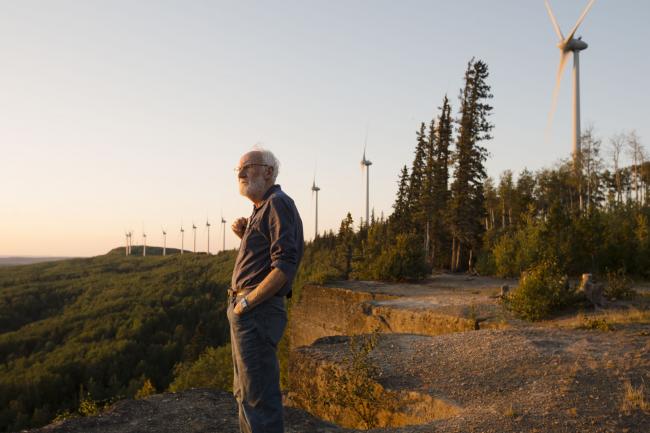
When the turbines began turning at Bear Mountain Wind Park in 2009, it became the first fully operational wind power project in B.C. The park’s 34 wind towers run along the crest of a rocky ridge just south of Dawson Creek, looking out over the flattening foothills of the Rocky Mountains. Together, the towers supply 102 megawatts of electricity to the provincial power grid, roughly enough to power 41,000 homes for a year.
The project marked a major milestone for the Peace Energy Cooperative, which spearheaded the development of the wind park. At that point, Don Pettit, the co-op’s executive director, was optimistic about the future of wind power and co-op energy projects in B.C.
“It was pretty good for our first go,” Pettit recalled. “It worked really well, so we assumed that we’d be able to do that in the future.”
But, despite Bear Mountain’s success and the expertise Peace Energy picked up while developing the project, things didn’t pan out that way. Big infrastructure projects are notoriously costly and there are restrictions on how much seed money co-ops — even investment co-ops like Peace Energy — can raise from their members. Peace Energy partnered with Aeolis Wind Power Corporation in the early stages of developing the project because the company had experience working with other co-ops.
When it came time to build, the co-op raised capital from its members and struck a partnership with AltaGas, an energy company that mostly builds oil and gas infrastructure, to help cover construction costs. Then, Peace Energy faced a big choice: whether to maintain an ownership stake in the project and shoulder a share of the park’s maintenance and operating costs, or sell.
“We decided to go with a royalty agreement instead,” Pettit said, adding that the deal provides the co-op with a stable, modest income stream that helps cover its operating costs.

Since selling its stake in Bear Mountain, Peace Energy has focused mostly on community-scale solar power projects, including helping the District of Hudson’s Hope set up the largest municipal solar project in the province in 2018. Located just upriver from the Site C dam in the heart of B.C.’s oil and gas country, Hudson’s Hope now generates much of the power for its municipal buildings — anywhere from 50 to 100 per cent — from solar. The district estimates its solar power project saves $74,000 per year on electricity costs.
But Pettit still thinks of Bear Mountain Wind Park as a “precedent-setting example” of how renewable power can be developed in B.C.
“And that’s the last time it ever happened,” he told The Narwhal.
There aren’t many energy co-ops in Canada. A recent study by researchers at Royal Roads University found 82 active energy co-ops across the country. Together, they own or co-own 214 renewable energy projects. By contrast, there were 847 energy co-ops operating in Germany in 2023 while the Netherlands is home to 713 active energy co-ops.

The gap between Canada and other countries is partly because not many provinces have policies that support small and localized energy generation. Instead, governments are used to working with big organizations that can invest big bucks into energy projects and infrastructure. It can be tough for small, community-oriented organizations to get a foothold in a system that favours larger, corporate entities.
In a statement, B.C.’s Ministry of Energy and Climate Solutions said the province supports the growth of B.C.’s co-operative renewable energy sector and acknowledged energy co-op projects “can increase the energy resilience of neighbourhoods and communities.”
But Pettit believes the government underestimates the value energy co-ops bring to the table.
“The co-operative movement in energy in B.C., it’s ignored,” he said. “There’s no sense of, do we want local people to own local energy resources? I think the answer to that question, provincially, is no, we don’t. If they did, they would be encouraging co-operative involvement.”
Co-operative businesses — referred to as co-ops for short — are owned and run by a group of people who share common goals. Profits are shared among co-op members and decisions are made democratically, with each member getting one vote. While traditional businesses typically prioritize producing profits that can be paid out to shareholders, co-ops often have a social focus and seek to fill a need that isn’t being well served by the traditional market.
In Canada, co-ops are more common in some sectors. You may have shopped at a food co-op, lived in co-op housing or used a credit union. But energy co-ops are fairly rare.
“Where co-ops work well is where there’s a strong, intimate user relationship,” Martin Boucher, dean of research at NorQuest College and president of Community Energy Cooperative Canada, said.
Most people probably don’t feel as connected to their local power grid as they do to their local food supply, their home or the daycare their children attend. Electricity isn’t exactly a warm, fuzzy subject, even if it is essential. In B.C., the energy sector is highly centralized and pretty much everything electricity-related flows through BC Hydro, the public power utility created in the 1960s.
BC Hydro is responsible for managing and maintaining most of B.C.’s power supply, from the massive hydro dams that generate electricity to the infrastructure that keeps the province humming.
“The logic of utilities, and rightly so, has been economies of scale,” Boucher said. BC Hydro and other Canadian power utilities have historically focused on building big electricity generation projects along with the infrastructure to deliver that power to customers, all while keeping electricity rates as low as possible.

B.C. is barrelling toward extensive electrification of its economy, including supplying power-hungry resource sector projects like mines and liquefied natural gas (LNG) facilities. Doing so will require a significant increase in the province’s power supply, one BC Hydro has not yet mapped out how to supply, according to its most recent resource plan. Boucher believes co-ops could help fill the gap.
“The kind of world we’re entering into is a high energy world with data centres, AI, electric vehicles, this sort of thing,” he said. “My baseline philosophy is energy diversification requires all hands on deck to really move this forward.”
Centralized electricity generation and distribution systems have served many communities well for decades, Boucher said, but they can be a barrier to co-operatively owned energy projects, which are often smaller scale with different goals than traditional energy companies.
“They’re very antithetical to that kind of business model,” he said.
Because the energy sector is so highly regulated, co-ops interested in energy projects are “completely at the mercy of policy,” Boucher added.
In Canada, it’s fairly easy to see where energy co-ops have been encouraged.
Provinces without a public power utility like BC Hydro tend to have more renewable energy co-ops. Ontario, for instance, is home to roughly 75 per cent of Canada’s renewable energy co-ops while Alberta, with its open access electricity market and a strong tradition of co-op businesses, also has a relatively high number.
“From the perspective of the electricity system, we might as well consider our provinces 10 different countries,” Boucher said.
“There’s more alignment between countries in Europe on electricity policy and sharing than there are between provinces in Canada.”
Despite their differences, most provinces provide pretty reliable access to affordable power so there has not been a lot of demand for alternative options, according to Julie MacArthur, an associate professor in Royal Roads University’s faculty of management whose work focuses on energy transitions and the political economy of energy projects.
“Energy systems in general are not super top of mind to most people in a developed country, until you have huge power outages or there’s some problem with it or it’s too expensive,” MacArthur said.
“I think there are a lot of activities co-ops could be contributing to that they’re not because they’re not recognized necessarily as legitimate actors in this space or there’s not a lot of policy attention on them,” she added. “But in every province, the need is going to be slightly different.”
With climate change boosting the intensity and frequency of natural disasters, co-op energy models could become more appealing to more people. On Galiano Island, the Salish Sea Renewable Energy Co-op was born out of residents’ desire to take concrete action on climate change and reduce their dependence on fossil fuels. Since 2015, the co-op has helped set up more than 110 solar power installations across B.C.’s Gulf Islands.
“We got sick and tired of just demonstrating and writing letters, and we actually wanted to do something,” Tom Mommsen, a founding member of the co-op, told The Narwhal.
“We give talks, we do initial assessments. We help people to go solar and then we hand it over to commercial installers and they do the rest.”
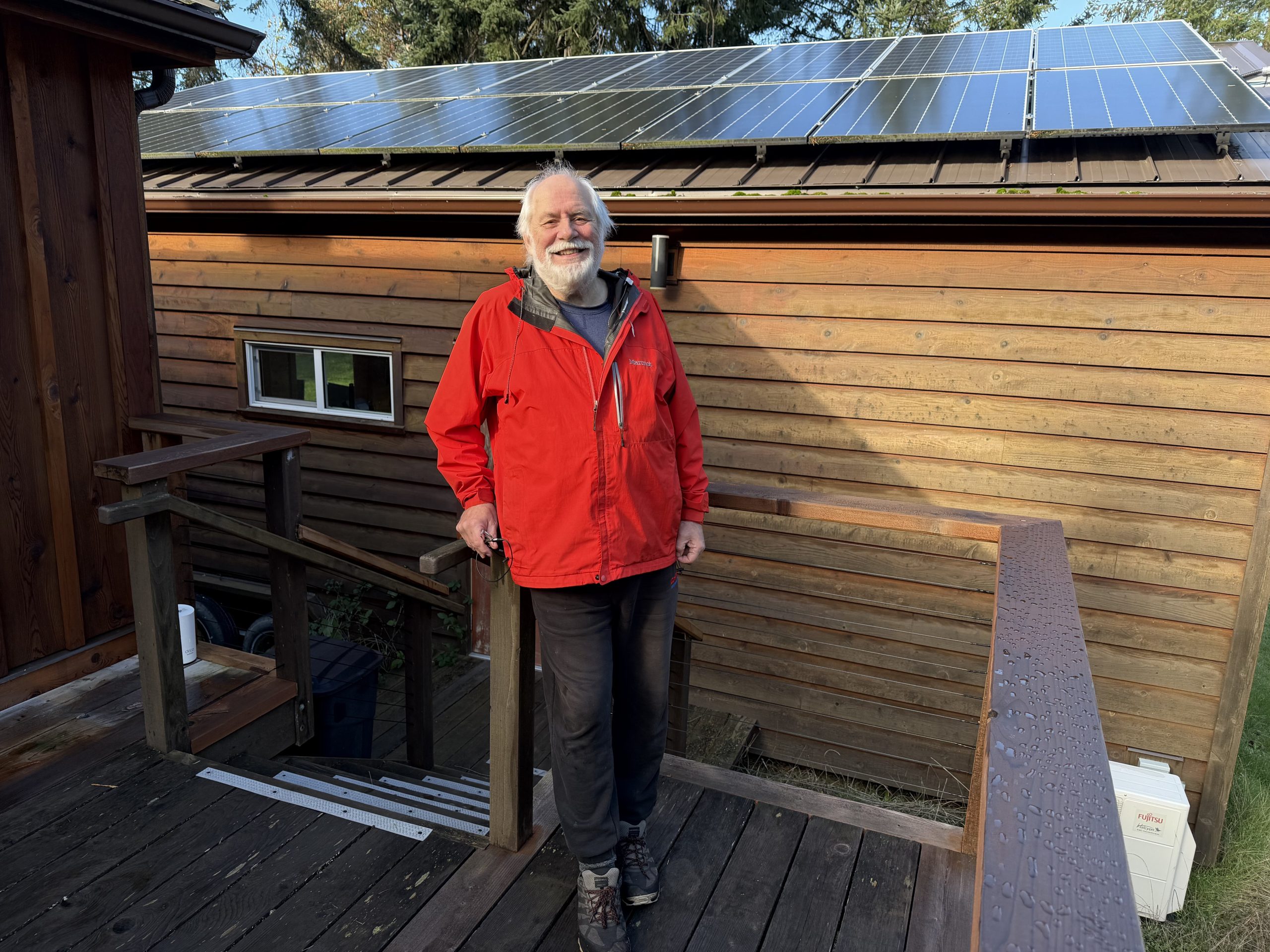
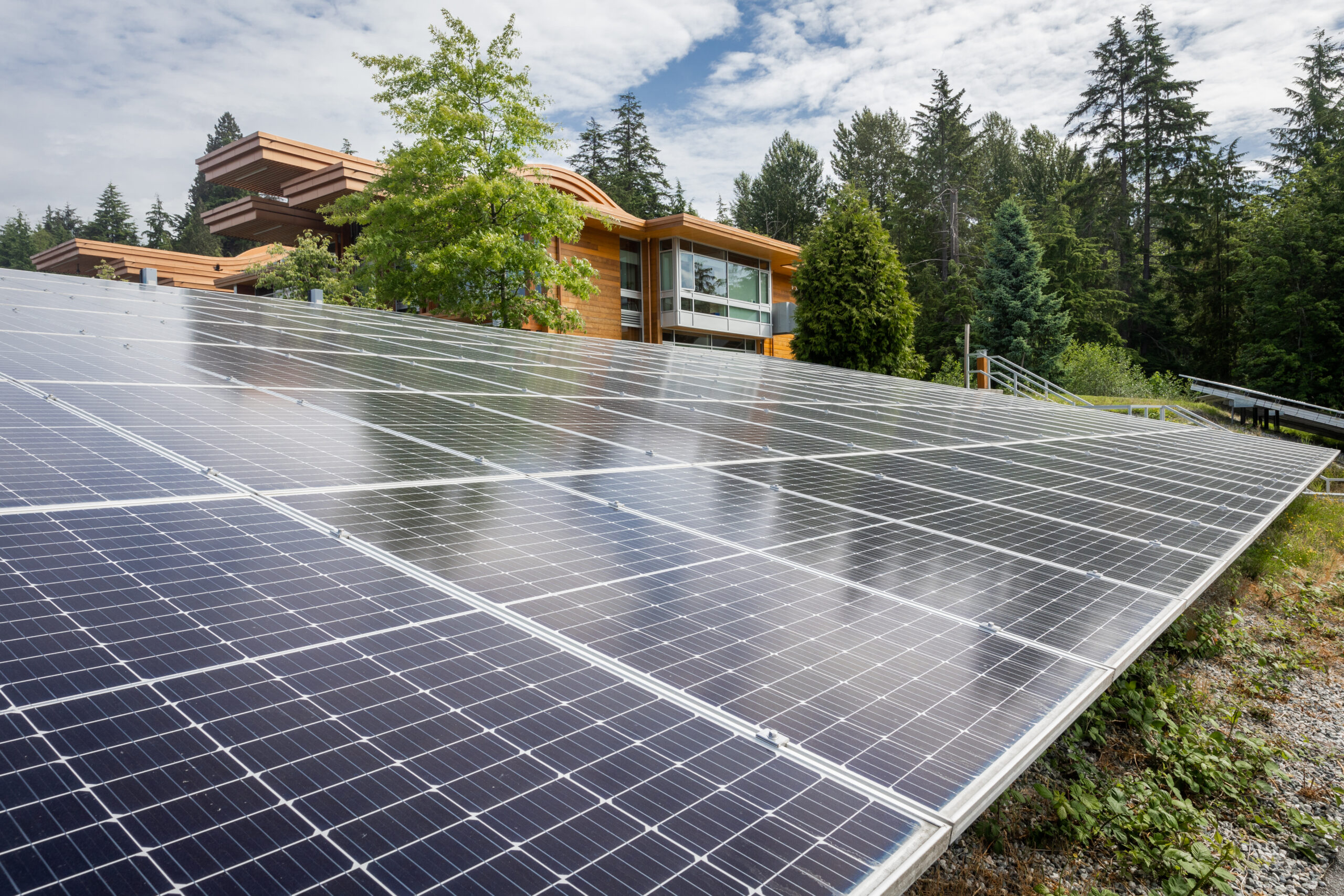
Solar power is by far the most popular form of energy for co-ops in Canada, accounting for 91 per cent of the renewable energy projects they operate.
Mommsen, a retired academic who still works with the University of Victoria’s School of Environmental Studies, spends a lot of time researching the latest solar energy policies and technologies so the co-op can share the information with community members.
Most people, Mommsen said, do not know much about the electricity that powers their homes and, in more and more cases, cars.
“Nobody understands what a kilowatt hour is,” he told The Narwhal. “Once these people have solar and they look at the solar production … they know very well what a kilowatt hour is. The best education is just to have solar in your backyard or on your roof.”
Support for solar can spread quickly, in Mommsen’s experience.
“Someone starts with solar and then a couple of years later, there will be five or six … neighbours with solar because they talk.”
Research bears out the knock-on effects community energy initiatives can have, MacArthur said. People may find it easier to trust the experiences of their friends and neighbours than the pitches made to them by government bureaucrats or private companies.
“If they get the information about it from their neighbour or when they’re chatting with someone at school, there’s that feeling of, ‘Okay, I trust that this is not because the person has an interest in getting money from me or having me pay them,’ ” she said.
“It makes a difference to energy system behaviours, a huge difference that is really undervalued and under-recognized when people are thinking about balancing massive systems.”
B.C. does offer rebates on solar panels and battery storage, but Mommsen wants to see the province do more to encourage community-owned energy projects, especially solar. In his opinion, provincial policymakers remain too focused on maintaining B.C.’s highly centralized electricity system when the future demands a distributed grid.
“The future of any grid under climate change has to be distributed,” Mommsen said. “What we need is a distributed system that is resilient under climate change and that helps the community. It empowers the communities and also it will help them understand energy.”

Boucher agrees. He also sees the current economic moment as an opportunity for co-ops as politicians look to boost homegrown businesses that pay dividends in their communities.
“Done well, this is a very powerful local economic development strategy and boy oh boy, does the timing seem right for local economic development in this country,” he said.
[Top photo: Peace Energy Cooperative executive director Don Pettit wishes co-ops could play a bigger role in B.C.’s energy sector. He believes policy changes could easily make that possible.]