Articles Menu
Jul. 21, 2026
It’s back. As dangerous wildfire smoke blanketed much of the northeast part of our continent, the conversation about our new climate change-driven normal returned with a depressingly predictable vengeance. So too did the loopy comments from Republican politicians in the United States, reflecting a fundamental misunderstanding of both climate science and geographic realities.
It is tempting, I’m sure, for some climate advocates to think that this will be the event — the long overdue moment where the costs of climate change become so obvious that they finally overwhelm our cynicism and obsessive focus on near-term economic realities. As the Toronto Star’s Adam Radwanski wrote, “last month, Abacus Data released public-opinion data suggesting that Canadians’ concern about climate change has risen (to 80 per cent of people at least somewhat concerned, up from 62 per cent in 2024) even as it has slid down their list of priorities. That suggests, the polling company noted, that it could become more politically salient if triggered by major events.”
Like most people in western Canada, though, I’ve seen this movie before. I’ve watched as destructive and destabilizing wildfires spread ash, smoke and misery across my city and province, and I’ve watched as the political conversation quickly moved past it once the near-term crisis was over. I’m not alone, and this isn't just an Alberta phenomenon. Trevor Melanson, the director of insights and communications at Clean Energy Canada (and, it should be said, my highly capable former deputy editor at Vancouver magazine), wrote on social media that “for all that BC has suffered in recent years, the data simply doesn't show a people more moved by the impacts of climate change. The Angus Reid Institute surveyed support for the BC-Alberta pipeline recently, and they also tested the most compelling reasons to oppose the pipeline. Climate change came in fourth.”
But, he noted, there was a clear silver lining in that data — and an obvious path forward. “There was a clear winner: Canada should be building renewable energy instead.” Or, as Prime Minister Mark Carney has hinted at in his own recent communications, Canada should walk the path blazed by Norway, a country that aggressively develops and exports fossil fuels while just as aggressively reducing its consumption of them at home. His government’s aggressive targets for electrification and its willingness to open our market up, however modestly, to Chinese EV imports are steps in that direction.
We need more than baby steps, though. Never mind, for the moment, the fact that Norway taxes its oil and gas industry far more aggressively than we would ever dare to consider in Canada, has meaningful public ownership of the companies that operate in it and then saves most of that revenue for the future. The window of opportunity for that sort of change closed when the National Energy Program was weakened and then eliminated by provincial and federal Conservative governments.
The window for more aggressive electrification of our economy, on the other hand, remains open. That doesn’t just mean increasing the production of electrons, which could theoretically be used for powering data centres just as easily as they could vehicles and homes. It means, and has to mean, both vastly increasing electricity’s share of our final energy use and vastly decreasing the volumes of oil and gas we consume in Canada. If we’re truly interested in expanding our energy sovereignty, as the prime minister and premiers have all claimed at various moments, that doesn’t mean substituting one source of oil for another. It means reducing our exposure to volatile global commodity markets over which we have almost no control and replacing it with domestically sourced electricity, as Norway has been busy doing for decades now.
That will require a far more robust federal commitment to technologies like heat pumps, solar panels and electric vehicles — adding up to at least as much financial support from Ottawa as it’s doling out to the oil and gas industry right now. The prime minister and his senior ministers, meanwhile, need to be talking about clean energy just as often and enthusiastically as they have been lately about oil and gas. As clean energy strategist Dan Woynillowicz noted on social media, the devil will be in the details around the federal government’s electricity strategy, one that’s still in the draft stage right now. “It's a big test of whether Prime Minister Carney's past clean energy and climate credentials hold, or have truly fallen victim to his Tragedy of the (Smoky) Horizon.”
It also presents another opportunity to deepen Canada’s ties with Europe — and diversify away from our reliance on the United States. The European Commission just announced the release of its “electrification action plan,” one that aims to make Europe the world’s first “electro-powered” continent. If met, it would double end-use electrification from 23 to 46 per cent by 2040. That would save the EU upwards of $415 billion per year in fossil fuel imports.
It’s ambitious — maybe too ambitious, according to Bloomberg New Energy Finance founder and electrification evangelist Michael Liebreich. But that, more than anything, is what’s most obviously missing in the Carney government’s approach to clean energy: ambition. So far, at least, it’s been concessions, strategic retreats and a conspicuous lack of rhetorical conviction all the way down.
Maybe, as I’ve argued, this is all by design. By refusing to create a target for Conservative counterattacks, the Carney government might be in the midst of implementing a more effective strategy than the Trudeau team and its noisier brand of advocacy. But if Carney really wants to turn Canada into the North American version of Norway — sans the massive sovereign wealth fund, of course — his government has to start laying down some bigger markers, whether that’s creating a national electricity grid, pouring real money into geothermal energy or investing more heavily in energy efficiency programs. If he doesn’t, the annual ritual around wildfires will be the least of our problems.
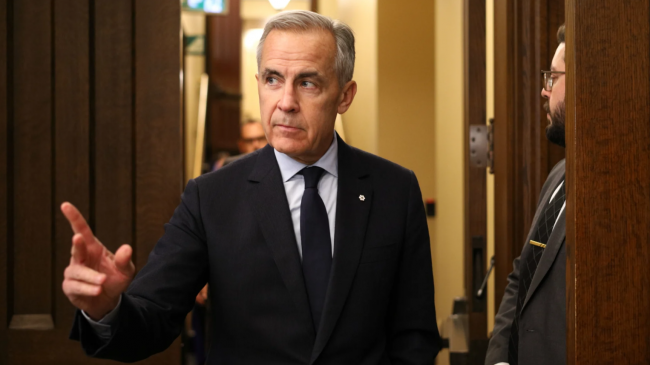
[Top photo: Mark Carney has spent much of the summer talking up the importance of fossil fuels. Now, with wildfire smoke covering large parts of eastern Canada, it might be time for him to do the same for the other side of the energy equation. File photo by: Natasha Bulowski / Canada's National Observer]