Articles Menu
May 16, 2026
|
To hear Alberta tell it, the deal is done and a new one million barrel per day pipeline to the West Coast is all but inevitable. Not so fast. A careful reading of Friday’s announcement from Premier Danielle Smith and Prime Minister Mark Carney suggests the champagne should remain on ice. This project still faces formidable political, commercial, legal, and market hurdles.. Friday’s event in Calgary — the heart of Canada’s oil and gas industry — unveiled the implementation agreement flowing from the November memorandum of understanding between Ottawa and Alberta. The sprawling document amounts to a provincial blueprint for Carney’s emerging energy and climate strategy. It touches everything from pipeline approvals and carbon pricing to electricity policy and carbon capture. In this essay, I’ll focus on the pipeline itself. The equally important issues of industrial carbon pricing, electrification, and federal-provincial climate policy deserve separate analysis. 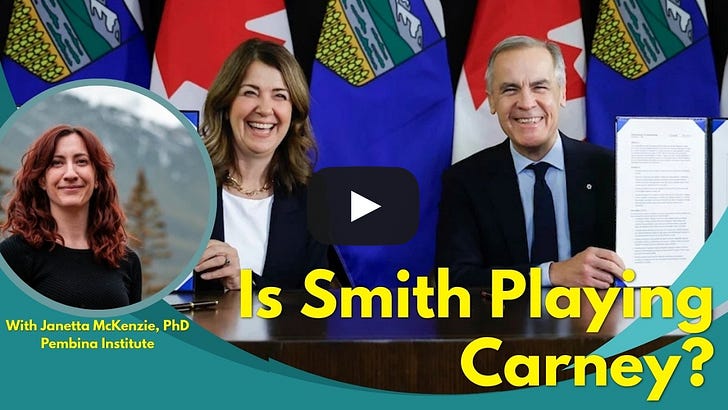
What the Implementation Agreement Actually SaysThe agreement does not approve a pipeline. Despite the celebratory rhetoric, relatively little has changed with respect to the actual project. Alberta must still submit a formal proposal to the federal Major Projects Office by July 1. Ottawa must then decide whether to designate it a “project of national interest” under the Building Canada Act by October 1. The federal government commits only to “best efforts” to provide a conditions document by Sept. 1, 2027. Only after all of that could construction begin. There is also still no private-sector proponent. That role effectively remains with Smith’s United Conservative Party government. Alberta assembled an advisory group that includes three pipeline companies, among them the federally owned Trans Mountain Corporation. But private companies continue to treat the project like kryptonite. Enbridge, in particular, has repeatedly signalled that it intends to prioritize investments in the United States for the foreseeable future. Both Carney and Smith have publicly insisted that the pipeline must ultimately be privately built and financed. So far, no company appears interested. That reluctance may not prove fatal. Ottawa under former prime minister Justin Trudeau ultimately built the Trans Mountain Expansion project after Kinder Morgan walked away in 2018. That precedent leaves open the possibility of another Crown corporation-led project. No government is openly discussing that option today, but it remains difficult to see how the project advances without some form of major public-sector involvement. Indigenous ownership is one area where governments appear fully aligned. The memorandum of understanding makes clear that Ottawa and Alberta are committed to backstopping Indigenous “co-ownership” of the pipeline through large public loan guarantee programs. Alberta plans to use the Alberta Indigenous Opportunities Corporation (AIOC), a Crown corporation created to help First Nations and Métis communities acquire equity stakes in major projects. Rather than lending directly, AIOC guarantees commercial loans backed by project revenues, solving a longstanding financing problem created by restrictions under the Indian Act. The current investment ceiling is $250 million, though Alberta would likely need to raise that significantly if Indigenous communities are to acquire meaningful ownership stakes in a multi-billion-dollar pipeline. Ottawa’s Canada Indigenous Loan Guarantee Corporation operates on a similar model. Created in 2024 with $5 billion in guarantee authority focused on energy and natural resource projects, the federal program was later expanded to $10 billion. Like Alberta’s program, it does not invest directly but instead guarantees loans used by Indigenous communities to purchase equity positions. The Controversial Pathways Project“Construction and financing of the world’s largest carbon capture, utilization, and storage (CCUS) project (Pathways) for the purpose of making Alberta oil among the lowest carbon intensity produced barrels of oil in the world.” — November MOU “Canada and Alberta also reaffirmed that construction of the oil pipeline project and construction of the Pathways Project are mutually dependent.” — May 15 implementation agreement The Pathways Project is central to the entire political bargain. The proposal would collect carbon dioxide emissions from oil sands facilities and transport them through a large pipeline system for permanent underground storage near Cold Lake. During Friday’s press conference, Carney described it as “the largest global initiative for carbon capture and storage.” Industry and governments have promoted the concept for years, but progress has been minimal. Large-scale CCS projects around the world have struggled to meet cost, performance, and deployment expectations. This has led to substantive concerns about whether the project will meaningfully reduce emissions at all. Under the November MOU, no Pathways project should mean no pipeline. The agreement explicitly states that approval and commencement of Phase 1 of Pathways is a precondition for pipeline construction. The governments and industry were supposed to finalize a trilateral MOU by April 1, but that deadline quietly passed without announcement. Negotiations appear to be continuing. Whether those negotiations succeed remains an open question. Industry has historically dragged out negotiations over emissions policy until governments increase subsidies or soften regulatory requirements. The stalled Pathways talks look suspiciously familiar. The first phase of Pathways is expected to lower oil sands emissions by roughly 16 megatonnes per year. Total oil sands emissions currently sit around 85 megatonnes annually. Expanding production by more than one million barrels per day to fill a new pipeline could easily overwhelm those reductions, leaving absolute emissions higher than they are today. The costs are also staggering. When Pathways was first proposed, the industry estimated decarbonization costs at roughly $75 billion, with governments expected to contribute approximately $50 billion. Inflation, supply-chain pressures, and future production growth would almost certainly drive those numbers much higher. Alberta has already committed billions through royalty credits and its Carbon Capture Incentive Program, which covers up to 12 per cent of eligible capital costs. Ottawa has layered on additional subsidies through investment tax credits covering up to 50 per cent of capture equipment costs and 37.5 per cent for transportation and storage infrastructure. On Friday, Carney also announced that Ottawa and Alberta would jointly issue 75 million tonnes worth of carbon contracts for difference to stabilize the carbon market and guarantee future carbon prices for emissions-reduction projects. Neither government provided a public estimate of the fiscal exposure associated with those guarantees. Without a trilateral Pathways agreement, the conditions laid out in the November MOU would technically not be met. Presumably, the pipeline could not proceed. But given the enormous political capital now invested by both Carney and Smith, it is difficult to imagine governments allowing the project to collapse over unresolved Pathways negotiations. In fact, industry voices are already floating another possibility: abandoning Pathways altogether and redirecting public subsidies toward pipeline construction itself. Moving the goalposts after securing political momentum is hardly unusual in the energy sector. Increasingly, the objective appears to be shifting as much infrastructure risk as possible onto taxpayers.
British Columbia Opposition Still Not ResolvedThe November MOU explicitly contemplated changing federal law to accommodate a new West Coast export route, including “if necessary through an appropriate adjustment to the Oil Tanker Moratorium Act.” That legislation currently bans large crude oil tankers from loading or unloading along British Columbia’s northern coast, effectively blocking any pipeline terminating near Prince Rupert. Despite his earlier vocal opposition, BC Premier David Eby sounded notably less confrontational in his response to Friday’s announcement, while still reaffirming support for the tanker ban. “Our government’s opposition to any repeal of the North Coast tanker ban has not changed,” Eby said. “British Columbia is a vital part of Canada. We must work together across federal-provincial lines to build this nation and to strengthen it.” If British Columbia ultimately refuses to support changes to the tanker moratorium legislation, that could eliminate a northern route to Prince Rupert, widely viewed as the most commercially attractive gateway to Asian markets because of shorter shipping distances. Smith strongly favours that route. Enbridge previously evaluated a Prince Rupert option during planning for the Northern Gateway project, but ultimately concluded the route was too technically difficult. If not Prince Rupert, Kitimat — already home to LNG Canada infrastructure — could emerge as the most plausible alternative export outlet. But any southern or central BC route would likely revive many of the same environmental, Indigenous-rights, and political conflicts that delayed Trans Mountain Expansion for years and drove its final cost above $34 billion. Asian Demand Remains Uncertain“The goal of the agreement is to transport at least one million barrels of low-emission Alberta bitumen a day, increase access to Asian markets…” — May 15 implementation agreement The biggest hurdle facing a new west coast pipeline may ultimately be Asian demand itself. Ottawa and Alberta are effectively betting that countries like China and India will continue increasing oil imports for decades as their economies grow and energy consumption rises. That assumption underpins the entire economic rationale for expanding oil sands production and building billions of dollars in new export infrastructure. But Asian energy systems are changing rapidly. Part of that shift reflects China’s long-running electrification strategy, which began nearly two decades ago and has accelerated sharply since 2020. Part also reflects the global energy shock created by instability in the Middle East and Iran’s threat to close the Strait of Hormuz. China, India, South Korea, and other major hydrocarbon importers are now investing hundreds of billions of dollars into electricity systems built around wind, solar, batteries, nuclear, hydro, and expanded transmission infrastructure. Domestic “energy sovereignty” is increasingly replacing the old energy-security model based on stable oil and gas imports. Those investments are expected to sharply slow oil demand growth and eventually reverse it, even as overall energy consumption continues rising. There are also refining constraints. Many Asian refineries and petrochemical complexes are already optimized to process discounted heavy crude from the Middle East and Latin America. That raises serious questions about how much additional Canadian bitumen Asian markets can absorb at profitable prices. Transportation economics add another complication. Pipeline tolls, insurance, marine shipping, dockage fees, and other costs can add as much as $16 per barrel, making Alberta heavy crude a marginal barrel in many Asian markets rather than a clearly competitive one. There is also the possibility that competing pipeline expansions absorb most future production growth before a new west coast line is ever built. Enbridge plans to expand its Mainline system by roughly 400,000 barrels per day over the next several years. Meanwhile, Friday’s implementation agreement commits the federally owned TMX pipeline to optimize capacity by another 300,000 to 400,000 barrels per day. Those expansions alone could absorb much of the additional oil sands output needed to justify another major export pipeline. 
Canada Should Take A Beat, Maybe Two
Friday’s agreement resolves some major political tensions between Ottawa and Alberta. But many of the hardest commercial, legal, technical, and market questions remain unanswered. Governments still need to find a private-sector proponent willing to build and finance the pipeline, negotiate with British Columbia and affected First Nations, finalize a trilateral Pathways agreement, and move the proposal through the Major Projects Office process before it can even be designated a project of national interest. At the same time, there is growing evidence that Asian oil demand may not be nearly as durable as Alberta and Ottawa assume. China, India, and other major importers are rapidly electrifying transportation, expanding non-fossil electricity generation, and investing heavily in industrial efficiency and domestic energy sovereignty. The result is that Friday’s agreement may ultimately prove less a straightforward pipeline announcement than a very large political bet on the future shape of the global energy system. A bet that, frankly, I would not take. Several thousand interviews with global energy experts since 2019 have convinced me that November’s MOU and Friday’s implementation agreement are serious strategic mistakes. At a minimum, Canada should proceed cautiously until the geopolitical and energy-market consequences of Donald Trump’s ill-advised Middle East adventure become clearer. Going all in on 20th-century energy while Canada’s target customers in Asia are busy transitioning to 21st-century systems is a disaster waiting to happen. 
|