Articles Menu
Jan. 13, 2026
A trial beginning this week in B.C. Supreme Court could help clarify the rights of Canadians to protest, the ability of the media to cover those events, and the consequences for police when they violate reporters’ constitutional rights.
Photojournalist Amber Bracken and Canadian non-profit news organization The Narwhal have sued the RCMP and Canada’s attorney general, alleging the RCMP breached Bracken’s rights as a journalist when officers arrested her in November 2021 while she was covering police efforts to evict protesters from a camp on Wet’suwet’en territory in northern B.C.
The RCMP were seeking to enforce a court injunction given to Coastal GasLink as the company worked to complete construction on its pipeline in northern B.C. Bracken had been hired by The Narwhal to cover the story and remained at the camp to document tensions after the RCMP imposed an “exclusion zone” that sought to bar people — including journalists — from the camp.
The Narwhal had notified police the preceding day that Bracken was present at the camp and working as a journalist. But when the police arrived to evict and arrest those who had remained at the camp, they also arrested Bracken and seized her camera and computer gear. Bracken was held in custody for three days and transported to Prince George before being released without charge.
The Narwhal and Bracken allege the arrest and detention were violations of Charter rights protecting free expression. A trial on the matter began Monday in the B.C. Supreme Court in Vancouver. The trial is expected to last five weeks. At the end, a judge will rule on whether Bracken’s rights were violated and, if they were, what, if any, punishment the RCMP will face for doing so.
The judge’s ruling could set a precedent that clarifies both basic rules surrounding the right to protest and the ability of the media to cover it.
Tyee reporter Amanda Follett Hosgood, who covered the conflict extensively, will be testifying during the trial about her experiences covering the story and interacting with police, including about the impacts of the exclusion zone on her ability to report. Follett Hosgood did not report from within the exclusion zone and was not arrested.
Narwhal editor-in-chief Carol Linnitt says the suit is necessary to stand up for press freedom. In its suit, The Narwhal says that Bracken was covering an issue of national public interest as a journalist and, despite the creation of the exclusion zone, chose to remain at the camp in order to document “newsworthy events as they evolved.”
The suit says the police had sufficient notice that Bracken was working as a journalist, and that police breached her rights by arresting her. It cites a previous case in which a court found that police had wrongfully arrested journalist Justin Brake as he covered a protest at a Labrador hydro dam.
The Narwhal says Bracken’s arrest and her detention over three days was unlawful and is seeking damages and a declaration that her Charter rights were breached.
In its reply, the RCMP said, “The fact that Ms. Bracken was on assignment as a journalist at the time of her arrest did not exempt her in law from obeying the terms of the injunction.” The RCMP also said Bracken wasn’t participating in “apparent good faith newsgathering” and was actively assisting the protesters.
The Narwhal has rejected those assertions, as did advocacy group Reporters Without Borders, which issued a statement on the matter.
“We cannot accept the police arbitrarily deciding who is and isn’t a journalist,” said Clayton Weimers, North America executive director for Reporters Without Borders.
A spokesperson for the RCMP declined to comment on the case, citing the upcoming trial. The RCMP also declined to explain how the RCMP defines journalism. Canada’s Department of Justice also refused to comment, with a spokesperson writing in an email that it deferred to the RCMP on the matter.
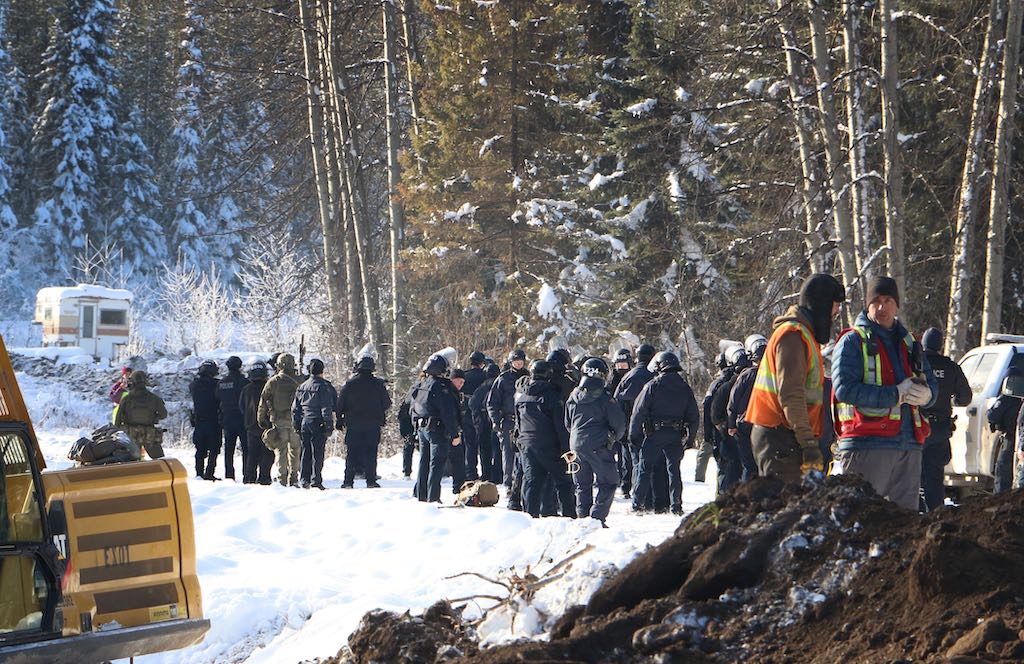
About 50 RCMP officers arrived at the Morice West Forest Service Road in mid-November 2021 to arrest Wet’suwet’en land defenders and their supporters.
The following day, they arrested photojournalist Amber Bracken. Photo by Amanda Follett Hosgood.
Legal observers say the judge’s ruling will depend on their specific findings about where and how Bracken was detained.
But both University of Waterloo constitutional law professor Emmett Macfarlane and media lawyer Peter Jacobsen said it appears clear that Bracken’s rights were breached.
Jacobsen, who has represented multiple media organizations over his career, pointed to the length of time — three days — Bracken spent in custody.
Canadian law requires people who are arrested to be brought before a judge within 24 hours, when it is possible to do so. The law also gives peace officers the right to release people who are arrested if they promise to appear in court at a later date and the officer doesn’t deem their continued detention to be necessary.
Bracken was arrested on a Friday afternoon. In its filing, the RCMP says Bracken was initially supposed to appear before a judge on Nov. 20, the day after her arrest, but the judge in question decided to move proceedings until the Monday after more people were arrested.
In its suit, The Narwhal says authorities could have chosen to release Bracken at various times but “intentionally and callously” chose not to do so. The Narwhal says authorities knew that keeping Bracken detained “would interfere with her and The Narwhal’s ability to report on the events of Nov. 19, 2021.”
Jacobsen said Bracken’s detention “was absolutely outrageous.”
He said the constitutionality of the arrest itself will depend on the information the officers had at the time, and their specific actions.
“Can the police allege that they didn’t know that she was a member of the media? Did the police have the time to go through and sort out who was who?”
Jacobsen said Bracken’s arrest illustrates how police have increasingly used exclusion zones to limit the ability of the media to cover enforcement activities.
“The big issue in all of this really is the media being able to be available to report on what occurs when the police go into these situations,” he said.
Macfarlane said there are clear constitutional protections that allow journalists to cover and be present in police-defined exclusion zones.
“It doesn’t seem, in my opinion, justifiable to make journalists go through checkpoints to be able to do their job and document things that are happening on the ground,” he told The Tyee.
Journalistic freedom has limits, Macfarlane acknowledged. “A journalist can’t jump on a bulldozer and stop things from happening in the course of doing their job.”
But he said ordinary Canadians “should be very worried” that police would stop a journalist from doing work to document events.
“A journalist has every right to be present, to do the job of reporting on a public interest story involving a protest, and that includes even when an injunction has been issued,” he said. “Maybe the state has valid authority to shut down the protest. That doesn’t necessarily give the state the right to arrest journalists who are covering the enforcement of an injunction, whether that’s before or after an injunction is issued.”
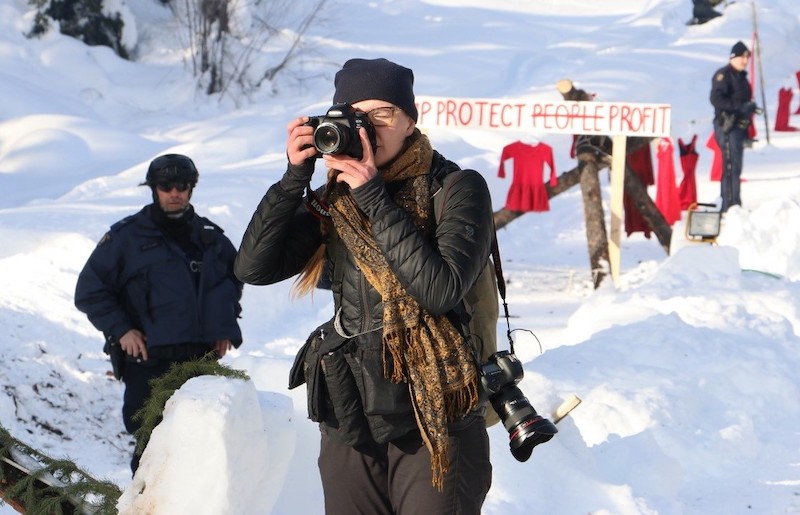
Like Jacobsen, Macfarlane said the ruling on Bracken’s arrest and detention will turn on individual details. But, he added, “anyone who has even a minimal understanding of the Charter or basic rights would see that the manner in which she was detained was a clear violation of her Charter rights.”
If Bracken’s rights were breached, a judge will decide what, if any, price the government and RCMP will pay for having done so.
The stakes in the Narwhal case are different than in many Charter challenges.
Damages in the form of monetary compensatory payments are not common for Charter violations, Macfarlane said; instead such a finding often ends simply in criminal charges being dismissed and a judicial ruling that tells police they won’t be able to obtain convictions if they don’t respect the Charter rights of the accused.
But with charges already dropped, The Narwhal and Bracken are hoping for a ruling that protects the rights of journalists and journalism organizations in the future. Court cases can define the rights of those who might encounter police as much as laws and legislations, Macfarlane said.
“There might be an important Charter case that only affects this one journalist, but that can make a statement for the limits of arbitrary state power in the future,” he said. “If there are remedies beyond just a declaration that Charter rights were infringed, that might also send an important signal.”
‘We are hoping to establish meaningful consequences’
Last week, in the lead-up to this week’s trial, The Tyee asked Narwhal editor-in-chief Carol Linnitt by email about the decision to take the case to court, and why it thinks it can win. This email interview has been edited for length and clarity.
The Tyee: Why did The Narwhal decide to sue the RCMP, and how did you weigh the various factors that went into that decision?
Carol Linnitt: The Narwhal is a small, non-profit news organization and we certainly did not want to have to bring a lawsuit against one of the most powerful organizations in our country. This case is enormous and bringing it forward has taken a significant investment in terms of our fundraising efforts and time and resources.
But, the truth is, what we’re fighting for is so critical to the work that we do every day at The Narwhal. It’s fundamental to the ability of journalists all across the country to do their jobs without fear of police interference and arrest.
If we didn’t bring this case forward, it would amount to a tacit acceptance of the RCMP’s practice of detaining and arresting journalists, including Amber. What we are hoping to establish in this case is meaningful consequences for police when they interfere with the rights of journalists covering events in injunction zones.
In terms of what we considered when actually suing the RCMP and bringing this case forward, we had to evaluate the impacts this would have on our staff and organization and also Amber, who is a working freelancer. We had to consider whether or not we could afford to bring a case forward and weigh the risks of doing so. Ultimately we felt a significant responsibility to the public and to our fellow journalists. Eventually it became clear that, despite the fears we had and the work that a case of this magnitude requires, moving forward was the right thing to do.
What is The Narwhal’s argument for why journalists should have the right to be in places like exclusion zones where the broader public has been prohibited from entering?
All Canadians have the right to a free press and deserve high-quality reporting, especially from sites of protest and conflict. And journalists not only have the right to report from injunction zones but, I would argue, a duty to the public to do so.
Journalists should be able to rely on the RCMP facilitating their access rather than interfering with it. And likewise, police should be able to rely on journalists showing up as professionals and conducting themselves respectfully.
Journalists are not in injunction zones to participate in protests. They are there to report, document and witness. And they do that on behalf of the public who cannot be there as observers themselves.
When the RCMP interfere with a journalist’s work in these areas, they effectively cut off the public’s ability to know what is happening in the country. This is important in nearly every circumstance one could imagine, but even more so in sites of conflict and protest and in particular where there are questions about Indigenous rights and title.
Canada’s press freedom Charter rights are fairly ambiguous. Brent Jolly, the president of the Canadian Association of Journalists, noted there are still unresolved questions about the RCMP’s ‘use of exclusion zones, checkpoints, and other tactics that impinge on journalists’ rights and prevent journalists from doing their jobs.’ What precedent is The Narwhal seeking to establish when it comes to journalist access to exclusion zones?
We are asking the courts to consider the facts of this case and establish some accountability for interfering with a journalist who was covering events of national importance as they unfolded in an injunction zone.
Prior to Amber’s arrest, The Narwhal and other publications asked a judge to issue a ruling on the RCMP’s use of exclusion zones in enforcement actions related to the protests out at Fairy Creek on Vancouver Island. Many publications were frustrated with the use of exclusion zones and media checkpoints that prevented journalists from witnessing and documenting arrests. In response to that legal challenge, Justice Douglas Thompson told the court the RCMP failed to justify the need for having “extensive” exclusion zones for police to do their jobs.
He told the RCMP to keep in mind “the media’s special role in a free and democratic society, and the necessity of avoiding undue and unnecessary interference with the journalistic function.”
This was just months before Amber’s arrest. So we are asking, once again, for the courts to evaluate the evidence put forward in our claim and issue a ruling as to Amber’s rights, The Narwhal’s rights and the activities of the RCMP in Wet’suwet’en territory in 2021.
Given the current ambiguity of the laws, is there a risk that the trial will set a precedent that ends up more clearly restricting the actions of journalists?
In this case we are asking the court to consider the press freedom right as it is enshrined in the Charter and then consider whether the RCMP’s arrest of Amber breached that right. So the court isn’t being asked to consider journalistic practices outside the specific circumstances of this case.
How do you respond to the RCMP’s argument that Bracken was ‘not engaged in apparent good faith newsgathering activities’?
We could not more heartily disagree. But the details of this are what will be considered at trial.
How do you define a journalist and who should determine who is and isn’t a journalist?
That will be discussed in the trial and these are things the court is being asked to consider. In other court cases, like the [Justin] Brake case, courts have already given some guidance on factors courts can look to in considering whether someone is acting as a journalist.
You’re now proceeding to trial. Was a settlement ever discussed regarding damages?
Settlement conversations are always confidential and we cannot confirm or deny whether settlement discussions ever took place.
You released a video this week saying the decision to file the lawsuit ‘put the reputation and the financial stability of The Narwhal... at risk.’ How much is this expected to cost The Narwhal, how are you paying legal costs, and is your financial stability still at risk if it loses?
The Narwhal has been criticized throughout this ordeal and our credibility has repeatedly been called into question. Misinformation has circulated about The Narwhal and about Amber. Publications have published false information about us. Amber’s credibility has been called into question and her legitimacy as a professional journalist is specifically at issue in this case. The toll of all of this, organizationally and personally, has been enormous. There’s no spreadsheet that could really tally all of that.
Legal challenges are also time-consuming and incredibly expensive. The costs and time commitment are very hard to predict. And any time you bring a legal case forward, you put yourself at risk of being on the hook for costs should your case not be successful. These are serious concerns. I won’t go into the details of the financial aspects of this case, but I can say that the only reason we have been able to bring this case forward is because of the astonishing generosity of thousands of individuals who have donated to support our fight for press freedom. The public’s support has truly been the wind in our sails.
Is there anything else you wish to share or the public should know?
It is harder than ever right now for journalists to do their jobs. At the same time it’s more important than ever that we have experienced, professional human beings going out into the world to witness, document and report. Journalists are an endangered species and we experience constant threats to our ability to do our work, especially the time- and resource-intensive work that is required to adequately cover the environment, the climate, the rush to develop natural resources and how all of this intersects with Indigenous rights. And with AI-generated content flooding the internet, it simply cannot be overstated how crucial journalists are for the functioning of our society and democracy.
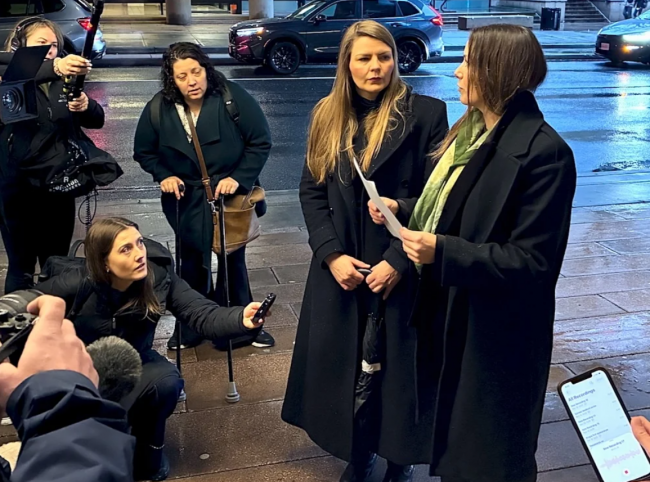
[Top photo: ‘If we didn’t bring this case forward, it would amount to a tacit acceptance of the RCMP’s practice of detaining and arresting journalists,’ Narwhal editor-in-chief Carol Linnitt says. Photo for The Tyee by Jen St. Denis.]