Articles Menu
Sept. 1, 2026
There’s no likely need for Alberta’s proposed West Coast Pipeline, as the rise of electric vehicles and a faster global energy transition drive down future oil demand and prices at a faster rate than industry and governments may have expected, the Institute for Energy Economics and Financial Analysis (IEEFA) concludes in an analysis released this morning.
That means there’s only “a poor chance that the West Coast Oil Pipeline repays its $35.2- to $43.7-billion cost,” raising important questions about “whether the export route diversification is worth that cost,” IEEFA reports.
Closing Soon: How else would you want to see your government invest $43.7 billion in taxpayers’ dollars?
That’s because the “potential acceleration” of the shift off fossil fuels “is likely to limit future long-term oil prices and brings the prospect of structural decline,” shifts that would “significantly weaken” the economic benefits of expanded pipeline infrastructure, write IEEFA energy finance analyst Mark Kalegha and independent consultant Will Scargill.
The West Coast Pipeline would also have to compete with existing or planned pipeline expansions that would be sufficient to meet any future demand for export capacity.
“Given that existing and brownfield expansion projects are largely capable of accommodating projected production growth—at presumably lower costs and with higher degrees of execution certainty—no capacity-driven need exists for construction of a new large-scale export corridor,” Kalegha and Scargill add. “The large scale of the proposed West Coast Oil Pipeline—which would nearly double the capacity added by the entire group of Tier 2 expansion projects—substantially exceeds all identified shortfalls.”
The project would also “represent a net loss” to oil sands producers, since it would have to charge “significantly higher” access fees, or tolls, than existing pipelines, the report states.
The latest energy futures study by the Canadian Energy Regulator (CER), published in March [pdf], included one scenario that suggested substantial future growth in fossil fuel consumption. It also included a net-zero scenario that indicated a much sharper reduction. But just months later, with the trajectory of global energy markets pointing to “a faster energy transition and lower long-term oil demand,” IEEFA says, “the conditions for the CER’s Higher Scenario appear increasingly unlikely.”
With electrification cutting into a road transportation market that soaks up about 45% of global oil demand, and China electrifying “significantly faster” than the rest of the world, IEEFA says oil demand growth is likely to hit zero in the next couple of years and then decline—just as the International Energy Agency has projected in recent years.
And the shift could be faster still. “Analysts have repeatedly underestimated the growth of clean technologies such as electric vehicles and solar power,” IEEFA says. “And while policy support for the electrification of transport suffered a blow through the Trump administration’s rollback of climate policies, this does not necessarily mean a shift in the long-term policy direction across the globe.”
China will no longer act as the catalyst for global demand growth, as it has over the last two decades, while importers in the European Union, Asia, and Africa “have a strong incentive to promote electrification to improve the trade balance and insulate economies from commodity price shocks,” the report adds.
The two most recent of those shocks were the high prices and volatile markets brought on by Russia’s invasion of Ukraine in 2022, then the American/Israeli war on Iran beginning earlier this year. “And as the impacts of climate change become ever more evident across the world,” IEEFA says, “policymakers are also likely to face further pressure to accelerate policies to reduce emissions.”
While the price shock themselves “may seem to make the case for ensuring that additional sources of oil supply can get to market, their long-term consequences suggest the opposite impact on the need for future crude supplies and oil prices,” the report continues. “Demand destruction” occurs when spiking energy prices drive down consumption, prompting countries and many households and businesses to make different choices. Those decisions are easier when the energy transition “brings additional responses into play due to the availability of viable and cost-competitive alternatives to fossil fuel for energy.”
In the end, “far from making the case for new long-term oil infrastructure, oil supply shocks today may reduce the long-term demand trajectory by spurring electrification, and this impact makes it less likely that the world will see higher long-term oil prices in the future.”
The report digs into projections for future oil exports and prices to conclude that the West Coast Pipeline will likely cost more than it’s worth. In the end, IEEFA says, fossil producers would pay more in higher tolls than the pipeline would bring them in new export revenue.
Kalegha said the report was meant for a wide audience, but primarily for financiers and analysts who have a hand in deciding where investment capital flows over the medium to longer term. “We have put forward facts and analysis that should hold weight when viewed by folks already raising questions about the pipeline,” he wrote in an email, “and also folks who may not be, have neutral inclinations, and can be persuaded by the data.”
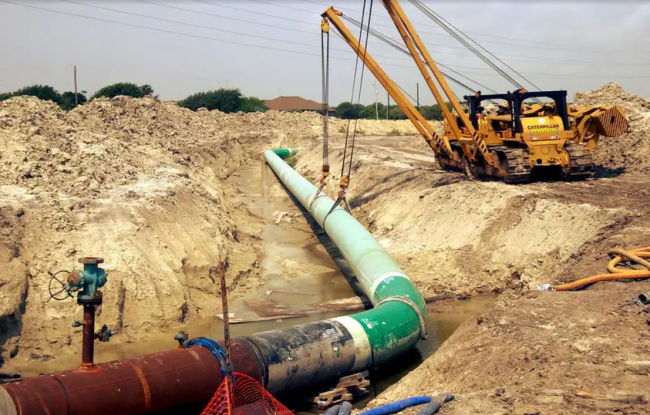
[Top photo: Jay Phagan/flickr]