Articles Menu
Dec. 5, 2025
The provincial Conservatives wasted no time calling for Forests Minister Ravi Parmar’s head this week after Domtar announced it would soon shutter its Crofton pulp mill.
The closure is a huge economic hit for the predominantly rural region on southern Vancouver Island. Three hundred fifty employees who earn an average of $100,000 a year will lose their jobs.
“The Minister has been moving imaginary armies around the board while real people are paying the price,” the Conservatives said in a Dec. 2 press release issued shortly after Domtar announced Crofton’s imminent demise (and shortly before the Conservatives ousted leader John Rustad).
But when it comes to what ultimately lies behind Crofton’s impending closure, previous BC Liberal governments (of which both Rustad and his interim replacement, Trevor Halford, were once members) and NDP governments past and present all have much to answer for.
Both were at the helm as tumultuous changes rocked B.C.’s coastal forests and forestry sector. And both did little of consequence in response. The result is not only pain for workers and their families, but a big economic hit for local government in terms of potential future lost tax revenues in coming years. Crofton is the Municipality of North Cowichan’s single largest taxpayer, contributing $5 million annually to the local budget.
The first change that governments ignored — at the peril of communities like Crofton — was the disintegration of what were once highly integrated forest companies.
At one point, each of B.C.’s three remaining coastal pulp mills — Crofton, Harmac and Howe Sound — were part of a continuous production chain owned by the same company. In the case of Harmac, the company was MacMillan Bloedel. In the case of Crofton, the owner was BC Forest Products and later Fletcher Challenge.
With integrated companies, all aspects of production from the tree standing in the forest to final products were linked.
The trees were cut down by loggers working for company-owned divisions.
Then the trees were trucked or barged to sawmills owned by the same companies.
After the sawmills turned the round logs into rectangular lumber pieces, the leftover “fibre” — sawdust, chips and shavings comprising about half the wood volume in each log — was sent next door or close by to make wood pulp and paper. Again, this was done in a mill owned by the same company.
That chain began to fracture on the B.C. government’s watch in the 1990s when forestry companies began breaking up and selling their assets individually to the highest bidders.
The pulp mills were cast adrift to sink or swim on their own in an open market where they now competed for the chips they needed. If they couldn’t find enough chips to buy, they were forced at great expense to buy whole logs and chip them up themselves.
That has left pulp mills like that in Howe Sound today to source the majority of the wood fibre they need either by buying barges full of chips from California and Alaska or by chipping whole logs — by the hundreds of thousands — at giant coastal log-chipping facilities that they own.
One of those plants, a formidable whole-log chipping facility in Port Mellon owned by Domtar, turns 1.4 million cubic metres of logs into chips each year. It is now responsible for 40 per cent of the fibre needs of the Howe Sound pulp mill.
That’s a lot of logs that could have been putting sawmill workers to work first, before the residual chips and sawdust were used to make pulp.
Watching sawmills close
Further complicating matters is the continued closure of sawmills throughout B.C., including on the coast. When John Rustad was a cabinet minister, the BC Liberals stood by and watched that happen. The NDP simply followed suit. In many cases, the same companies shuttering mills in B.C. simultaneously bought existing mills or built new ones in the United States.
As previously reported by The Tyee, the flight of investment capital from B.C. to the United States has been enormous. Just three companies in B.C. — Canfor, West Fraser and Interfor — have invested a combined US$8.4 billion in 59 mills in the United States.
According to reports compiled by the provincial Ministry of Forests, sawmills on B.C.’s coast produced 1.97 billion board feet of lumber in 2019. By the beginning of this year, that production was down to 1.44 billion board feet at most, marking a 27 per cent reduction in lumber production in just the past four years.
That has left 27 per cent fewer chips from local sawmills available for local pulp mills — and mounting costs as mills either buy relatively expensive logs to chip to make up the shortfall or foot the bill for chips to be barged great distances and at great expense from outside of the province.
Raw logs leave to be processed elsewhere
The impending closure of Crofton also highlights another persistent and ugly problem that neither the Liberals nor the NDP have yet wrestled to the ground: log exports.
Next door to the Crofton mill lies a giant log storage yard in which thousands of logs are stacked in piles awaiting the arrival of ocean freighters. Those ships will take the unprocessed logs away to buyers in China, Korea, Japan and the United States.
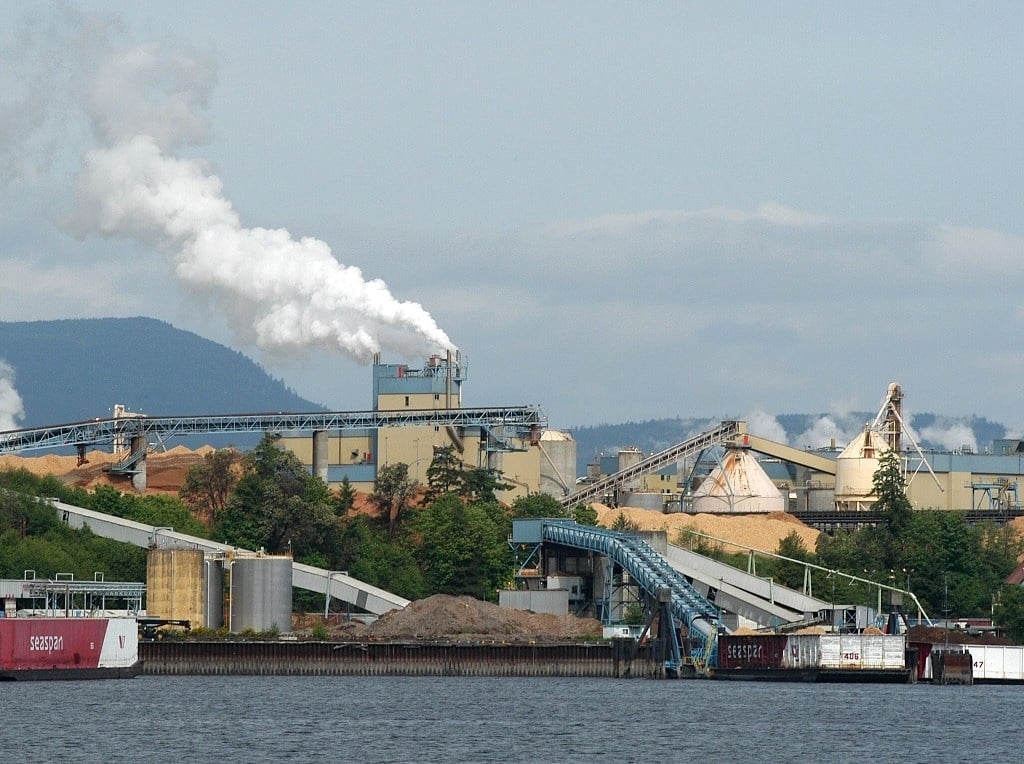
Exports of raw logs from B.C. have raised the ire of mill workers, local government leaders and environmental activists for decades. Yet they continue right on the doorstep of the Crofton mill.
Statistics Canada export data on raw log exports shows that in 2024 more than 2.7 million cubic metres of unprocessed logs left B.C. from docks along the province’s coast. Those logs were worth a combined $420 million.
That means that as many as one of every five logs coming out of the province’s coastal forests last year went into the holds of ocean vessels for export rather than being run through B.C. sawmills and, eventually, pulp mills.
It’s true that exports have also declined. Ten years ago, the volume of raw logs exported from B.C. was more than 6.2 million cubic metres. But the overall logging rate that year was almost double what it was last year, meaning exports in 2014 represented about 29 per cent of everything logged that year.
So while there has been a marked decline in the number of unprocessed logs shipped out of B.C. in the past decade, the number of logs exported as a percentage of the total log harvest has declined far less.
Arnold Bercov, a former worker at the Harmac pulp mill north of Crofton and former president of the Pulp, Paper and Woodworkers of Canada, said the log export issue has real consequences for pulp mills and sawmills because those logs could be — and should be — processed by both.
Bercov, who participated in a successful effort to prevent the Harmac mill from closing when mill employees helped buy the mill out of bankruptcy in 2008, said he is most disappointed with the current government for failing to take action on numerous fronts.
When the NDP government was in opposition, Bercov said, there were talks about the challenges posed by log exports and the need to improve log utilization.
“I was there. They promised changes. And when they got in they basically changed nothing,” Bercov said. “Here we are with eight years of NDP government with the same outdated policies as under the Liberals.”
That inaction, Bercov said, is ultimately behind the pain now being visited on Crofton’s workers and families.
Ultimately, though, the biggest challenge for secure jobs in the forest sector may be logging rates, which continue to plummet.
Those rates are down for many reasons. But the most obvious one is frequently the one least talked about as Rustad and the Conservatives attempt to make political hay out of the Crofton closure.
Logging rates in B.C. are down dramatically in part because the easiest-to-access forests were long ago logged and what remains is much farther away and more expensive to get.
In 2014, coastal logging operations produced 21.5 million cubic metres of logs. In 2024, that production fell to 12.6 million cubic metres, according to data available on a searchable government website maintained by the Ministry of Forests.
That’s a drop of 41 per cent. When 2025 comes to a close, it looks like production will slide further still. As of the end of November, log production on B.C.’s coast had slipped to 10.1 million cubic metres, making it possible that 2025’s rate will be half of what it was in 2014.
Rustad’s response is that the government must “speed up permits,” a point on which Premier David Eby is in agreement, as spelled out in his mandate letter to the forests minister.
Facing Conservatives’ attacks in the legislature on the government’s alleged failure to issue permits fast enough, Parmar avoided the issue, choosing instead to blame “volatile markets” and U.S. President Donald Trump’s tariffs for the decision to close the mill.
Speeding up permits, however, doesn’t happen in a vacuum. The trees have to exist to be cut down economically. And there must be buy-in from First Nations on whose lands those trees are found. This applies both on the coast and in the Interior, where pine beetle logging and massive wildfires have played a major role in accelerating the decline in trees available to log, triggering numerous sawmill and pulp mill closures.
Meanwhile, raw unprocessed logs continue to leave the province by the millions, while millions more are chipped whole to feed pulp mills decoupled from sawmills.
If this is the future for forestry workers, more ugly news may well lie ahead for rural communities elsewhere in the province.
*Story updated on Dec. 5 at 4:30 p.m. to reflect that the Crofton mill was not owned by MacMillan Bloedel but by BC Forest Products and Fletcher Challenge.
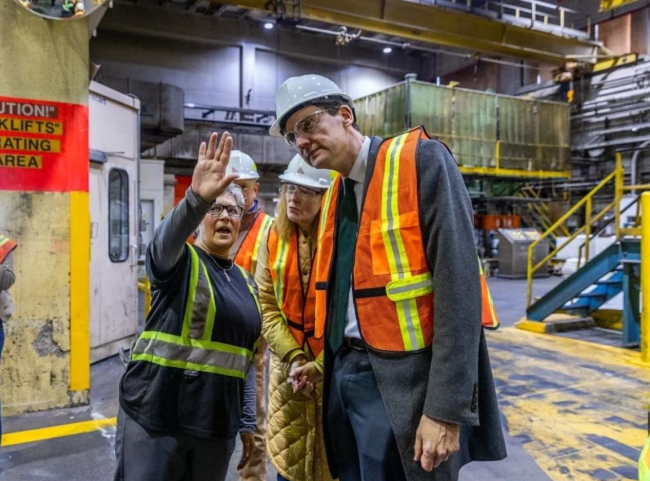
[Top photo:Premier David Eby visited the Crofton pulp mill in 2023 to announce government funding to help the facility. The company returned the money after it curtailed paper production. Photo via BC government.]