Articles Menu
Dec. 1, 2025
Lo and behold, Prime Minister Mark Carney, a global banker, and Alberta Premier Danielle Smith, a petro-populist à la Donald Trump, have big energy plans for Canadians.
The two now support an undefined bitumen pipeline project from Alberta to British Columbia’s northwest coast, claiming it will bring economic glory and growth for a troubled nation.
In response to the news, Robbie Picard, an oilsands booster, has proposed that the resurrected project be called the Spirit Bear Pipeline. According to Picard, who is not Indigenous, the Spirit Bear symbolizes “resilience, harmony, and the sacred balance of nature and industry.”
To gain a different, more measured perspective, I called David Hughes. He is one of the country’s foremost energy analysts and a geologist who worked for the Geological Survey of Canada for 32 years. Based in B.C., Hughes is neither an industry booster nor a green activist.
Hughes works with numbers based on inconvenient biophysical realities. Over the years his accurate reports and presentations have warned that net zero by 2050 is pretty much a fantasy, given unfettered economic and population growth. He also points out that most renewables depend on materials mined, made or transported by fossil fuels.
In any case Hughes doesn’t see any need for another pipeline.
Twenty years ago, Hughes and lots of others in Canada concluded that the Northern Gateway project was a bad idea. That abandoned project proposed to move half a million barrels of bitumen a day to the coast across a thousand gleaming waterways and through some of the most mountainous and avalanche-prone terrain in Canada.
The export scheme would have snaked its way to the port terminal of Kitimat, located on a fiord that empties onto the Hecate Strait. The strait is shallow and known for producing rough water. Environment Canada lists Hecate as the most dangerous body of water on the entire Canadian coast. Others call it the fourth most dangerous ocean body in the world.
Hence the justification for a 50-year-old tanker ban.
The Carney-Smith memorandum of understanding proposes something bigger and greater than Northern Gateway. The new project, which so far has no route and no proponent, would move a million barrels a day. The inconvenient tanker ban would be adjusted. To do its bit against climate change, Alberta would capture, transport and then inject underground its growing carbon emissions using an energy- and water-intensive technology called carbon capture and storage, or CCS. More about that later.
To Carney and Smith it all spells progress while solving political challenges each of them faces.
Hughes sees an altogether different reality. He calls the proposal part of the Great Fossil Fuel Blowout. Since 1850 human beings have burned their way through nearly 1.6 trillion barrels of oil. It took many millions of years to make that fossil energy, but humans consumed half of the world’s ultimately recoverable oil in a record 175-year binge. And 50 per cent of that cheap oil in just the last 28 years.
Another trillion barrels of oil will be burned by 2050, according to the International Energy Agency’s current policy scenario. At that point civilization will have to make do with leftovers, some 500 billion barrels more difficult to extract and refine, the final supply for centuries to come in a world undone by the heat, drought and floods of climate breakdown.
The numbers also show that humans have used finite fossil fuel resources to drive an unprecedented population boom since 1800. That boom turned a modest party of one billion peasants into an 8.2-billion fandango with cellphones. In turn the population boom drove a steep increase in per capita energy consumption. People today use four times as much energy per capita than they did in 1800, says Hughes. When you couple that fact with the population explosion, it means humankind now uses 33 times more energy than it did in 1800. And that’s about as sustainable a development as pancreatic cancer.
Hughes counts as a colleague Dennis Meadows, one of the authors of the famous 1972 “Limits to Growth” report. A 2023 update of the report’s original model confirms that economic growth on a finite planet has placed civilization on a trajectory to resource depletion and collapse.
But politicians including Carney and Smith dismiss the accelerating chaos as a temporary “affordability crisis” and call for more growth. To Hughes that’s like a cancer patient ordering more cancer as a treatment.
Here are some facts Hughes points out about the Carney-Smith pipeline.
The oilsands allegedly contain 160 billion barrels of heavy oil that requires lots of fresh water and energy from methane to mine. (The project gobbles up 30 per cent of Canada’s natural gas supply every year.) At current extraction rates of roughly 3.5 million barrels a day, that ancient deposit of degraded petroleum might last 128 years.
Keep in mind that the easiest parts of the deposit have already been extracted, refined and burned, largely for the benefit of the United States. Any expansion will have to come from less favourable deposits with higher environmental costs. It takes two to four barrels of fossil-fuel-heated steam, by the way, to coax out one barrel of bitumen in thermal operations. That’s where the majority of bitumen now comes from.
The Carney-Smith project, combined with the proposed expansion of the Trans Mountain pipeline to move another 360,000 barrels a day, would increase production by another 1.4 million barrels a day. That would bring oilsands production to five million barrels a day. At that rate the oilsands would be gone in 91 years.
Hughes doesn’t think the fast spending of a finite resource with severe biological and climate consequences is a wise practice.
Hughes notes another stark political reality: the oilsands is no longer Canadian owned. Just five bitumen producers (happily referred to as the “Big Five”) account for about 80 per cent of Canada’s bitumen mining and steaming. But Husky, Cenovus, Imperial, Suncor and Canadian Natural Resources are largely possessed by foreigners.
Exxon Mobil, for example, owns 70 per cent of Imperial Oil, while China’s Hutchison Whampoa has a 40 per cent stake in Husky Energy. Financial giants like Capital Group, Fidelity and BlackRock hold over 25 per cent of the Big Five. All in all, more than 70 per cent of major oilsands shareholders are foreign firms.
This concentration of ownership means another pipeline will mainly enrich a small group of foreigners who really don’t give a fig about climate change. Or Canada’s future for that matter. “Who benefits from that?” asks Hughes.
Who pays the bills?
Another point to ponder is the financial cost of building another bitumen pipeline. Kinder Morgan abandoned the controversial Trans Mountain project when cost estimates hit about $8 billion. Then the Canadian government bailed out Kinder Morgan. Nearly a decade later it cost Canadian taxpayers more than $34 billion to double an existing export line through the mountains.
Hughes suspects that building a pipeline from Alberta to Kitimat might cost between $30 billion and $40 billion. Or even more given inflation, climate change and the rising cost of materials. “I think that sticker price makes it unlikely it will ever be built.” Unless of course politicians decide that Canadian taxpayers should foot the bill.
Then there is the issue of liabilities. According to calculations by the Alberta Energy Regulator, it will cost somewhere between $57 billion and nearly twice that to clean up the oilsands mining sites and 1.6 trillion litres of toxic tailing waste. Right now, Alberta’s mine financial security program holds only $1 billion for that job. Hughes doesn’t think governments should support the expansion of a carbon bomb that has no credible plan or funds for its growing environmental liabilities.
Last but not least comes the issue of carbon emissions. Canada’s oil and gas industry, of which the oilsands are the largest part, now is responsible for about 30 per cent of the country’s carbon pollution. Even without a proposal to grow oilsands production by 25 per cent, Hughes concluded in a 2024 report that Canada didn’t have much of a chance of reaching net zero by 2050. The adjective Hughes uses is “daunting.”
According to the Canada Energy Regulator, the country can’t reach that goal without tripling high-cost nuclear power production or scaling up by 34 times carbon capture and storage technologies — a method the International Energy Agency calls uneconomic and dubious, admitting “the history of CCS has largely been one of unmet expectations.”
Hughes agrees. He also points out that buried carbon dioxide has a demonstrated tendency to leak, cause earthquakes and contaminate groundwater.
Instead of floating grandiose export pipeline projects as solutions to a rising tide of problems, the Canadian government might want to change course.
Hughes suggests, for example, that our leaders take a hard look at economic inequality combined with concerted efforts to power down. Canadians, for example, use more than four times as much energy per capita as the world average, and 17 times as much as the average person in 1800 before the fossil fuel blowout got started. Half of the world’s population presently lives at, or below, levels of per capita energy consumption circa 1800.
“The big question is: How do we downsize the human enterprise? The inevitable end of fossil fuels means a future with much less energy and consumption. But if humanity can downsize gradually, while energy is still plentiful, disruption can be minimized and a maximum of Earth’s bounty can be retained. If we can’t do that, Mother Nature will take care of our excesses via a chaotic collapse.”
Don’t expect Carney or Smith to stake their political fates on telling that hard truth. Hughes, however, can’t ignore the reality of our predicament: “I have four grandchildren who will feel it.”
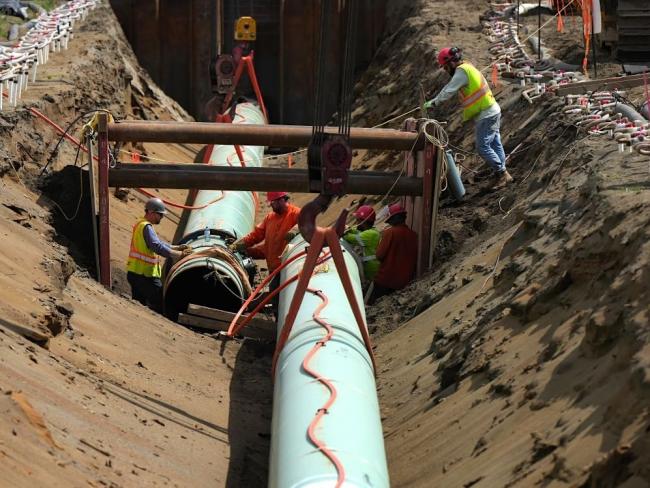
[Top photo: The plan to daily pump 1.4 million more barrels of bitumen includes expanding the Trans Mountain pipeline, shown here being buried in Abbotsford, BC, in 2023. Photo by Darryl Dyck, the Canadian Press.]