Articles Menu
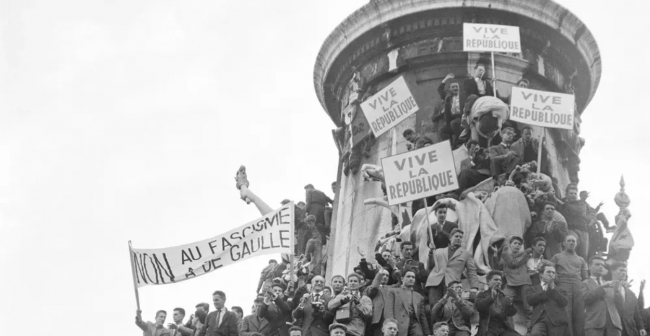
Essay by Patrick Lawrence, re-published here in The Multiplural World, Oct 12, 2026
(With extensive, related readings further below. Patrick Lawrence is a former correspondent in Europe with the International Herald Tribune. The following essay first appeared in his Substack blog ‘The Floutist’ on October 11, 2026. His essays are regularly re-published in Consortium News.
‘What is at issue and being contested across France is the liberal-authoritarian model of government and society.’

High school students protest at Perpignan, France near border with Spain on Oct 2, 2026 (CC)
The French have had a certain gift for street demonstrations going back to 14 July 1789, when they stormed the Bastille and the monarchy’s subjects began to transform themselves into citoyens (citizens). Now they are out in force once again, this time led by high-school students whose grievances run to broken windows, crumbling classrooms, absentee teachers, and poor education altogether. In this, they are being supported by university students and also by some of France’s largest unions and by the left-wing, La France Insoumise (France Unbowed) electoral front.
They often start small, these waves of national protest in France. The memorable évènements of May 1968 began over outdated academic standards, overcrowded classrooms and prudish dormitory visitation rules at the country’s universities. In 2018-2020, proposed increases in the price of diesel fuel sparked the widespread gilets jaunes (‘yellow vest’) demonstrations. And now it is the turn of the students in France’s decrepit lycées (high schools), where neglect and disrepair seem to be the national norm.
But how often do small, local grievances prove merely sparks that ignite prairie fires, as we Americans would put it. The May 1968 student revolt very soon became about far more than fusty rules and remote, inaccessible professors. It was also about the social and political order; it was about power. It was the same in 2018-2020 with the gilets jaunes protests–they were about neoliberal austerity and targeted President Emmanuel Macron as a ‘president of the rich’. So they, too, were about power.

Students blockade Sciences Po university in Paris on October 7, protesting against under-resourced schools (photo by AP)
The hundreds of thousands of students who began protesting several weeks ago against deteriorated conditions in high schools across France have stayed ‘on message’ since they took to the streets. The lousy conditions in which they get their lousy educations remain the focus as these demonstrations, and they have spread to major cities—Marseilles, Strasbourg, Toulouse, Tours, et al.—as well as to many towns and rural villages. But as students, parents, some school administrators and some teachers are joined by national unions, opposition parties, working professionals, and local government officials, it is obvious that the broken windows, falling plaster, and teachers who don’t show up to teach are, while justified sources of outrage, also signifiers of larger grievances.
What is at issue across France is the liberal-authoritarian model of government, now known in polite company as “centrist” even if it is not the center of anything. And if the streets of France have something important to tell us now, it is this: The centrist model—let’s call it ‘Macronism’, or in Germany ‘Merzism’, or in Britian ‘Starmerism-cum–Burhamism’—is crumbling as surely as the lycées of Lyons and Nimes.
Social system in decline in France
The French social system, one of the nation’s great strengths in the postwar decades, has been in decline for many years. Schools, hospitals, pensions, and numerous social services have all suffered in the service of a succession of national budgets reshaped to the benefit of corporate power and France’s economic elites. Macron, a Rothschild merchant banker before his election to the presidency nine years ago, has made increased inequality his defining project. “There is definitely a widespread feeling of neglect,” a Parisian friend said to me the other day. “You see it everywhere.”
There is also the Russophobia and, in keeping with the rest of Core Europe, the condemnable dismantling of the postwar social order in favor of a military-industrial complex on the American model. France’s military budget is to reach €63.4 billion (US$71 billion) by the time Macron leaves office next spring—almost exactly double what it was when he was elected in 2017.
These connections obviously animate the demonstrations now sweeping across France, but they are so far implicit—unspoken of at the barricades. For better or worse, and I would say worse, the French are divided on the issue of Russia and responsibility for the NATO proxy war in Ukraine and the regime in Kiev which is spearheading it. Jean–Luc Mélenchon, much favored by France’s youth as leader of the leftist La France Insoumise, takes the impossibly contradictory position you find among some purported leftists in the United States, namely, that Russia is to be condemned for its February 2022 invasion of Ukraine but NATO and the major Western powers share responsibility for provoking it. This is Not workable; not helpful, either.
In my view, this confused understanding of the moment accounts for an apparent reticence among student demonstrators and their supporters to broaden, let’s say, the theme on the streets. Some students have declared with pride that they are the heirs of the May 1968 generation—les soixante-huitards (the ’68ers). Not quite, I would say: So far, anyway, they appear to lack the larger vision, the consciousness. Have they been propagandized to flinch from any serious critique of power?
As many have remarked, the confrontations between demonstrators and the police have been far more violent than anything one saw in 1968. So who is responsible for this violence? The other day, The Times of London quoted a 16–year old protester saying, “Without violence, no one pays attention to you.” Maybe someone said this and maybe no one did: The Times did not name its source. But I have heard no one following these events at close range who does not think the French police, never noted for their delicacy, are primarily responsible for those occasions when demonstrations tip into violence.
Stun grenades, rubber bullets, tear gas: These have all been deployed on France’s streets since the first student protest broke out on September 18. There are those who suspect—strongly in some cases—that it is the police who are smashing glass doors at some schools and setting fires to others to justify for the public the severity of the official crackdown. The violence of these events, I am told, is another reason the demands of demonstrators have remained narrow: When the police meet protesters with violence, the violence self-reflexively becomes the premier issue.
These demonstrations could not have come at a worse time (or maybe a better time) for Macron’s centrist government. It is in deep political trouble, for one thing. Mélenchon, of La France Insoumise, is not likely to replace Macron in next May’s elections, but his sharp rise in the polls—along with the rightist Marine Le Pen and her Ralliement national (National Rally) party —suggests a growing rejection of the neoliberal order and a determination among voters finally to turn the centrists out of power. For another, Macron has made a mess of France’s finances. It is the usual thing: He has cut taxes and raised defense spending but is politically unable to cut social services sufficiently to cover this financial regime. Investors are consequently dumping French debt, forcing the yield on French bonds to a 24–year high this past week.
Sébastien Lecornu, Macron’s in-over-his-head premier, now speaks of “overlapping crises” but has so far stayed true to Macron’s way with France’s citoyens: expressing sympathy for the students in the streets but committing to nothing by way of substantive reforms in response. As the daily Le Monde reported in its edition of Wednesday, October 8, while the prime minister changed his tone, he did not change his policy. He did not agree to any material or financial demands raised by high school students for renovating school buildings, replacing absent teachers, or improving teacher pay. “In the past, there have been too many promises that were not kept, simply because they were not feasible. What I want are concrete, rapid and therefore funded responses,” he said.
Lecornu’s speech was an admission of powerlessness in the face of the country’s budgetary and political situation, with no majority in the national legislature and pressure from financial markets bearing down, leaving little choice just six months before the presidential election. “We cannot reopen the same spending with every crisis, especially with higher interest rates now in place,” he warned. “That would mean easing the bill today only to prepare an even heavier one for tomorrow.”
This is a clear case of ideology leading to paralysis—the malady, I will add, from which Europe’s other centrist regimes suffer—the Merzists, the Burnhamists, et al.
I am always a touch humiliated, I have to say, when I watch the French take to their streets. The street has served as a fourth branch of government ever since the Bastille days, as a British scholar recently put it: When the executive, the legislature, and the courts all fail, the street is where people go to get things done. France’s students may or may not get their buildings fixed up and their teachers paid properly so that they are willing to teach. I hope they do. I hope they begin thinking about power. And I hope the rest of us in the West remember, or learn for the first time, how useful streets can be.
Related readings, drawn from the ‘World news’ page of The Multiplural World:
* School strikes and blockades continue in France as prime minister makes unspecified promises; new day of mass protests to take place on Oct 8, Reuters news agency, Oct 8, 2026 …According to an Elabe poll for BFM TV, 72% of French people think the students’ demands are legitimate… Another day of student rallies, backed by teachers and trade unions, is planned for October 8 across France, two days after hundreds of thousands of demonstrators took to the streets across the country…
* The school near Paris that shows why students in France are protesting, New York Times, Oct 7, 2026 Angered by poor classroom conditions, students at Paul Éluard High School in a suburb of the capital were among the first to blockade their campus during an ongoing round of unrest (Read the report here in pdf format: The school near Paris that shows why students in France are protesting)
* French gov’t announces big boosts to military spending, Reuters, April 8, 2026 Amid a rising government budget deficit in France prompting cuts to social spending, the government plans to add a further 36 billion euros ($39 billion) to its military spending between now and 2030 under an updated military planning law that expands its nuclear arsenal and boosts missile and drone stocks… The revised 2024–2030 law would lift military spending to 2.5% of GDP by the end of the decade from about 2% now, with the annual budget reaching 76.3 billion euros in 2030, almost double its 2017 level…
* French president Macron unveils voluntary military service amid what he calls ‘accelerating threats’ in the world, Reuters news agency, Nov 27, 2025 …Macron’s announcement brings his government into line with nearly a dozen other European country-members of the imperialist NATO military alliance that have launched similar projects, including Germany and Denmark… Macron’s announcement has been overshadowed by comments from General Fabien Mandon, France’s armed forces chief, who last week caused an uproar when he said France needed to steel itself for possible future losses against Russian aggression, implying this would happen in Ukraine…
* Comment by the editors of The Multiplural World, Oct 8, 2026: [There is next to no analysis being published about the role that rising military spending and aggression by the Western military powers is playing in the student-led protest movement in France opposing austerity. That’s because of anti-Russia prejudices that run deep in media in France, including in left-wing media and other alternative media.]
* In New York Times, three writers discuss the rise of the far-right in Europe, interview published in the New York Times, Oct 12, 2026 (David Broder is the author, most recently, of Mussolini’s Grandchildren: Fascism in Contemporary Italy. Caroline de Gruyter is a Brussels-based columnist for the Dutch newspaper NRC and Foreign Policy magazine. Mattia Ferraresi is a writer for the Italian newspaper QN. Tim Schneider is an editor in the ‘Opinion’ features of the New York Times. Read the interview here in pdf format: In New York Times, three writers discuss the rise of the far-right in Europe)
* Wars in Ukraine, Gaza and Iran, and the collapse of Western superiority, a conversation with Professor John Mearsheimer, broadcast on the ‘Peacemonger’ interview program on YouTube (host Ian Proud), Oct 11, 2026 (54′)
[Top image: Once upon a time. Paris, May 1968. (Agence France–Presse/ Wikimedia Commons.)]