Articles Menu
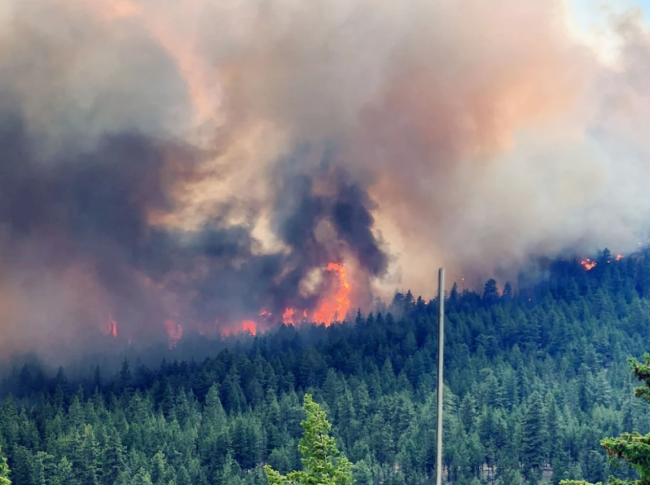
“To be honest, there aren’t really good data on the cost of climate change,” co-author Andy Hira said, something he attributed to “willful ignorance” among policy-makers reluctant to link fossil fuel production to the costs it helps create.
Aug. 19, 2026
SFU researchers say the amount of money B.C. has spent fighting wildfires in recent years is almost the same as what the province has collected in natural gas royalties.
Citing government statistics, the researchers, in a preview of a study to be released next month, said Wednesday the average cost of fighting wildfires in B.C. over the past 10 years was more than twice as much as the decade prior. B.C. spent an average of $525 million a year on wildfire suppression from 2016-2025, compared to $252 million a year the decade before.
More recent years have been far more expensive. In 2024 and 2025, for instance, wildfire suppression cost B.C. $1.3 billion.
Hira called the comparison of firefighting costs to gas revenues a helpful illustration, since reliable estimates of climate change’s full costs, including health impacts, lost tourism revenue, evacuated communities and damaged ecosystems, don’t exist.
“To be honest, there aren’t really good data on the cost of climate change,” he said, something he attributed to “willful ignorance” among policy-makers reluctant to link fossil fuel production to the costs it helps create.
B.C.’s natural gas industry only represents “a fraction of global emissions,” Lisa Baiton, CEO of Canadian Association of Petroleum Producers, said in an email.
“Canada’s 2025 National Inventory Report stated that B.C. had achieved a 51 per cent methane emissions reduction from the oil and gas sector as of 2023,” she said.
Dan McTeague, a former Liberal MP and now an energy commentator, rejected the comparison of wildfire costs to royalties.
He said the energy sector’s much-bigger economic footprint, including jobs, Indigenous partnerships, manufacturing of chemicals and fertilizer and more, gets lost when the debate narrows to royalties alone.
In 2024, the oil and gas sector generated 68,000 jobs with a total compensation of $189,000 a job. It contributed $14 billion to the economy that year, according to the Canadian Association of Petroleum Producers.
McTeague said global demand for natural gas remains strong, particularly as buyers look to diversify away from Russian supply.
“We’re setting ourselves up for ever-changing and worsening fire seasons,” he said.
The provincial government’s budget projections expect royalties will bring in more than $1 billion a year for at least the next several years.
B.C. and Ottawa have committed $4 billion in public funding through 2030 to the LNG sector, including LNG Canada’s Kitimat facility, which began exporting gas last year.
Hira said that investment would be better spent on other sectors, like critical minerals, batteries, and biotech, where Canada and B.C. in particular, could be competitive. He said many countries in the Middle East are investing heavily in AI, transportation and electric vehicles as a way to diversify their economies away from fossil fuels.
“I think it’s clear those would be way better investments of our money,” he said. “I’m not saying shut down natural gas tomorrow or oil. I’m just saying just don’t put public money into it.”