Articles Menu
Nov. 3, 2026
Four of Canada’s largest pension funds are joining private equity giant Blackstone's purchase of a major stake in Mitsubishi Corp.’s LNG Canada holding for US$3.1 billion (C$4.3 billion), a bet on the country's flagship LNG export terminal that climate and stakeholder advocacy groups say endangers workers’ retirement savings.
Canada Pension Plan Investment Board, Ontario Municipal Employees’ Retirement System, Investment Management Corporation of Ontario and Public Sector Pension Investment Board — which handle some 22 million Canadians' retirement savings — will join Blackstone funds that are taking a 49.9 per cent stake in the Mitsubishi subsidiary investing in the LNG Canada facility near Kitimat, BC.
The move by the Canadian funds, responsible for over $1.4 trillion in assets, drew immediate criticism from environmental and pension watchdogs, including Stand.earth and Shift Action. They accuse the funds of gambling with members’ savings on a project that is heavily polluting, prone to operational problems and exposed to a fast-approaching projected global gas glut.
“The use of Canadian workers’ hard-earned money to subsidize the expansion of a majority foreign-owned, malfunctioning and polluting LNG behemoth is irresponsible,” Richard Brooks, Stand.earth’s climate finance director, said in a statement.
Shift Action director Adam Scott called the pension funds’ decision “deeply irresponsible and indefensible.”
But Geoffrey Souter, head of real assets credit at Canada Pension Plan Investment Board, defended the investment.
“LNG Canada is a high-quality, globally strategic asset with strong long-term fundamentals and attractive return potential for the CPP Fund,” he said. “We see this as a compelling opportunity to invest at scale here in Canada alongside Mitsubishi Corporation, Blackstone and our Canadian peers.”
The deal will see the investment group take a non-controlling 49.9 per cent interest in the subsidiary that invests in LNG Canada, while parent Mitsubishi Corp will remain the controlling partner and retain its original gas purchase volumes for Japanese customers.

The investment puts Canadian institutional capital behind the C$33 billion Phase 2 expansion of the project, which shipped its first cargoes last year. It aims to double production capacity to 28 million tonnes per annum (mtpa), making it one of the largest LNG export operations globally.
The transaction follows a final investment decision by lead operator Shell and its Asian joint-venture partners PetroChina, Petronas, Mitsubishi, and KOGAS to enlarge the project by adding two LNG processing units and new storage tanks. Commercial operations are targeted for the early 2030s.
The expanded LNG Canada project, to be fed by TC Energy’s extended 670-kilometre Coastal GasLink pipeline, would account for more than a quarter of Ottawa’s ambition to expand the country’s LNG export capacity to 100 million tonnes annually by 2040.
Stand.earth and Shift Action accused the pension fund directors of risking capital amid a looming global gas supply glut.
Canada’s pension giants, known as the Maple 8 with C$2.7 trillion in assets under management, have faced aggressive lobbying from the federal government in recent months to make massive capital wagers on Canadian LNG export infrastructure for the first time.
"The bottom line is that every dollar workers’ pensions put into LNG Canada is a dollar not building the clean energy future,” Brooks said.
“That capital should instead be accelerating clean energy projects with better long-term returns,” he said, adding that “private sector investors should bear stranded asset risk — not Canadian workers’ pensions.”
Shift Action's Scott said the pension funds’ backing of LNG Canada violated their mandated capital risk thresholds and the trust of Canadian taxpayers.
“These pensions have broken the trust of their members with this investment. We are digging ourselves deeper into an incredibly risky project, we’re now using our taxes and our retirement savings against us to harm our climate,” Scott said.
Critics also pointed to serious operational problems at the Kitimat terminal, which they said ran at below half capacity in Phase 1 and continued to burn-off huge volumes of methane during gas refining.
Chief Na’Moks, Hereditary Chief of BC’s Wet’suwet’en First Nation, said the pension managers are attempting to bypass Indigenous rights and local opposition to LNG Canada 2.
“These projects destroy our law — yet our pension funds are choosing to ignore our laws and our rights when investing in LNG Canada,” Chief Na’Moks said in a statement.
Some energy analysts have warned that Ottawa’s plans to expand the LNG sector faces potentially severe economic headwinds.
Demand in target Asian markets is unlikely to meet earlier forecasts, they argue, as oil markets roiled by disrupted shipments through the Strait of Hormuz this year accelerate Asia’s shift from fossil fuel to renewable power production.
For LNG Canada, the second phase build-out also carries its own risks, Mark Kalegha, an energy finance analyst at the Institute for Energy Economics and Financial Analysis, said recently.
“LNG Canada Phase 2 is not simply a duplication/twinning of Phase 1: it faces a materially different risk environment,” Kalegha warned in September. “Construction of Phase 2 will have to contend with volatility and increases in prices of labour, steel, equipment, debt and other input costs.”
Sustainability and climate advocacy groups also highlighted the heavy taxpayer exposure and environmental risks associated with the project.
Nichole Dusyk, Canada Energy Transition lead at the International Institute for Sustainable Development, said when the Phase 2 expansion received its financial green light that it “put Canada’s climate goals on the back burner for little public benefit and substantial taxpayer risk.”
Phase 1 of LNG Canada has been calculated by the IISD to be adding 2.1 megatonnes of CO2 equivalent a year – equal to the exhaust of 450,000 cars. Total project emissions will double after the expansion, Dusyk estimated.
“Taxpayer dollars are being funnelled to this project in a moment of uncertain long-term demand. Whether it’s a question of long-term economic or environmental stability, this project is a risk,” she said.
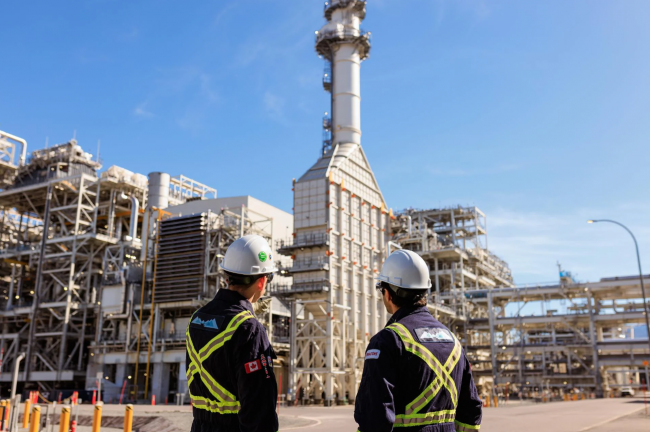
[Top photo: Workers at LNG Canada facility in Kitimat, BC. Photo: LNG Canada]