Articles Menu
Mar. 2, 2026
In an opinion piece published on vancouversun.com last month, Richard Brooks called on Canadians to ask tough questions about the liquefied natural gas (LNG) industry, including how will it benefit us and, “Are (these projects) really of national interest?”
There is no case that B.C. can compete with producers who are closer to buyers in Asia and Europe, who can export gas by pipeline (such as Russia or Malaysia to China or Azerbaijan to the EU), who have lower labour costs, and who have already existing infrastructure.
We are also entering a period of LNG oversupply driven predominantly by export development in the U.S. just as the energy transition in Asia is taking off. LNG demand fell in India and China in 2025, and Pakistan has shut down domestic gas production and is begging suppliers to cancel shipments because solar is outcompeting gas. Many forecasts indicate that within a few years, international prices will slump as supply overwhelms demand.
Putting the declining market outlook aside, though, our research has found that even under the best of circumstances these projects do not contribute to long-term, healthy economic development for B.C.
Last year, one of us co-authored a report that interrogated the reality of economic claims made about the industry. We found that claims about investment and jobs are drastically overblown; that prospective tax revenues have been decimated by legislative changes; and that offshoring and foreign ownership undercut the growth these projects might bring.
In 2013, Premier Christy Clark promised that LNG investments would create 100,000 jobs and generate enough revenue to seed a sovereign wealth fund. Thirteen years later, one project — LNG Canada — is online.
Nearly 90 per cent of LNG export capacity that is moving forward is majority owned by multinationals and foreign state-owned enterprises. Every single project that has been built or is moving forward is building its most expensive components — if not the entire facility, as with Cedar and Ksi Lisims LNG — outside Canada.
Perhaps worst of all is that the industry’s impacts on utility prices will raise costs for British Columbians and significantly impact other industries.
LNG represents a massive new source of demand for gas produced in Alberta and B.C., which will drive up domestic gas prices. This phenomenon has already played out in Australia, where an LNG boom doubled domestic gas prices, and is now playing out in the U.S.
Based on a 2026 price forecast published by Deloitte, which predicted that the ramp-up of LNG Canada would drive an 88 per cent year-on-year rise, the average household in Vancouver will see their annual costs increase $188.39.
B.C.’s industrial sector, which includes natural resource sectors such as forestry and mining, will pay an even higher price. Based on the same numbers, forestry company Canfor’s annual gas bill would rise $14 million in 2026. Across all industrial users, costs would rise $222.76 million in 2026 alone.
It remains to be seen to what degree the LNG industry will electrify, but even modest electrification will create an analogous problem. The costs of new infrastructure like the proposed $6-billion North Coast Transmission Line and discounted rates will be borne by other ratepayers.
If LNG expansion raises costs for other industries in B.C., then many of the economic benefits touted — GDP growth, tax revenues, and even jobs — are not so much additions but transfers. The industry’s effects on utility rates will crowd out other economic activity, including in more labour-intensive sectors like forestry and manufacturing.
To put it bluntly, the LNG industry is not a growth engine, but a mechanism for redistribution of B.C. ratepayers’ dollars to foreign shareholders, and of B.C.’s industrial economy towards LNG.
Finally, the environmental claims made about LNG — and its putative ability to position as us “climate leaders” — also collapse under scrutiny. Proponents argue that LNG can reduce emissions by displacing coal in Asia, but there is no evidence that this displacement has ever happened. What’s more, in the U.S., where local gas power generation did displace coal, researchers have found that methane emissions associated with producing, transporting, and burning gas offset any benefits. Some studies have even found that LNG’s warming effect is worse than coal.
The provincial and federal governments have staked their reputations — and billions of dollars — on these projects. Under the enormous pressure of the fossil fuel industry, they appear to be considering even larger handouts to ensure the industry moves forward despite its questionable outlook. This would be a mistake.
It would commit B.C. and Canada to continued investment in a dying industry. And it would cause irreparable harm to affordability and self-sufficient economic development at a time of economic and political upheaval.
It is not too late to change course.
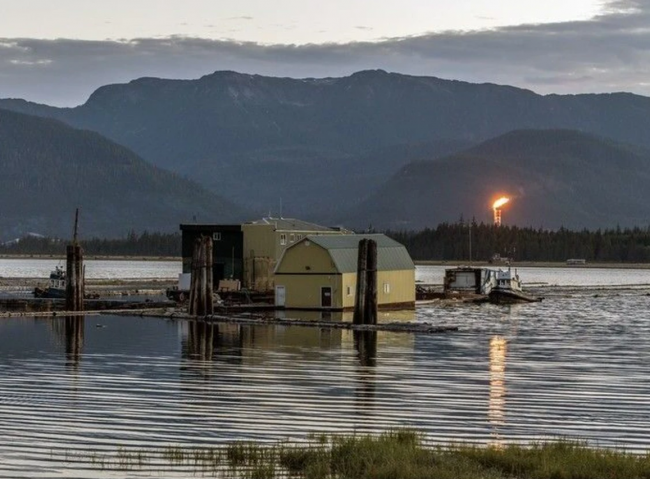
[Top photo: Flaring of waste gas at the LNG Canada plant in Kitimat. Photo by Government of B.C. /Government of B.C.]