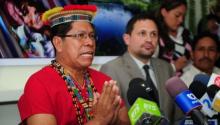
“We don’t want what happened to us to happen to the people in Dakota,” Piaguaje told teleSUR.
Indigenous groups affected by the contamination of Chevron in Ecuador—led by Humberto Piaguaje—joined the Native Americans protesting the construction of the Dakota Access pipeline in the state of North Dakota in the U.S.
Play VideoPlay Current Time 0:00 / Duration Time 2:48 Loaded: 0% Progress: 0% FullscreenMute Embed Why we need to keep fossil fuels in the ground Damian Carrington
‘Shocking’ revelation finds $5.3tn subsidy estimate for 2015 is greater than the total health spending of all the world’s governments
Fossil fuel companies are benefitting from global subsidies of $5.3tn (£3.4tn) a year, equivalent to $10m a minute every day, according to a startling new estimate by the International Monetary Fund.
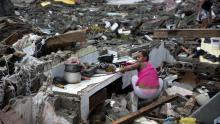
Residents of Baracoa, Cuba, begin to dig out after Hurricane Matthew destroyed dozens of homes.
While much of Cuba was spared the wrath of Hurricane Matthew, some areas were devastated by flooding and storm surge.
Residents of Baracoa, Cuba, are digging out rubble that was left after Hurricane Matthew hit the eastern portion of the country with heavy flooding and strong storm surge.
Perhaps the most revealing words on the topic of globalization in recent years came not from the pen of Thomas Piketty, nor were they written by Robert Reich or Joseph Stiglitz or Paul Krugman — rather, they can be found in the pages of The Lexus and the Olive Tree, written by the notorious New York Times columnist Thomas Friedman.
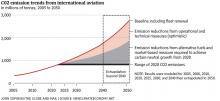
National governments will meet in Montreal this month aiming to conclude a climate deal for the global aviation sector that would establish a cap-and-trade system for airlines that fly international routes and could cost as much as $12-billion (U.S.) by 2030.
Germany have agreed to permanently ban fracking in the country following years of debate over the issue.
The coalition government have said that they will outlaw the practise of fracking for shale gas, but will allow test drilling to take place in certain circumstances.
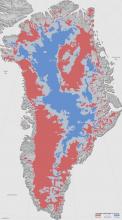
Aug 3, 2016 - NASA researchers have helped produce the first map showing what parts of the bottom of the massive Greenland Ice Sheet are thawed – key information in better predicting how the ice sheet will react to a warming climate.
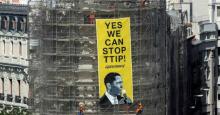
A new leak provides further confirmation that the pro-corporate TransAtlantic Trade and Investment Partnership (TTIP) between the U.S. and European Union would result in "a giant leap backward in our fight to keep fossil fuels in the ground."
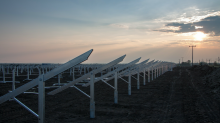
With growing urgency, governments across the globe are setting bold targets for renewable energy. However, the United Nations Environment Programme (UNEP) says that smart development will be needed to ensure the right mix of low-carbon electricity generation to cut emissions and to avoid unexpected environmental problems.
!['Whether she is writing of Kashmir or of the Palestinians, of American foreign policy or of terror in the Middle East, of environmental degradation or of the threat posed by nuclear proliferation, [author and activist Arundhati] Roy,' writes Johnson, 'maintains a sense of hope, one that jumps from the page even in the midst of her devastating polemics.' (Photo: jeanbaptisteparis/flickr/cc)](https://ecosocialistsvancouver.org/sites/default/files/styles/medium/public/article-image/arundhati_roy.jpg?itok=Oo5ZSczB)