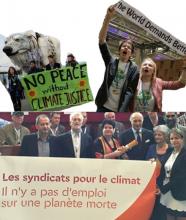
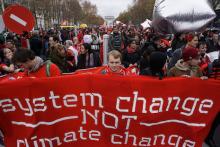
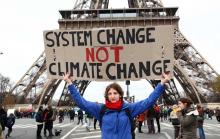
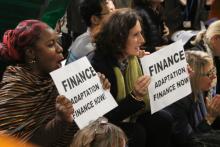
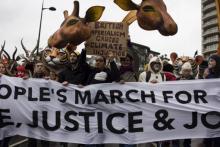
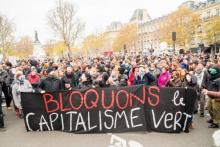
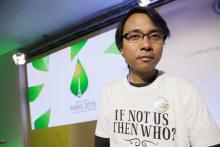
The Climate Summit in Paris has once again reminded us of how vulnerable we are on planet earth. However, humanity is faced with a number of deep and challenging crises: economic, social, political, over food – and, of course, over climate change, which is threatening the very existence of millions of people. These crises have many of the same root causes, going to the core of our economic system.
The struggle for climate justice did not end in Paris after 196 nations voted to adopt an agreement curbing global warming on Dec. 13, according to environmental activists in the Philippines.
"The Paris agreement is not the climate solution nor the justice we hoped and fought for," said Rep. Neri Colmenares, senior deputy minority leader of the Philippine House of Representatives.
The emission cuts promised in the deal are "neither equitable nor even scientifically viable," the legislator said.
The Philippine government, however, welcomed the deal.
The terrifying deadlines approached by climate change tempt us to despair. But the face of the movement stirs us to courage.
Two certainties existed entering the Paris climate talks. They hold as true coming out. The first was that the world’s heads of state were not prepared to act as is necessary. The second is that it was never going to be up to them anyway.
The headlines from the Paris climate talks tell an inspiring story. Agence France-Pressereported an outbreak of “euphoria” as the international climate accord was sealed. Reutershailed a global “turn from fossil fuels.” The Guardian headlined “a major leap for mankind.”
The COP21 Paris Climate Conference has, as expected, led to an agreement. It will come into effect from 2020 if it is ratified by 55 of the countries which are signatories to the United Nations Framework Convention on Climate Change and these 55 countries account for at least 55% of global emissions of greenhouse gases. In the light of the positions taken in Paris, this dual condition should not raise any difficulty (although the non-ratification of Kyoto by the United States shows that surprises are always possible).
Globally influential climate activist Yeb Saño has just returned home to the Philippines disappointed, having recently trekked 1,500km from Rome to Paris only to see the COP21 climate change summit reach a spectacularly bad result last weekend, he says.
Saño and those in his multi-faith and environmental entourage —called the “People’s Pilgrimage" — had marched for two months across Europe, praying for a miracle.