Articles Menu
Oct. 13, 2026
Prime Minister Carney has said, “Don’t tell me what you are against; tell me what you are for.” Well, with respect to the first part – tough! Telling the truth about the climate emergency requires saying “No” to new fossil fuel infrastructure. But with respect to the second request – done!
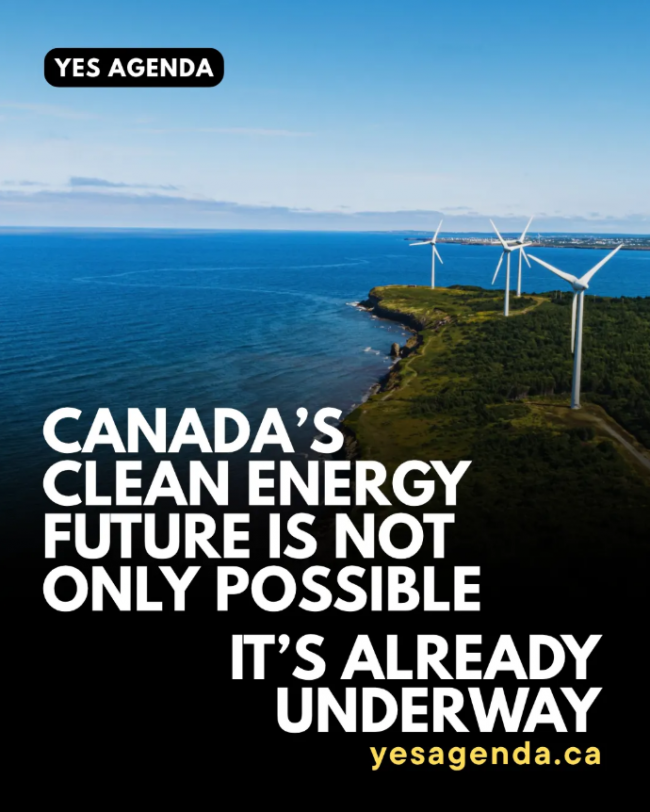
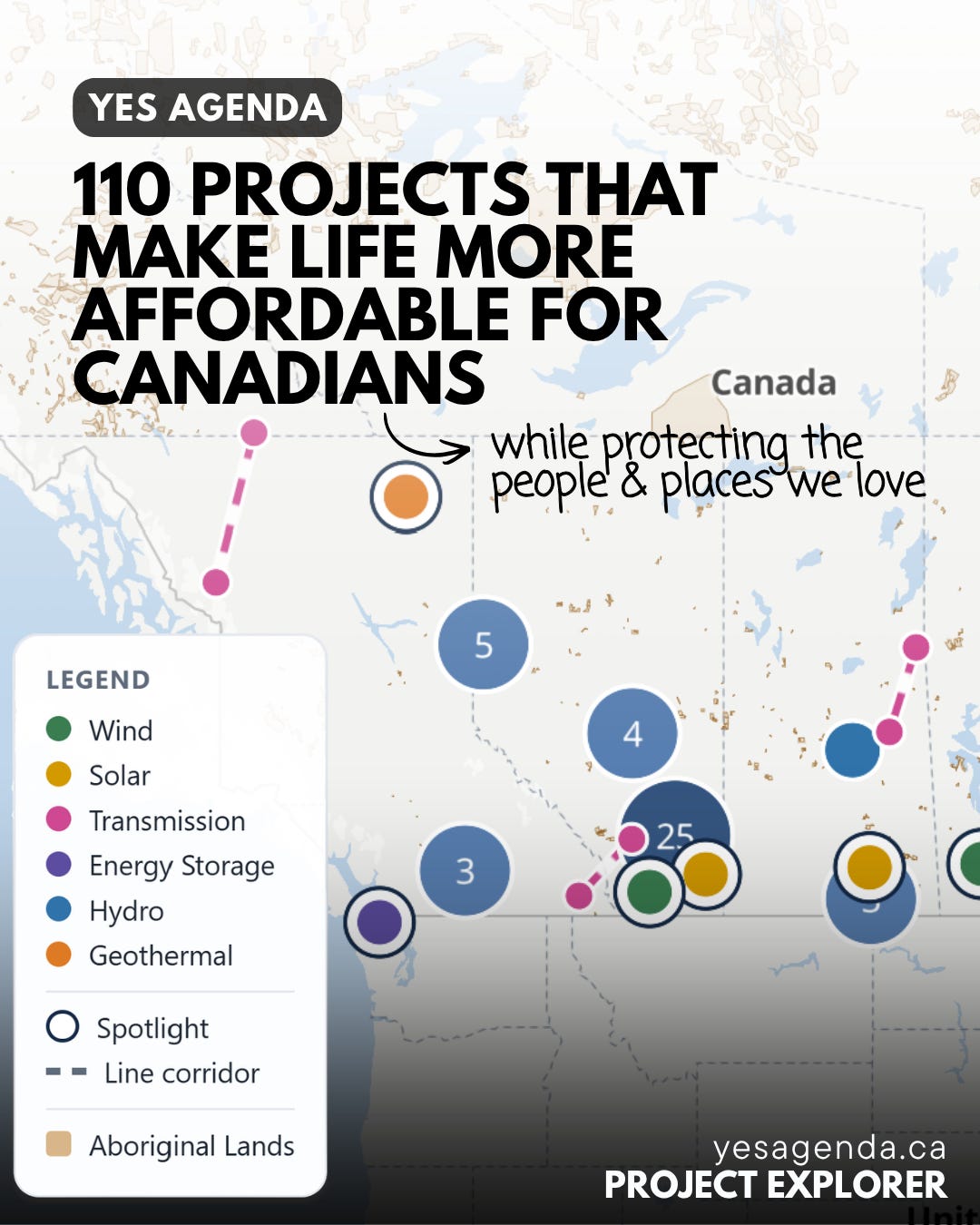
Last week, Climate Action Network Canada (the national umbrella organization for the climate movement) released the outcome of an important new project – The YES Agenda: Building Canada’s Clean Energy Future. “Canada needs to build clean, renewable energy infrastructure that works for Canadian communities and Indigenous nations. And the solutions are at our fingertips,” states CAN. The Yes Agenda Project Explorer offers a coast-to-coast look at 110 solar, wind, geothermal, hydro, storage and transmission projects in development right now, tracking close to 100 GW of electricity generation. The mapping tool was developed by Climate Action Network Canada and Adamant, built on research conducted by Dunsky Energy + Climate Advisors.
More than half of the projects identified are led or co-owned by Indigenous Nations, while others proceed under provincial governments or public utilities. They represent billions of dollars in investment in clean, reliable electricity and will create thousands of jobs and make life more affordable for Canadians.
You can explore all the projects identified here.
“These projects can lower Canadians’ energy bills, boost our independence and ensure resilience to external shocks – whether extreme weather, volatile fuel prices, or the agenda of belligerent heads of state,” said CAN executive director Caroline Brouillette. “This vision is not hypothetical; it’s already happening. A different approach to nation-building is taking shape, and Indigenous Nations, communities, provinces and territories are leading the way. What we need is a federal government that invests in renewable nation-building projects rather than costly fossil fuel infrastructure that risks leaving Canada behind.”
Serena Mendizabal, managing director of Indigenous clean energy group Sacred Earth, said of the project, “There’s a lot of talk about nation-building right now. Our Nations have been building on and caring for these lands since long before Canada. Real nation-building means investing in the energy futures communities are choosing for themselves: power that keeps the lights on, keeps wealth in the community, and keeps the land and water whole for the generations to come.”
Gratitude to CAN for leading this important work.

A few weeks ago, I published a piece asking if Prime Minister Carney is a climate denier. The answer, sadly, if there was really any doubt, is a firm: Yes!
While many of the projects on the YES Agenda are still seeking funding, Carney is ready to plow over $40 billion of public money into a new oil sands pipeline from Alberta to the BC Lower Mainland, now officially to be known as the “Pacific Link.” The true opportunity cost of this new monstrosity are all the clean energy projects that go languishing.
Two weeks ago, we were hit with the brutal double-whammy of LNG Canada (joined by the federal and BC governments) announcing it was proceeding with a final investment decision for its Phase 2, and two days later Carney announced that the Pacific Link was designated as the first “Project of National Interest,” meaning, it would be granted advance approvals and expedited forthwith. “The goal is to get consultations, environmental safeguards, financing and Indigenous partnerships completed by Sept. 1, 2027, to clear the way for construction to begin,” reports The Energy Mix. Pacific Link, if completed, will transport an additional one million barrels a day of bitumen for export from the west coast.
But, don’t give up hope just yet. The pipeline is not yet a done deal. There will surely be major protests. There will be significant Indigenous opposition (as reporter Brandi Morin reports here); already, the Cold Lake First Nation in Alberta has announced it is taking the government to court over its move to fast-track the project. And it remains unclear if a sufficient number of oil sands producers will commit to filling the pipeline.
Regarding LNG Canada Phase 2: While both the federal and BC governments were all smiles at this announcement, there is nothing to celebrate here. Combined, LNG Canada Phases 1 & 2 will have downstream carbon emissions roughly equivalent to the TOTAL annual domestic emissions for all of British Columbia. Phase 2 will only result in about 240 more permanent jobs. Seems an awfully heavy price in climate destruction for a number of jobs that, in the larger context, represents a statistical rounding error.
All these LNG announcements are wreaking havoc with the shattered remains of BC’s climate plan. Check out this chart, produced by Tracey Saxby (ED of My Sea to Sky):
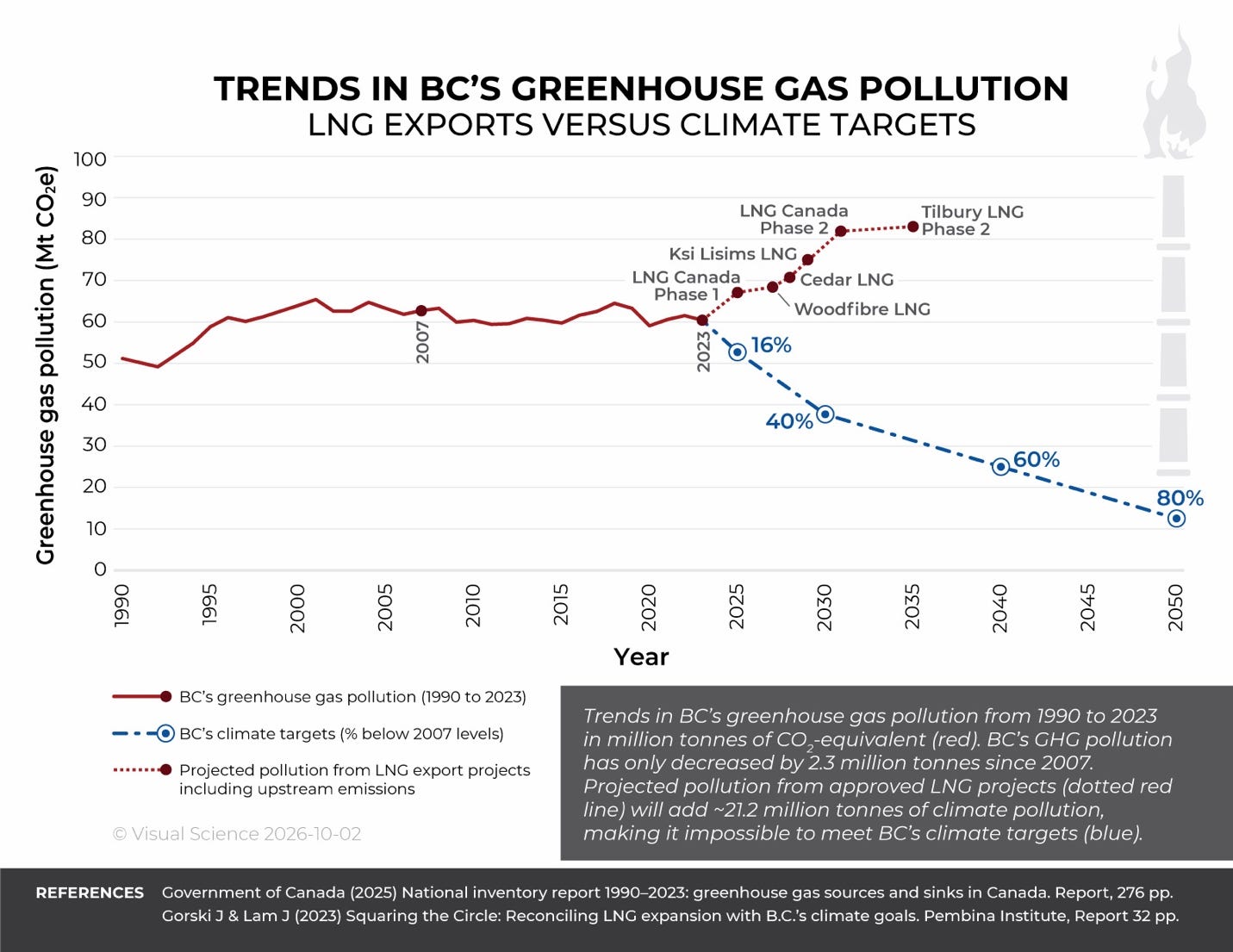
As Tracey notes:
Since 2007, BC’s climate pollution has decreased by a mere 2.3 million tonnes.
In contrast, approved LNG export projects will increase BC’s climate pollution by 21.2 million tonnes by 2035.
This is ten times more pollution than we’ve managed to cut in nearly 20 years.
If we use public dollars to electrify all these LNG exports (which is not a good use of our clean energy), BC’s climate pollution will still increase by ~13 million tonnes.
But the above is only capturing the extraction and production emissions within BC. When the gas is finally burned overseas, add another ~130 million tonnes of climate pollution (for context, all of BC’s domestic emissions currently clock in at about 60 million tonnes).
As Tom Green of the David Suzuki Institute says, “We are exporting fossil fuels and importing extreme weather.” (BTW, if you’d like to hear a master class in climate communications, I highly recommend this CBC radio interview with Tom, reacting to both these new fossil fuel projects; give a listen).
So, friends, let’s say YES to clean energy. But let’s keep saying NO to the projects that threaten the people and places we love.
Last month’s UN General Assembly marked the last with Portugal’s António Guterres serving as secretary-general. I’m going to miss him. I can’t recall such a morally powerful UNSG. I’ve come to greatly admire the way Guterres was always willing to tell the truth about the emergencies we face, not least the role of fossil fuel corporations in their wilful escalation of the climate crisis.
Chris Hatch has a lovely tribute to Guterres, which you can find here: The UN chief who refused to hush climate change.
The climate crisis isn’t the only emergency that struggles with denial from our political class. The poison drug crisis – declared a public health emergency 10 years ago – wrestles with the same.
Both crises suffer a similar fate: political leaders who declare emergency, and then fail to act accordingly; a refusal to heed the warnings and advice from experts (whether climate scientists or health professionals); an apparent willingness to sacrifice populations seen as somehow undeserving of our solidarity.
Last year, on a special episode of the Climate Emergency Unit’s podcast Break in Case of Emergency, Anjali Appadurai and I interviewed Garth Mullins, a long-time harm reduction advocate and host of the award-winning podcast Crackdown. We explored the many parallels between the climate emergency and the poison drug crisis. It’s a fascinating discussion, which you can listen to on Apple podcasts here, and on Spotify here.
In late September, there was on bit of good news on this front. Two leaders of the Drug User Liberation Front, Eris Nyx and Jeremy Kalicum, who had been arrested for trafficking, won a constitutional challenge at BC Supreme Court and had their charges thrown out. Instead, Justice Catherine Murray ruled the law was unconstitutional and gave the federal government six months to update it.
As The Tyee reports, DULF “provided tested methamphetamine, cocaine and heroin to DULF members at cost. The idea was to allow people with substance use disorders to understand the makeup of the drugs they were taking to avoid overdose and death.”
“You selflessly put yourselves to the side for this cause and that’s something most people wouldn’t do. For that I applaud you. You should be very proud of yourselves,” Murray said, directly addressing the pair in court as she delivered her judgment.
Hear, hear.
As with the climate crisis, change will come from heroes prepared to break the rules.
Kudos too to my friends Tim and Steph Dickson, who served as pro bono legal counsel for DULF on the case.
**
Finally, as we come to the end of a Thanksgiving weekend, I want to express huge gratitude for all these amazing young protesters in France, Spain and India, who are taking great risks, as they demand better education, housing and democracy.
Also, grateful to the sun this Thanksgiving, which every hour sends more energy to the Earth than we need for an entire year, telling us, "A better world is possible, so what on Earth are we waiting for already!"
That’s all for this week.
Let’s break the silence on the climate crisis! Please share these items on your social media.