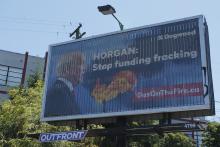
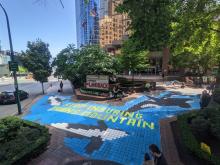
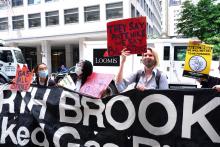
Braided Warriors were attacked by the police on Friday February 19 in the lobby of the Vancouver branch of AIG Canada, a transnational finance and insurance company that is insuring the Trans Mountain tar sands pipeline in violation of Indigenous rights.
About half of the 1,150 kilometre-long pipeline is set to cross unceded Secwepemc territory without their free, prior and informed consent.
Energy experts are working to produce the world’s first public and complete database of fossil fuel reserves in the lead-up to this year’s UN climate summit.
The “Global Registry of Fossil Fuels” would fill a major gap in public knowledge, where only expensive or proprietary databases on fossil fuel reserves have existed before, or ones that are not detailed enough or are designed for industry use.
A Vancouver-area public health physician is challenging the Trans Mountain pipeline in court after his protest site along the expansion route was demolished so trees could be cut down.
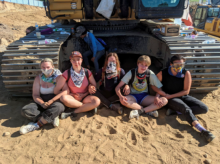
"We are endangering future generations," said Charles King, who locked himself to construction equipment, "and that's got to stop."
After three protesters were arrested on Monday at a Minnesota construction site for Enbridge's Line 3 pipeline, more than 50 water protectors on Tuesday marched onto an easement—with two people locking themselves to an excavator—and temporarily shut down work on the contested tar sands project.
Canada’s federal government is voicing its support for Calgary-based Enbridge’s Line 3 project in northern Minnesota as opposition to the pipeline’s construction intensifies.
"We owe it to future generations, to the Indigenous communities we've signed treaties with, and to every living being on this planet to stop building fossil fuel infrastructure."
Democratic Rep. Ilhan Omar of Minnesota traveled to the northern part of her state on Saturday to meet with Indigenous leaders and environmental justice advocates who are organizing opposition to Enbridge's Line 3 pipeline project.
The global operational capacity of carbon capture and storage (CCS) currently stands at 39 megatonnes (Mt) of CO2 per year, or roughly 0.1% of global annual emissions, with deployment slow and plagued by accidents. And despite its fervid marketing as a climate saviour, CCS today is primarily used merely to extract more fossil fuels.
Maybe, taking a lesson from what this article reveals about the U.S., we need to increase the rattling of the cage about Canadian provincial and regional rights to decide whether unsafe megaprojects are allowed to proceed or, at least, have more ability to regulate them (to death?). Gene MGuckin
There’s good news and bad news about Canada’s 2030 climate target.
The good news is that for the first time, Canada has proposed a way to meet a climate target. The government’s recently announced Healthy Environment and a Healthy Economy (HEHE) plan contains enough new climate policy proposals that, if implemented, will allow Canada to reach its 2030 target.