Articles Menu
Website editor: in depth and insightful interview
Dec. 4, 2025
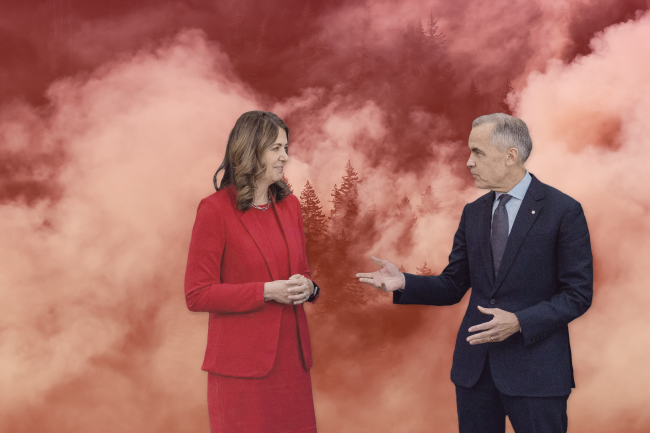
Mark Carney’s deal with Alberta’s Danielle Smith is the climate sell-out of the century.
Author and analyst Seth Klein joins Desmond Cole to break down everything it contains—from pipelines, to AI data centres, to dirty electricity, to a rollback of almost every Trudeau-era climate policy.
The Breach Show is our podcast featuring sharp analysis on politics and social movements in Canada. Subscribe to the podcast on Apple, Spotify, Iheartradio, Youtube Music or your favourite service.
Desmond Cole: Welcome to The Breach Show featuring sharp analysis on politics and social movements in Canada. I’m your host, Desmond Cole.
Prime Minister Mark Carney wants more oil production in Canada, and, in partnership with Alberta Premier Danielle Smith, he’s been busy getting rid of environmental protections and checks on greenhouse gas emissions. A new memorandum of understanding between Alberta and the federal Liberals paves the way—the legal way—for a potential new oil pipeline.
There’s still no company offering to build the pipeline, there’s no proposed route, and many First Nations and the government of British Columbia are strongly opposed. A new pipeline may never be built, but the impact of Carney’s shift in climate policy will be significant.
Here to discuss this with me is Seth Klein, a board member at the BC Society for Policy Solutions, team lead and director of strategy with the Climate Emergency Unit, a five year project of the David Suzuki Institute that’s about to wind down, and the author of A Good War: Mobilising Canada for the Climate Emergency. Hey, Seth.
Seth Klein: Hi Desmond. Good to be with you.
Cole: Seth, Mark Carney did campaign during the 2025 election on turning Canada into what he called an “energy superpower.”
In some ways, I think that his support for a potential new pipeline is not that much of a surprise, but the way that his government is going about it—namely, negotiating with Alberta, but not with First Nations, not with British Columbia, and rolling back a whole host of Trudeau-era measures on greenhouse gas emissions—this is the part that seems to be surprising and even angering many people. So what do you make of this pipeline plan with Alberta, right off the bat?
Seth Klein: I think you’re probably right that it isn’t surprising, or maybe shouldn’t be surprising, and yet it has been surprising. I think for a lot of people in the climate movement, they’re experiencing a bit of whiplash. I would say you’re right that Carney talked about making us an energy superpower, but he was coy about it and did it in a way that I think his campaign successfully managed to be a kind of political Rorschach test, where everyone could see what they were looking for in there.
For a lot of people in the climate movement, they thought Carney was their guy. They certainly don’t think that anymore. I think there’s definitely some feelings of betrayal, and I think this new memorandum of understanding with Alberta was really the last straw. The budget, a few weeks prior, was also pretty definitive: a budget that clearly put the interest of fossil fuel companies ahead of climate.
Cole: There’s also a lot going on. There’s conversations about a new pipeline, there’s conversations about existing pipeline capacity. There’s conversations about bringing in data centres and needing the energy to power that. He’s really thrown a whole bunch of things into the mix here all at the same time.
Klein: Much of the media attention has been about the pipelines piece, and we should talk about that for sure. But actually, as you dig into the agreement, and the more it sinks in, the more it becomes clear that this is about much more than just pipelines.
What we got is, in fact, an entirely new energy framework, certainly between the federal government and Alberta, but actually with ripples across the rest of the country. We got massive concessions to Alberta in the oil patch on climate policy that effectively leaves the whole of the last ten-year Liberal government approach on climate in tatters. As you were just intimating, there’s a lot there on electricity and AI as well.
Cole: Let’s start with what Danielle Smith has been saying for the last several months, which is that she’s identified a bunch of regulations and rules and laws, and she calls them the “nine bad laws,” and they’re these federal regulations and rules which, in her mind, have been hindering increased oil production in Canada.
To be fair to her, not just in her mind, I think that in many ways, the Trudeau government did put a lot of pieces in place to try and limit greenhouse gas emissions. Carney, now, has signalled a willingness to remove or alter the majority of these nine rules and regulations that Danielle Smith singled out as being a problem for oil production. So we should talk about a few of those first.
But I want to talk first about the proposed cap on oil and gas emissions that the Carney government, Seth, has just said, We’re not doing that anymore. What’s your reaction?
Seth Klein: The writing was on the wall on that one. So, first of all, you’re right that Danielle Smith has basically gotten everything she wanted here, and whether or not a pipeline happens, she has effectively already won. The oil patch has already won. That’s why that very same day, Mark Carney got two standing ovations at the Calgary Chamber of Commerce, which is not something anyone would have expected—because they could see it, they’d already won. The budget a few weeks prior had already signalled that the oil and gas emissions cap was going to be gone.
And just to say, let’s be clear: the climate movement has spent years working on this and it’s effectively all for not. It’s not going to happen. But that was one of many of the immediate concessions, so that cap is gone.
This was also signalled in the budget, but the federal prohibitions on greenwashing, they’re backing away from that. They wanted that gone. It was a change that was made a couple of years ago under the Competition Act, and it basically said—and it wasn’t just targeted to fossil fuel companies—that any company that is making environmental claims has to be able to substantiate what they’re saying. They can’t just B.S. their claims, they have to be able to back it up. Or, put another way: you can’t just lie.
It was a significant reform. When it was instituted the next day, the Pathways Alliance—the main mouthpiece of the oil patch in Canada—scrubbed their entire webpage and their social media feeds realizing that they were vulnerable to a legal claim, that they were making all kinds of claims about oil and gas that they could not back up. They didn’t like this rule, and they are effectively being told that, “okay, we hear you.”
Alberta and the oil patch also got a five year delay on the methane regulations. This is very technical, but this is one of the more significant things the federal government was doing to actually lower emissions, is that methane needed to be reduced by 75 per cent by 2030. Methane is a very potent greenhouse gas. It mostly comes from the oil and gas sector. Alberta got a five year delay on that.
The big carve out that Alberta got was on the clean electricity regulations. They’re basically told that they can continue to generate electricity by burning gas.
Also, Danielle Smith has been very actively blocking new renewables, and now she can just keep doing that. There’s no imperative for her to rethink that, because now they’re allowed to continue burning gas.
They also got an important concession on carbon capture and storage. One of the juiciest tax credits that the federal government has offered is a tax credit for investments to do carbon capture and storage, but until a week ago, they couldn’t use it for what’s called “enhanced oil recovery”—basically when they capture all of this carbon from their own emissions. The idea is, and of course, this is all technically very iffy, they have to basically bury it deep underground to get rid of it. But they couldn’t use it to basically pump more oil out of the ground. Well, now they can. Now they’re saying that you can actually get the tax credit and use it for that, which effectively wipes out the whole net zero purported claim of the thing, if you’re now going to use it to extract even more oil.
Cole: A weakened mandate on carbon capture and storage, weaker rules about clean electricity. We have the loss of the carbon emissions cap, but to substitute, we were told for all of this, the claim that was made was, don’t worry, because there’s also a price on carbon in Canada, and it’s going up for Alberta, so we’re going to be able to actually make up a lot of the concessions that we’re giving on emissions in other places by increasing the price of carbon. So what do you make of that argument, that whatever we’re losing in these other areas that you’re listing off, that a higher price for people who pollute will kind of balance things out.
Klein: To be clear, this is the one piece that Carney has said he gets and supports—an industrial carbon price.
One of the very first things that Carney did was scrap the consumer carbon price, but he said he remains committed to not only keeping but enhancing the industrial carbon price, and under the current regulations, that price was supposed to increase to $170 a tonne by 2030.
It’s approaching $100 now. Those who defend this deal with Alberta have said, well, okay, we scrapped all of these regulations, but in exchange, we now have Alberta’s agreement to move forward on the industrial carbon price.
Done well, an industrial carbon price is effective. It’s one of the things that is currently making a difference. But in fact, this is a concession too.
It was already the law of the land that the industrial carbon price needed to be $170 a tonne. That was a federal backstop. It’s one of the areas where the Supreme Court of Canada had already clearly said that it is federal jurisdiction to go ahead and do this, with or without the agreement of the provinces.
But under the agreement, they defer to let Alberta run their own industrial carbon price plan, but it’s no longer going to escalate to $170 a tonne. It’s only now going to increase to $130 a tonne. So it’s backtracking there, and the timeline is delayed. The new timeline is yet to be determined.
That’s what we got in exchange for all of these other concessions.
And for those who say, oh, well, you know, it’s effective, it’s a known thing—interestingly, this has become more apparent in the last few days. I first heard it on The National from Althea Raj. There is this unpublished report circulating from Environment and Climate Change Canada where they tried to estimate what the industrial carbon price would need to be if it were to offset all of the greenhouse gas emission reductions we’ve now forfeited by getting rid of all of these other things.
Their estimate was it would need to be $400 a tonne, nowhere close to the new limit of $130. So, this too is actually a major capitulation.
Cole: I believe I heard Chantal Hebert saying that if the government had wanted to publish the analysis that you just cited of $400 a tonne needed versus the $130 that Alberta actually is getting, if the government had wanted to put that in the MOU to show people, they could have, but they chose not to, probably because it doesn’t look very good when you’re talking about climate change, greenhouse gas emissions and trying to meet our Paris Climate Accord agreements.
Klein: I think it’s worth saying too—because there’s this whole risk of ripple now across the rest of the country—but the fact that Alberta has now got a carve-out for its own arrangement when it comes to the clean electricity regulations, the fact that they’re getting their own rules when it comes to the industrial carbon price just means that other provinces, Ontario, Saskatchewan, Newfoundland, they’re all going to start lining up to say, “Me too.”
This is very reminiscent to what happened with the death of the consumer carbon price. Because to my mind, if you had to put a timestamp on the death of the consumer carbon price, it’s when, under pressure, the Trudeau government announced a carve-out for oil in Atlantic Canada.
In that one move, I mean, that is going to go down in history as one of the dumbest political moves. The floodgates opened, and suddenly the whole logic of carbon pricing started to come into question, and everything unravelled from that point.
Cole: Let’s talk a little bit about one of the most contentious and unsettled pieces of this agreement with Alberta, which talks about the oil tanker moratorium off the coast of northern British Columbia.
We know that this moratorium on large oil tankers coming to the northern coast of B.C. has been in place since 2019. but broader environmental consideration of these waters goes back decades. Let’s talk about some of the risks that are associated with more tanker traffic along the northwest coast, the Pacific Ocean and British Columbia.
Klein: This is at the root of the Indigenous and First Nations opposition to a northern pipeline. When the Enbridge pipeline was killed ten years ago, this was really at the crux of it. There was opposition from First Nations all across the route, but in particular it was the coastal First Nations. The North Coast is rough. I mean, we have had ships run into trial before. This is being led in particular by the Heiltsuk First Nation and their chief, Marilyn Slett, who’s the president of the coastal First Nations alliance.
For the Heiltsuk, this is personal for them. They had a ship go down just a few years ago and are still dealing with the repercussions. That wasn’t an oil tanker, it was just a regular ship, but just that had resulted in oil leaks that had profound consequences. If you had a major oil tanker run aground on the north coast, the long term consequences are profound.
This is why you have some—and I will emphasize some and certainly not all—First Nations saying they’re okay with LNG tankers, because if an LNG tanker goes down, it’s gas, it doesn’t have the same long-term consequences. But when a bitumen tanker goes down, the consequences could be massive.
We haven’t even talked about the pipeline really, but that was what brought about all of these concessions. The MOU with Alberta now says that the federal government would be prepared to expedite a new pipeline carrying at least a million barrels a day.
If a proponent were to come forward, they would bring it to the Major Projects Office designated as a major project of national interest, which, under this C-5 law that they passed a few months ago, would basically exempt it from all kinds of environmental regulations.
A big open question is: to what extent does it also run roughshod over the UN Declaration of the Rights of Indigenous Peoples? The MOU with Alberta talks a lot about Indigenous people. There’s lots of language of engaging in meaningful consultation, but not clear language around free, prior and informed consent. There’s language in there about First Nations becoming equity partners.
At the time that you and I are recording this, just yesterday, at the Assembly of First Nations, they unanimously passed a resolution for this whole MOU to be withdrawn. That’s even including First Nations who support a pipeline, but who were still offended, I think, by the scope of what’s in this agreement.
Cole: A lot of people forget that there is another pipeline that’s part of this conversation that the Liberal government actually purchased several years ago, and that’s the Trans Mountain pipeline.
There is talk in this MOU also Seth about increasing capacity for Trans Mountain. So I wonder, should people who are living in areas like Vancouver, Victoria, Kamloops, Fraser Valley, should they expect a possible expansion of this pipeline in the future?
Klein: Yes, and I actually think that’s more likely. The MOU says, in addition to a new pipeline, there would be expanded capacity of the existing, new TMX pipeline by 300 to 400,000 barrels a day. Most of that could be achieved by like more compressor stations and things like that, that just gets more bitumen flowing through the pipeline.
For what it’s worth, my own sense is that a northern pipeline remains unlikely. The combination of B.C. opposition, the combination of First Nations opposition. Alberta did get in in the agreement that the federal government was prepared to suspend or amend the oil tanker ban on the north coast, and the economics of it are just not there. The world is moving off of oil, and whether or not you would get a private proponent prepared to spend the billions and billions that would be required to build a whole new pipeline through that rugged territory, I still think is unlikely.
What worries me is that I think what might be more likely, in addition to expanding the current TMX pipeline, is that they will actually build another pipeline right along it that could carry as much as a million barrels. They already have the right of way. It would be more easily done. And you avoid all of the opposition of the coastal First Nations in central and northern British Columbia, because it would just come here, where I am in Vancouver. I actually think that’s more likely. I think the B.C. premier is signalling he might be willing to entertain something like that.
But again, the economics might not be there. The one interesting thing about this deal is that the pipeline piece of it is contingent on the carbon capture and storage piece that they would move forward with this Pathways Alliance proposal. The two things combined are so expensive, given the world in which we are living, where demand is starting to peter out. I’m unconvinced that it will happen.
To bring this back to the first part of our conversation, this is why, whether or not a pipeline happens, Danielle Smith and the oil industry have already won. It’s all of the concessions on climate policy that they’ve already secured that are effective now, with or without a pipeline,
Cole: Danielle Smith has been very happy in public the last little while since this MOU was signed. She was really happy signing it next to Prime Minister Carney. She said that she’s gotten most of what she wanted, as you’ve suggested here, but we’re still a very long way from there actually being a new pipeline in Alberta, and it may never come.
Nevertheless, what path does this set Alberta on for the future? Because, as you mentioned, globally, the world is turning more towards renewables and more away from fossil fuels. And meanwhile, Danielle Smith is tripling down, quadrupling down, on an economy in Alberta that is more and more and more dependent on these resources. So what does it mean? What course is she charting for this province?
Klein: Well, for the short and medium term, it’s a course that continues to see an expansion of oil and gas production, even using the TMX pipeline that they have. And by the way, the whole debate about TMX was supposed to all be about getting bitumen to Asia. In fact, about half of what’s coming out of the TMX pipeline is going to the U.S. west coast, where they have the refining capacity for it.
I think we are going to see an increase in production, and they have been liberated from a whole bunch of rules, as we’ve discussed, that was holding that back in any way. The whole agreement begins with a mutual recommitment to being net zero by 2050—for the oil and gas industry to be net zero by 2050—but then a little while below, they clarify what they mean by that.
The language that they actually use is that that will be done by, and I’m quoting here now Desmond, “reducing the emissions intensity of Canadian heavy oil production to best in class in terms of the average for heavy oil by 2050.”
I mean, if you can figure out what that tortured English actually means, it’s almost like satire, suffice it to say. It’s an extremely low bar. I’m not sure what it means to be best in class of an average, but that’s their new goal.
In terms of the mid to long term future, we said off the top that this is actually about more than pipelines or even oil. It’s a new energy agreement.
There is a lot of language in there about producing electricity for the massive demand of AI and there’s a bunch of stuff in there about building out the grid between Alberta and its partners in B.C. and Saskatchewan. Where we might actually see federal investment dollars is on these interties that bring electricity across those provincial borders.
Now, the irony here is that the climate movement has been arguing for a long time that we need power lines, not pipelines, and that we need an east-west grid. The agreement actually kind of talks about that, but—and this is sort of a cautionary tale of careful what you wish for—what they’re basically proposing is that clean electricity from B.C. will come across the border to Alberta to power the oil sands, carbon capture and storage, and massive new AI data centres. Alberta electricity, which will now not be renewables because it’s no longer required, will be gas powered electricity and nuclear. So Alberta’s nuclear and gas powered electricity will come to British Columbia to help us electrify LNG and mining.
We take an idea that is compelling and necessary to rapidly decarbonize and electrify our lives—and instead, we’re going to use it this way to produce more fossil fuels and these energy sucking AI data centres.
Cole: We’ve mentioned that globally, the trend is away from fossil fuel development and towards more renewable sources of energy. Is there maybe some hope that we, as Canadians, we’re lagging behind right now? Yes, we have resources here that we still want to develop, but that ultimately the momentum is going to drag us towards a future of renewable energy and away from this very short-term, and people would say short sighted focus on fossil fuels.
Klein: I think that’s right. The question is not if, but when. You’re right, first of all, that we are the foot draggers here. Within the G7, Canada is the worst performer in terms of lowering our emissions.
But also, we’ve been talking about all the ways in which our federal and provincial governments are in retreat on this fight of our lives. Of course, in the United States, it’s even worse under Trump, although not at the state level or municipal level everywhere. But in many ways, North America is an aberration. The rest of the world is moving on. The explosion in renewables, solar—in particular in China, in the rest of Asia, in Africa, in much of Europe—is jaw dropping. Frankly, I mean, Bill McKibben has this new book out called Here Comes the Sun, in which he enumerates a lot of this and I recommend the book or interviews with him if people are looking for a glimmer of hope on this stuff.
He makes the point of the exponential growth of solar. The world produced a third more solar power this past summer than the summer before. To put it another way, it took between 1954 and the invention of the solar voltaic cell and solar panel in 2022 for the first terawatt of solar power to come on stream. The second terawatt happened two years later, and the third this year.
That is the exponential growth occurring. And practically on the ground, that means, particularly in Asia, that the demand for this bitumen and LNG is starting to dry up.
Just to give you one example, a couple of weeks ago Pakistan—where there’s been an explosion in solar adaptation—just chose to pay a penalty to cancel their LNG contract with Qatar because they can’t use it. That’s happening. In the end, that’s what might save us, despite the best efforts of the fossil fuel industry here to block and slow progress.
The tragedy is that we’re being left behind, and that those workers are being left behind instead of actually having a transition plan that gives them some hope and prospect for the future. We’re going to keep digging and then they’ll be abandoned. That’s not the kind of industrial revolution we want.
Cole: Look, overall, it’s pretty staggering what Mark Carney has been able to do in six months, just about, in terms of completely changing environmental policy from the direction that Justin Trudeau had set for about a decade in this country. Other than the things that we’ve been talking about in this MOU, all of which are very significant, Carney has also scrapped the residential carbon price, you mentioned that. He’s pulled back on supports for electric vehicles, and we have targets in Canada for wanting to have a certain proportion of electric vehicles in this country. We’re pulling back on that. He’s making it very unlikely, if not impossible, that we’re going to actually meet our Paris Climate Agreement on greenhouse gases.
How do we hold accountable a government that so recently was pointing in a completely different direction when it comes to climate change?
Klein: Just to add to your list there, Desmond, he also has ended the home energy efficiency and retrofit programs; so buildings, vehicles, oil and gas, those are the main sources of emissions, and they are in retreat in all of those areas.
In addition to passing C-5, this major projects bill, we’ve now seen among the early projects that have been referred to this major projects office, LNG Canada phase two, and the Ksi Limis LNG project. To be clear, when you look at the gas that’s going to be exported from these two facilities, if those two things move forward, when that reaches its destination and is burned, each of those projects will produce as much greenhouse gas emissions as equivalent to roughly five per cent of Canada’s total domestic emissions. If they both went forward, 10 per cent of Canada’s total emissions.
That’s why we call these projects carbon bombs. They are a massive undoing of all of our efforts from the last 10 to 20 years.
Cole: We’ve mentioned some of the opposition in First Nations. We’ve mentioned British Columbia’s opposition to certain pieces of this MOU, especially a new pipeline to northern British Columbia.
There’s also the reality that a lot of people in places like Quebec really are invested heavily in Canada’s climate goals, and didn’t really vote for this when they voted for many of the Liberals that they supported. Stephen Gilbeault, the former environment minister in this country, resigned from the Liberal cabinet over this. Not everybody is really thrilled, and not all Liberals are, I think, excited about this real big pivot that Carney seems to be taking.
Klein: I think this has been a wake up call for the climate movement. As I said off the top, I think a lot of people in the climate movement thought and understood that Carney was a climate guy and that he got climate. There were a lot of climate people who joined the Liberal Party to support him for leader over Chrystia Freeland, who they viewed as much worse.
Then there were a lot of people who lent the Liberals their vote. This is in the context of the worries about Trump and Pierre Poilievre, of course. But in particular, the biggest gains that Mark Carney secured were in Quebec and British Columbia. What the polls tell us is that those are the two provinces that tend to be most supportive of climate action.
A lot of people, I think, lent him their vote thinking that he would move the climate file forward, not backwards. I think everyone’s sort of wrestling with this dawning reality of what we have.
I don’t really understand the political calculation if you’re Mark Carney. It’s obviously super important to him to be the one who finally brought the Liberal Party back to Alberta. Gaining agreement from Alberta seems to be really important to him.
They have two seats in Alberta, and obviously hope to have more. This seems like a really risky proposition, that he may actually lose seats in Quebec and British Columbia, more than any prospective new seats in Alberta that would come from this.
He’s oddly governing, in a way, as if he has a majority when he doesn’t. He only just narrowly passed his first budget bill. He needed Elizabeth May’s vote, and yet, in the wake of this MOU she has now been very clear that she made a mistake and she would not do that again. There were some New Democrats who abstained, who may be unwilling to do that again,
Who knows, there may be Liberal MPs who go even further than what Stephen Gilbeault did. Stephen Gilbeault quit cabinet, to his credit, I would say, but he remains a Liberal MP. There may be other Liberal MPs who decide, actually, this isn’t what I understood I was signing up for, and are prepared to actually leave caucus entirely. So all of that’s possible.
Cole: There may be another reason that Mark Carney has decided to do this push. We’ve heard a lot since his election and since Trump and tariffs started dominating all of our conversations in Canada.
We’ve been hearing that Canadians are actually more open to things like new fossil fuel development because we’re scared, because we’re worried about what’s happening with the United States right now. We’re worried economically, about the hits that tariffs are going to take. And I can cite things like, for example, this is from the Vancouver Sun: Polling data released just as Eby repeated his government’s sentiments about not wanting this new pipeline, showed that 53 per cent of residents in B.C. lean in favour of the idea of building a new oil pipeline from Alberta to B.C.’s north coast.
Is it possible that what Mark Carney is saying is, normally Canadians wouldn’t accept me completely shifting on climate policy, on greenhouse gas emissions, but in this particular situation—where, as he likes to say, we’re in a whole new world—the agreements and the partnerships that we had before are all over now, and we have to start again.
Klein: It’s a hinge point, he would say, it’s a hinge point.
Cole: Yeah, we’ve got to adopt all Mark Carney’s languages now. But maybe that’s the argument here, Seth, is that Canadians actually want this more now than they did, and so now’s the time to capitalize on it before they change their minds.
Klein: That lack of understanding is something that industry and governments, like the ones we have, both federally and provincially, are able to take advantage of to justify these projects. The basic level of climate literacy in Canada is pretty poor.
Let me explain what I mean. If you poll Canadians about climate in general, and are they worried, and do they actually think it’s a crisis? In fact, the majority say yes. They are worried. They do see it as an emergency, and they want the government to do more. That’s the good news. Here’s the bad news. One is, even though a majority of Canadians feel that way, a majority of them feel themselves alone in feeling that way, meaning they’re a majority that doesn’t know they’re in a majority.
The second piece is that they don’t understand what causes climate change. Roughly half of Canadians don’t know that the main source of global heating is the combusting, the burning of fossil fuels.
Now, if that’s the case, you can end up with these very dissonant polling results where people will say, I do want more climate action, but I’m okay with pipelines. Well, why not? Because half of them don’t see the connection. Here in British Columbia, bringing it back to LNG is another example, a majority of British Columbians say they are supportive of new LNG terminals—but a majority also say they’re opposed to fracking.
The fact that all of the gas going to the LNG terminals is fracked gas, that connection is not made, and so the context is certainly to his advantage. Both he and the industry have spent the last year strongly making the case that we need this new fossil fuel infrastructure and these new pipelines as part of becoming less dependent on the United States.
It’s of course a ridiculous argument. Most of these companies are American. The oil sands themselves are mostly foreign-owned primarily by Americans a this point. The LNG industry is being pushed by some of these MAGA well, douchebags is really the only word for them, who are super close to Donald Trump.
On the flip side, it tells us in the movement, that it wouldn’t take that much leadership and good public education to have very different results in terms of that public support.
Cole: Let’s go there as a final piece then, because the climate movement writ large, in the absence of the government doing this, and of course, we know industry is not going to educate people about the realities of climate change and greenhouse gas emissions. That leaves things up to the broader climate movement in this country. There’s a lot of work to be done. There’s a lot of educating and organizing to be done.
How well positioned do you think that the climate movement broadly in Canada is, at this moment, to respond to this very, very serious set of threats that have been presented now that we have Mark Carney as our prime minister.
Klein: It’s a hard question to answer. The climate movement is big in Canada. I mean, it includes hundreds of thousands of people and a very broad ecosystem of organizations. The infrastructure, if you will, is there.
I think everybody is reeling a little bit by what we’ve been discussing and by the fact that climate has moved down the rankings of people’s primary preoccupation. That’s understandable, right? I think the public rightly will always prioritize the emergencies that are most proximate in time and geography and time and space. The challenge to us is not to ask people to choose. We have to link these things, the climate imperative, with the other emergencies in our lives. I think the climate movement is slowly getting better, and I hope we’re learning our lesson.
My takeaway, especially when you look at this fallout now between Stephen Gilbeault and Mark Carney, these two different approaches, is actually that neither of them were good. That whole legacy of policies from Trudeau and Gilbeault has proven to be as non-resilient as it is. It didn’t even take a change in government. It just took a change in leader to leave the whole thing torpedoed. It tells us that the approach we were taking is too vulnerable.
My own critique is that the government has been way too fixated on long-term mandates like vehicle mandates and oil and gas mandates that are far too in the future, that they’re just politically imaginary. Or this package of market-based solutions to send price signals or offer incentives and tax credits that are too easily undone, and where the take-up rate is too small.
And the movement allowed itself to spend time fine tuning all of these measures, instead of demanding new institutions and new programs that would drive change and that would be more resilient.
The work we’ve done in the Climate Emergency Unit, for example, has said the focus should be on new programs, like a Youth Climate Corps, new Crown corporations to mass produce and build these items. Because if you have those public institutions and public corporations, you know those can’t—particularly the corporations—can’t be undone with the stroke of a pen, like we saw in these agreements.
You actually have a political constituency employed in these projects that is now ready to defend them, whereas what we have now is the architecture that is being abandoned now. In the end, very few people were ready to go to the barricades to defend it.
Cole: Well, it’s been a really tumultuous year in terms of people who care about this climate and are worried about what direction Canada is going. We really appreciate you coming in, Seth, to give us your thoughts and insights on all of this. Thank you so much.
Klein: Good to be with you, Desmond.